high school music requirement

R – I have three questions for you High School teachers out there. Here’s question #1: “Should music education be for every student?”

I wish I could hear your own individual response to this… is it “yes”, “no” or “depends”? My own professional journey has led me through all three of these answers at different stages in my career, but fundamentally this is a philosophical question that goes to the core of what we believe as music educators. It is NAfME’s belief that music IS for every student and I believe that the majority of us feel similarly. We argue all the time (with parents, administrators and even at times our own students) what the value of music education is and we implore them to consider the benefits both intrinsic and peripheral to the profession. We talk about studies that show how in pull out programs across the country, students who are pulled from a subject to participate in music not only test as well as the others, but sometimes test even higher in that subject than the ones who stayed behind. We talk about SAT scores being higher for music students than non-music students. Studies show that drop out rates, drug use and social behavior are all positively impacted when measured against our music students across the country. When our programs are threatened, we argue vehemently the universal value of Music Education.

Question #2: Have you made any effort to implement a graduation requirement for music in your High School?

Question #3: Does your answer to question #2 align with your answer to question #1?

I wonder sometimes if we aren’t guilty of having cooked our own goose. When we talk about music receiving equal shrift with other disciplines, we often choose to ignore one basic premise to the whole picture: Math, Science, Social Studies, Physical Education, English Language Arts, even World Languages are all universally accepted as subject areas necessary for each and every High School student. Music is not. But here’s the bigger problem: that universal perception in practice is dead on accurate… we do not mandate music for every student. To suggest that this is a topic we have never moved on would be quite inaccurate: inaction IS an action. We have largely rested on our belief over the years that what we do is critically important, without actually putting teeth into it. Though we know what we do IS critically important, we only have a year of fine arts required in the state of Maine. What this means – in practice – is that students determine if they want to take classes in visual art or classes in music. Some do choose to do both, but that is by accident, not by mandate. Consequently, the general public has every right to view music education (performing arts) as important for JUST the musicians, visual art important for JUST the artists. Then we wonder why our communities don’t see music as essential as the other disciples and are shocked and dismayed when we’re the first to consider being cut when crunch time comes? What would happen if we were on the same playing field as the other disciplines that don’t have to argue their worth (and incidentally, which other of these subject areas is required of all students until they enter high school???)?

I got sick of fighting for the “essentialness” of music education and worked with my visual art colleagues first in my gig in Vermont and then again at York High School to establish this very graduation requirement (half year of each). And it didn’t occur quickly, but we did our groundwork, did our homework, drew up the proposed curriculum and pathways, and presented it to a very enthusiastic school board both times. The York High School class of 2012 was our 5th where every single graduate earned standards based credit in music as a requirement for them to receive their High School diploma. And it required no extra money or staffing to implement. It didn’t increase graduation requirements either: we just mandated that it would be visual “and” performing arts, not visual “or” performing arts. This put us in perfect alignment with the actual state graduation requirement! Listen, this isn’t about me or about York High School, it’s about putting convictions into action and this is just one first hand account of having done so.

Reflect for a moment where music stands right now in your own high school’s educational priorities. Content with it? If so, then great. But if not, then WE need to consider being the ones approaching our administrators with authentic ways to make music education essential for all students. Work to create a music requirement for every high school student? I’m not naive: I can tell you better than you can what the roadblocks and brick walls will be if you choose to go down this path, and the journey there is a daunting one with absolutely no guarantee of success. And only you know the circumstances in your own school that will determine if it’s even feasible to begin that journey. Unless I’m in your shoes (and I’m not), I will be the last person to judge those types of decisions you’d have to make. But in general, and this is why I wrote this blog post today, I have a strong conviction that it’s one thing to lose the battle, it’s another to have never taken up the fight… and I’d love to see more colleagues take up the fight. “I’d rather attempt to do something great and fail than to attempt to do nothing and succeed.” – Robert H. Schuller. Please, don’t get me wrong. Choosing not to pursue a graduation requirement is not the “nothing” of the Schuller quote. But not being proactive about changing the culture of your entire high school – administrators, teachers, students and community – in its approach to music education being essential for all students is. That’s what this is all about.

A music graduation requirement for high school students? Food for thought.

YHS course overview for graduation requirement

Posted in Advocacy, Etcetera | Tagged , , | 2 Comments

letters to PCC: not-so-psycho analysis

R – I don’t sing so much any more (conducting really is my first love) but when I was teaching in Vermont in the early 1990’s I decided for a term to commute to Worcester, Massachusetts to perform with the Worcester Chorale under the direction of their esteemed director, Dr. Gerald Mack; a prominent figure in New England choral music for over four decades. It was a three and a half hour commute round trip but it was worth it – a wonderful group that performed outstanding literature really well, giving me the chance to learn from a director I really admired while also performing some masterworks with orchestra in concert. I remember the “rush” of being challenged musically and the joy of sitting in rehearsal with my brain swimming in more information than I could process. The real fun for me was – and remains – the analysis of everything that’s going on in the music and how I respond to it at any given moment. Here’s some of the “good stuff” that I loved to analyze as a singer in rehearsal:

* Is my tone consistent up and down my vocal range, and is it consistent from vowel to vowel? Different languages present different types of challenges, but good tone is good tone. For me, I change how I physically produce my sound the higher the notes are. I also have to be sure I’m removing all upper tension (throat, neck, face) as I sing higher notes and especially faster passages, constantly adjusting how I phonate during rehearsal. Simply saying, “Well, this is just what I sound like tonight…” is a cop-out in my book and I never wanted to be guilty of that.

* Where and how am I placing my consonants? Are my phonated consonants (“mm”, “vv”, “ll” etc.) appropriately produced so that the note I am singing on them is sung properly? I love this part of singing choral literature – the vowels are the primary meal but the consonants are the dessert… making a distinction in any given phrase between the hard and phonated consonants really brings the text alive. Am I singing both with the same emphasis? Am I improperly producing the consonants differently depending where they fall in the word? For me (most people?), I have a tendency to over sing the starting and ending consonants and undervalue the ones in the middle of the word and this is a common issue for even the best of singers. I love sitting in rehearsal and fixing this issue.

* Is my phrasing appropriate for what the director is looking for and am I able to compensate for the rest of my section when theirs isn’t? I can listen to a selection in rehearsal, watch the conductor and do what he or she says, but is my section and even the entire choir responding appropriately as well? Sometimes I can adjust my phrasing to match or “balance” the phrasing going on around me. This is where the ears have to pick up the other sections in a big way.

* Is my intonation part of the problem or part of the solution? Every second of every rehearsal that I sing in, Intonation “happens”. It may be good, it may be bad, or it may be somewhere in-between. The issue therefore is, at any given moment, how is mine and am I contributing in a positive way? If I’m worried about notes, I’m likely not too worried about intonation which is why I try to learn every note BEFORE rehearsal begins so I can concentrate on this issue.

* “Get the “lead” out!” These and additional issues would preoccupy my mind in rehearsal but then – for every one of them in every single measure – how would I then write shortcuts/reminders in my music to remind me what I needed to do? I don’t think you could go three measures in any of my music without seeing a pencil marking denoting breath marks, phrasing, apex of phrases, underlining difficult parts of words, self reminders that at a quiet passage for instance I had to sing the “n” mezzo forte but the “l” pianissimo. To this day I can’t sing in a choral rehearsal if there isn’t a pencil in my right hand, and if I go four minutes without writing, underlining or circling SOMETHING, I feel like I’ve absolutely cheated the conductor as well as the composer and myself.

I’ve said often that it is more important to be an intelligent and engaged singer than a talented one. I also believe that music is work, but that it’s also a labor of love. I hope these examples of my “not-so-psycho” analysis in rehearsals gives some insights as to why I feel this way – mentally and manually “elevating your game” as a singer of the choral art.

Posted in Music is work, Rehearsal | 2 Comments

role playing

R – Role playing… I think that we as music educators do this better than anyone else I can think of. The variety of hats we wear seems to transcend anyone else’s definition of “normal” except for ours. Think about it: our discipline often plays the role of both curricular and co-curricular. Our expertise exists simultaneously in music performance, creation and responding. We are performers and conductors both. We are educating our students, administrators and communities. Juggling all these and other roles can be daunting under any circumstance. For our profession, doing it all and doing it well is ingrained in us and we pay a price for that. I remember as an undergraduate going to the infirmary my Junior year. I was feeling awful physically and I knew someone had better do a quick check up on me. When I arrived, I told the nurse my symptoms and that I had been really quite busy with my studies. I’ll never forget that when I finished, she looked at me for a moment in silence and then said, “Let me guess – you’re a music student, right?”

Finding a balance in our role playing is the key to our success – and survival. Here are a few suggestions for appropriate hats to wear and strategies for keeping invigorated in the process.

Know your job. Compartmentalize those issues that are absolutely expected of you in your school. There are many roles that are “understood” that we have to do, but do they align with reality? Remember that EVERYTHING you do must fall under your contracted or stipended responsibilities. You may choose to go above and beyond, but you must make it clear to yourself what roles you are playing. Burnout occurs at a faster rate when you take on assumed responsibilities against your wishes or better judgment. Don’t. Take a stance and make it clear whose role it really is that others are expecting you to take on. For example, you are hired to teach music and putting on concerts is a related component – NOT the other way around. Take a stand! If your school doesn’t give you enough time to instruct authentic music education and put on a reasonable concert, make sure it’s the concert that gets eliminated, not the quality of instruction (and see how quickly the time issues then get addressed!). Know your job, know your role!

Go outside the box. Find at least one professional piece to add to your resume and body of experiences each year. Selfishly from my perspective this is a wonderful reason to be involved in NAfME, the Arts Assessment Initiative or District activities, but the gamut may run from managing a District ensemble to performing on your primary instrument in a community or semiprofessional ensemble. The benefits are many by doing this: meaningful engagement with colleagues, giving back to an organization or ensemble of your abilities or talents, peer mentoring, working with students in a new environment. You can’t use the excuse that there’s no opportunities for this – give me a call or send me an e-mail and I’ll set you up with something! But honestly, being involved outside of your school or studio enables you to incorporate unique perspectives that will keep you fresh in the long run.

Know your life… and your job is not it! Among the bad habits I have fallen into again and again over the last 25 years is failing to keep my professional world separate from my personal one. It isn’t that there aren’t overlaps, it’s that they aren’t one and the same thing. I’ve attempted to incorporate some healthy habits along the way. For example, with only a few exceptions each year, I refuse to bring schoolwork home with me. My home is just that, and I don’t believe that isolating that space from my job is being selfish. I may stay after school quite a few hours to get my schoolwork done if I choose(!), but I won’t bring it home. Foster your life so that your role outside of school is unique, rewarding and revitalizing. Without this role firmly isolated and in place, I submit that you will never find that healthy balance.

None of these three points are radical or new ideas. But as I look at my peers in the field, I have been moved by the professionalism, initiative, conviction and commitment that is displayed in so many ways. My concern for the future of Music Education in Maine lies not in the willingness of the membership to fight the good fight, but rather to see that the membership stays mentally and physically fresh while working so hard. I hope you will use this school year to develop strategies for playing your variety of roles while maintaining that great balance we all strive for.

Posted in Etcetera, Music is work | Leave a comment

sacred music police

Rpreface: I have spent 11 of my 25 years in this profession as a president or president-elect of a state ACDA or NAfME organization. All that means is that I have been in a position to hear what’s going on in schools across northern New England and beyond. I have long since lost count of how many times I have heard of colleagues being coerced or flat out bullied by administrators, school boards and communities to alter what they program for music. Most of the time, it’s been due to religious text issues. What follows is part personal venting, part professional setting of the record straight. This is intentionally being written at the start of a new school year so colleagues can get their ducks in a row as they consider their programming for the months ahead.

Ignorance is defined in Webster’s Dictionary as, “lacking knowledge or comprehension of the thing specified”. That is an apt description of the sacred music police virtually every time I have seen them in action in my career. They don’t mean to be, they simply are. It’s our job to educate them when confronted. It’s also our job to educate our communities, who may not likewise approach us but still have lingering (and often legitimate) questions and concerns around what appears at first glance to be a murky issue. Sometime around the early 1990s if I recall correctly, ACDA passed along a very significant letter written by Jay Alan Sekulow, Chief Counsel at the time for the American Center for Law and Justice. This letter was sent to each and every one of the 14,766 school Superintendents in the United States. Twenty years later, it’s as if no one ever read it! Let’s shed some light on the role of sacred and Christmas music in our schools for all the sacred music police out there, SHALL WE??? The blue text is directly from Sekulow’s letter.

Removal of religious texts: There is not a law or ruling in our country that has ever upheld this action! In School District of Abington Township v. Schempp, 374 U.S. 203, 225 (1963), the Supreme Court said, “It certainly may be said that the Bible is worthy of study for its literary and historic qualities. Nothing we have said here indicates that such study of the Bible or of religion, when presented objectively as part of a secular program of education, may not be effected consistently with the First Amendment.” I’ll go one step further. Cited with direct statements by Faith D. Kaparian in the Duke Law Journal, “…in Doe v. Duncanville Independent School District (1995), the Fifth Circuit found a public school choir’s designation of John Rutter’s The Lord Bless You and Keep You as the choir’s theme song to be constitutional. Citing the choir director’s opinion that The Lord Bless You and Keep You is useful in teaching students to sight-read and to sing without instrumental accompaniment, the court stated that there was a legitimate secular purpose in maintaining the song as theme song. The court found that labeling it as theme song did not effectively endorse religion because of the predominance of sacred music within the repertoire of choral music. The court also stated that singing the theme song was not a religious exercise and it rejected the relevance of the fact that students would identify their choir by the theme song because of the crucial point that in the world of choral music, ‘singing about religion is not the same as endorsing or exercising religion.’ Since singing the theme song was not a ‘religious exercise,’ the court determined there was no excessive entanglement with religion.”

And mind you, this wasn’t over just the mere inclusion of a song with a sacred text, it was over allowing a sacred choral selection to be publicly performed as a theme song!

If an administrator says you cannot perform music because it has a religious text, tell them that unless they know of a court ruling you’re unaware of, they are putting you in a position you cannot contractually, legally or ethically be put in; administrators do not have jurisdiction to circumvent the law, and they do NOT have the authority to ask you to!

Balance of sacred and secular texts: Determining “what is a balanced program” is not a subjective endeavor. It’s based in fact. Courts of law have established that 60% to 75% of all choral music has a sacred text. That’s not a subjective opinion. If the sacred music police want “balance”, then that’s the ratio they deserve! A 50/50 split is less representative, so do NOT get pressured to give it! I choose to achieve a 50/50 split for my concerts and that works well for me, but the concerts where I program more sacred than secular? Go ahead, call me on it!!!

Christmas Carols: Our country has a heritage of carol singing. Period. Singing music that either reflects or is part of that heritage has legitimate historical and educational relevance. …no court has ever banned the singing of religious Christmas carols by public school choirs. The only court ever to address the issue upheld the singing of religious Christmas carols in public schools. The Florey v. Sioux Falls School Dist., 619 F.2d 1311 (8th Cir. 1980), the United States Court of Appeals for the Eighth Circuit said that the study and performance is the “advancement of the student’s knowledge of society’s cultural and religious heritage, as well as the Provision of an opportunity for students to perform a full range of music, poetry, and drama that is likely to be of interest to the students and their audience. 619 F.2d at 1314.0. The federal appeals court in Florey found that the religious songs and symbols can be used in public schools if they are presented in a “prudent and objective manner and only as part of the cultural and religious heritage of the holiday.” 619 F.2d at1317. This court decision was based on two U.S. Supreme  Court decisions that permit the study of the Bible in public schools. In Stone v. Graham, 449 U.S. 39, 42 (1980), the Supreme Court said, “the Bible may constitutionally be used in an appropriate study of history, civilization, ethics, comparative religion or the like.” Therefore, it would be constitutional for a public school teacher to have students study the Biblical passages that relate to Christmas (e.g., Matthew 1:18-2:22 and Luke 2:1-20) if the purpose was to study the historical or literary significance of the passages. Of course, any student that had ideological or religious objections to reading the Bible should be excused from the assignment. 

Balance of religions: this is the one that makes my blood boil. “You should have Christmas AND Hanukkah AND Kwanza AND…”. Let me get this straight: you lost on the argument that religious texts shouldn’t be included at all, so now you want me to program music OVERTLY BECAUSE OF ITS SACRED TEXT? You didn’t want Christmas music in my concert but now realize you’re not allowed to outlaw it, so now you want me to program other sacred music BECAUSE of the specific religion it represents? That would end up making me guilty of exactly what you were trying to accuse me of in the first place!!!! How does the saying go, sometimes it’s better to not say anything at all and risk the appearance of ignorance than to open your mouth and remove all doubt?!!! And by the way, the cultural heritage of the Hebrew tradition for instance is soloistic, not choral. I thought it was my job to program representative choral pieces, and not solo pieces poorly (but popularly!) arranged for choirs? I have a variety of Hebrew choral selections that makes the rounds on my 5 or 6 year rotations, and they do so because they are great pieces of choral literature, NOT because they merely have a Hebrew text.

Okay, but just don’t call it a Christmas ConcertIt should be remembered that School officials must take into account the free speech rights of students, as well as the districts obligations under the Establishment Clause. For example, students have the free speech rights to distribute Christmas cards or religios tracts on the “true meaning of Christmas” to their fellow students, or to wish them a “Merry Christmas” or a “Happy Hanukkah.” A school district could not constitutionally prohibit those activities… school districts are under no constitutional obligation to rename “Christmas Vacation” as “Winter Vacation” or some similar name. The Supreme Court itself has acknowledged with approval that Congress gives federal employees a paid holiday on December 25 and Congress calls it, “Christmas”. See Lynch v. Donnelly, 465 U.S. 688, 6754, 680, (1984).

The problem with Music Education in this country is simply people’s perception of what Music Education is… or more to the point, “what it should be” in their minds. The American Civil Liberties Union (ACLU) and others have made well intentioned (I’ll give them the benefit of the doubt here) inquiries into this realm and have been swept aside by, of all things, the law.

Wow. Gee. Go figure.

What a concept.

There are legitimate questions often raised in a respectful manner, and there are always concerns around these types of issues. Embrace them! I have made it a life goal of mine to see that, after a period of time, there is absolutely no misunderstanding of what music education entails in the communities I teach in. With regard to sacred literature, even Christmas music, we are either leaders in our communities when it comes to informing what schools are legally allowed to do or we bow to the sacred music police in all their forms and feed their ignorance. Choose wisely. You and your students are going to have to live with the consequences.

For those of you wanting very detailed, specific cases and legal statements: THE CONSTITUTIONALITY OF TEACHING AND PERFORMING SACRED CHORAL MUSIC IN PUBLIC SCHOOLS

 by Faith D. Kaparian, Duke Law Journal.

 
Posted in Advocacy, Etcetera, Programming, Rehearsal | Tagged | 8 Comments

what would betty atterbury say

R – I never met Betty before she passed away in 1998. I was still teaching in New Hampshire at the time and had not crossed paths with her while I was up in Orono doing my graduate work a few years earlier. One thing I do know is that her reputation is still legendary here in Maine. She was an author, educator, mentor and researcher. She was also, by all accounts, an extraordinarily loved person. I was going through some old files at home this afternoon and came across a series of articles she wrote for the MMEA Bulletin in 1992, reporting out research that she did on music education in Maine. Her research yielded an extraordinary 62% participation rate so her stats had a very high validity. For fun, I decided to cross reference her findings with those from the state-wide Opportunities To Learn Census that Argy Nestor and the Maine Alliance for Arts Education put together 17 years later in 2009. Here’s a few tidbits I found:

* In 1992, Betty reported that 35% of 8th graders and 28% of 7th graders were receiving music instruction. The Census showed that those numbers became 60% and 45% respectively.

* Betty’s research showed that 67% of music teachers in Maine served in two or more buildings (16% of the state music educators taught in FOUR or more different sites!). By 2007, that number was down to 46% at the elementary level and 33% at the secondary.

* Betty said, “One finding that concerns me is the drop-off in required music instruction in higher grades… what other subject is no longer taught to every student after sixth or fifth grade?”. Seventeen years later from the Census, “Overall, there appears to be little continuity of moderate or extensive provision within districts for K -12 arts education… regardless of the relative wealth or size of the district.” The current data reflects only a 20% participation rate of our high school population in our music programs.

* 1992: 1% (that’s not a typo) of elementary teachers met with their students more than once a week. By 2009, that number has been pushed up to 31%.

* Right now we have a gifted and talented program in place for Maine that Schools are being held accountable for. In 1992 there were a total of THREE TEACHERS in our state who reported that they were teaching gifted and talented coursework.

* Betty reported that 50% of Maine’s music teachers taught in a room designated for music. By 2009 that number became 72% at the elementary level, 89% at the secondary level.

* Average budget: elementary music 1992= approximately $1,000. elementary music 2009= $2,191. The 1992 data is difficult to determine at the secondary level as Betty broke it down by vocal and then instrumental. But for vocal, 77% of choral directors reported a budget of less than $1,700 a year (16% had a budget less than $500) and instrumentalists reported a median of approximately $3,000. The overall median for 2009 secondary schools is reported at $6,250.

* In 1992, less than three quarters of our teachers taught in districts with a written curriculum guide. Seventeen years later, elementary reported 81%, secondary reported 77%.

I think Betty would be happy about many of the trends, discouraged at others and very proud of us all and our progress in general. Thanks to the work that is going on at the national and state levels, with our 7 districts and regional music associations, our partnerships, local school districts and very vocal advocates, we are making progress. In 1992 we did not have a Visual & Performing Arts Specialist at the Department of Education. Fifteen years later the Arts Are Basic Coalition, along with others, succeeded in getting the position reinstated. Now our specialist has brought us to dizzying heights, implementing professional development and collaboration on a scale that quite literally is the envy of other states across the country (did you know that the Arts Assessment Initiative is the first of its kind in the country and that Argy Nestor now has more people on her blog listserve than there are arts educators in all of Maine?). We’ve defeated legislation that would have cut us off at the knees and continue to do advocacy work in Augusta. Today, we need to look at where we are in every single school in Maine and push for “more” and “better”. Resources. Opportunities. Teachers. Schedules. Time allotment. Understanding. Relevance.

To close, my favorite quote of Betty Atterbury’s from her articles 20 years ago is, “One way (to advocate for change) is to present professional standards that our organization supports.” Maine continues to move forward with the Arts Assessment Initiative and are beginning our alignment with a new state law mandating standards based assessment for all subject areas. Our new national standards are being unveiled this winter. So the question I’d pose to you as we begin our new school year: what changes are you going to push for from yourself, in your school and your program THIS year? Lets continue to make the strides forward our students so desperately deserve. What would Betty Atterbury say to that?

Posted in Advocacy, Etcetera | 5 Comments

analytical

R – I was watching the symphonic band rehearsal at MSYM yesterday morning with an instrumental colleague of mine when he leaned over and asked if I teach concepts to my choirs with metaphors or with technical explanations… energy being created through imagining something or articulating where and how energy is produced for example. And the answer I immediately gave surprised me a bit because I don’t think I had ever articulated it before quite this way: “Instrumentalists are analytical by nature but choral singers are not, and one of my pet peeves is a choir that is not analytical. So I try to go out of my way to explain why technically things occur the way they do, so that my singers have to become more analytical to accomplish the goal.” That made me think that this might be THE most important difference between a band and a choir, and how that has radical ramifications for how we train each. I KNOW it’s at the heart of why I train them the way I do although I may never have reached this specific conclusion as to why.

Instrumentalists are unable to produce music without being analytical. A sound is not produced unless the correct fingering and/or embouchure is employed. Moreover, there is hours of practice an instrumentalist may put in before a selection is able to be performed to satisfaction. It has to be technically perfect or else they’re called on it… one of the hazards of being one of only a handful of others on your part. A choral singer on the other hand will generally put in no outside practice whatsoever. When they don’t get a note, they are generally unable to understand why, outside of, “gee, that’s difficult”. And this passive approach is not only normal, it’s ingrained in our psyche. Everyone sings! Some do it in choirs, some only in the shower or in their cars and others study it professionally. But everyone sings! And they do so largely without being analytical about it. Some in the field would suggest (DO suggest) that asking singers to be analytical actually takes away their love for the art!!! Is this true?

Unlearning the irrelevant in this realm begins with my favorite statement that I make over and over to my choirs: singing is fun but music is work. Music IS work. There is discipline, analytical application of concepts, physical and mental labor required to get an artistic or aesthetic result. I would argue vehemently that unless we train our choirs to understand THAT, we will not be serving their best interests no matter HOW good they sound.

I’ll fess up now. I use metaphors all the time in rehearsal. I love them and they DO work. But they must support concepts which have already been explained in technical terms prior. And I ask my choirs to be analytical in multiple ways in rehearsals… we learned Mendelssohn’s He Watching Over Israel yesterday entirely count-singing before I allowed them to add text. Their brains hurt, and it wasn’t easy, but I now have a choir the rest of the week that understands – and has applied – the role of being an analytical musician. I would also argue that their love for the art isn’t being hindered by being so, anymore than the trumpet players at camp are. Choirs get a bad (but too accurate) rap for being the ensemble that is more concerned about performing with emotion than performing with technical precision; performing by rote instead of by analysis. I think it is fully appropriate to ask ourselves individually as choral directors where our priorities lie as we train our own choirs. There’s no “wrong” approach, but I believe we had better be very careful about the justifications we give for our choices. Training a singer to be analytical? For me, I can’t think of a higher priority.

Posted in Music is work, Rehearsal | 6 Comments

moments

R – As the school year winds down, goober music teachers likely will as well for a bit (though I have little doubt Jarika and I will be talking shop and getting each other revved up all Summer long), so here is a repost of a letter I came across; a letter I wrote in the MMEA Bulletin 5 years ago. It’s from the heart…

From the President’s Collection Of Disjointed Thoughts…

* You helped her get over her fear of singing in front of her classmates.

* He was accepted to All State for the very first time.

* You saw in him a smile when he found out he could routinely go to the blackboard and give the correct note names – and now he is excited about music.

* You were there for her when she lost a relative.

* She was able to get a music scholarship.

* He was failing most of his classes but you found a way to engage him in Music Theory class and it became his best subject.

* You got every eye to watch you at the concert.

* She sang her first solo in front of an audience.

* He improved to the degree that he could now play 1st Trumpet in the Jazz Band.

* She discovered that playing the recorder was fun.

* You attended your first ever music conference.

* An administrator saw your general music class and couldn’t believe how engaged every student was.

* You made new connections with colleagues in the field.

* He didn’t make the cast, and it tore you up inside to have to make that choice.

* You kicked her out of the musical and taught her – and the cast – a very important lesson.

* You fought tooth and nail with a parent over what they perceived as an injustice… and when you lost the battle, you kept your chin up and kept on working hard.

* Their dad told you at the parent conference that you are all his son and daughter ever talk about – in a good way!

* Your kids gave you a hard time about that day you blatantly screwed up, and you all get a big chuckle over it… and just a little closer as a result.

* An alumni of yours came back to visit a few years after graduating and said “thank you”.

* You attended your 27th music conference.

* The song you didn’t think would come together for the concert did.

* The song you thought would come together for the concert didn’t – and you held your head high just the same.

* Your student teacher grew leaps and bounds in the brief time he worked with you.

* Her attitude changed for the better after that “chat” you had, telling her to get over herself.

* Your schedule for next year is all messed up, and you still care enough to let that bother you.

* You made him laugh on a day he was in a bad mood.

* She learned every scale you assigned and she is becoming one of the best players you’ve had in years.

* He has worked with you for all four years of High School and now wants to become a music teacher. Just like you.

These are just a few of the moments of the 2006-2007 school year for us. If amateur musicians are guilty of too often overlooking the details of the 16th notes, so are music teachers guilty of forgetting or overlooking the details; the most memorable moments of the year gone by. As this school year closes, take the time – make the time – to think back on all those little moments. And then take the time – make the time – to sit back for just a minute or two with pride for the lives you impacted in such an important way.

Have a peaceful and relaxing Summer everyone.

Posted in Etcetera | 1 Comment

letters to PCC: programming

R – Some of you have asked me from time to time about how I program for our concerts together. Great question! There are several factors I incorporate when selecting the music that ends up in our folders each term:

  • I try to include at least some literature that PCC and/or York High School already has in its library. I think it is good to revisit past material to see what we can find new in it, plus it saves us thousands of dollars (literally!) to access music we already own.
  • I try to make the front half of the program heavier and more “serious”, with the back half being a bit lighter and incorporating literature that’s a change of pace and requires a different type of choral discipline (jazz, Broadway, gospel, spiritual, etc). This allows us to enjoy some variety in our concert program while improving our skills at a wider variety of styles.
  • I try to find a balance of “rigor”. For each “Storm is Passing Over”, I try to program a Basler “Alleluia” to go at the opposite end of the spectrum. All in all I strive to select literature that is relatively challenging for you, literature that is relatively straight forward to sing musically, and then fill the rest of the program with every base covered in between.

The teacher in me has a hard time not coming up with an educational agenda to each song as well, but I believe you continue to grow through each selection and its unique demands without planning ahead for it any more. As for selecting music people might “enjoy”, I found over the years by polling my students and my first Community Choir in Vermont, the top vote getters for “favorite” song were the SAME titles as their LEAST favorite songs! Consequently I’ve ceased to program music for the sake of popularity… it’s just too imperfect a science, and especially so in a chorus of 100+ and hundreds more in our audience. But I continue to hang my hat on the hope that if the three factors above are adequately met, our programs end up being at least a sufficient representation of our skills as well as an accurate reflection of our love for the choral art!

Posted in Programming | 2 Comments

letter to the legislature: music for all

R – My statement letter from 6 years ago for a bill that would repeal a provision that allowed a school administrative unit to delay adoption of the system of learning results in the performing arts, enabling only partial adoption of those standards. With the help of many hands, we got the legislature to repeal the provision. In coming across this again, I found that it outlined many of my core beliefs about Music Education.

The issues surrounding our K-12 Music programs in today’s Maine are complex, and  parallel those of the Visual Arts. Yet there is one common thread we can easily tie these together with: Understanding of what the Visual and Performing Arts offer our students.

It can be said of the Arts that they suffer a great dilemma: they are a process based discipline in a society that is increasingly concerned with primarily the product. There used to be a time in our state’s history when the Arts were considered a standard part of education for all students. This was long before scientific studies were done on the benefits of Arts education, but we knew instinctively that they were a critical component for all. Over the years, as the tangible case for the benefits of Arts education has strengthened, there has become less and less tolerance for results that are less easily seen or touched or measured. Consequently, we have allowed the public to perceive Art and Music as “what artists and musicians do” and the corollary perception that these are specialized areas of study. Worse yet, the Arts have achieved a popular perception that they are merely for those who show an interest or aptitude in them.

The Arts are Basic Coalition (ABC) developed a position statement five years ago that is instructional and enlightening. It states as documented fact that students who participate in the arts improve their learning in other subjects, understand diverse cultures, learn group cooperation skills, have fewer disciplinary problems and higher school attendance rates, increase their scores on standardized tests, and develop such life skills as creative thinking and productive interpersonal communications. Revealed in this statement is the clear reality that there is nothing “specialized” about the subject area. In other words, the Arts are not for the artists, and Music is not for the musicians: Art and Music are for every child and young adult. Research and informal study alike reveal that the benefits are not skewed toward the talented. Additionally, it could be argued still that the greatest value of Arts education lies in the inherent value of the discipline as a whole. The true value of Mathematics for example, while latent in other areas of study, is certainly founded within its own discipline. The same holds true for the Visual and the Performing Arts. Its curriculum involves rigor, discipline, self-discipline, depth and breadth of study in an area of intrinsic value.

In our pop culture society, we have interpolated what we see on TV with what we believe Arts education to be. It is high time to take to heart what George Frederick Handel said himself about his music, “I am sorry if I merely entertained them… I wished to make them better.” We must begin to mount a counter offensive against the factions of our communities and our state that have placed a false but convenient brand on the Arts. We must begin to demand comprehensive Arts training, in the school day along with all the other NCLB Core Subject Areas, for every student in every grade in PK-12 in every school district. LD 1137 is a bill that will ensure for years to come that no one shirks that responsibility and that all school districts take the high road for the complete education of Maine’s children – all of Maine’s children.

Posted in Etcetera | 1 Comment

letters to PCC: approaching our performance

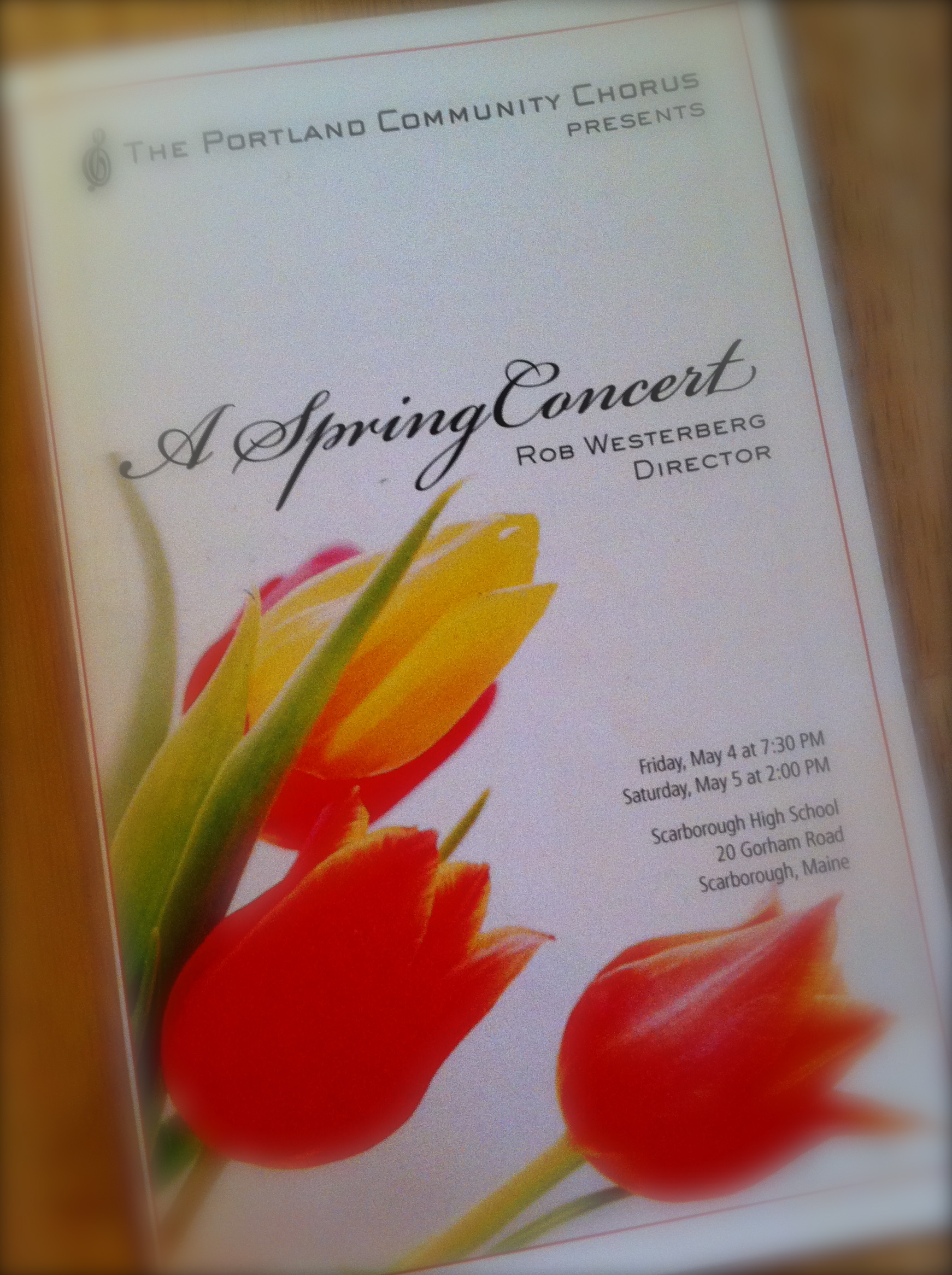
R – So… how do we approach a “performance”? As we near the end of our rehearsals together, this is worth asking. How DO we approach performance? For me, it comes down to whatever our fundamental goal is, and unfortunately there are often times as many different goals as there are singers. I can speak for myself at various stages in my life, I performed to make a relative proud, I performed because I “loved” the literature, I’ve performed because I wanted to see the audience happy. Truth be told, I’ve also performed because, “well, I’ve gone this far with it, I guess I should stick with it through the performance”. I’m sure many of you could add additional motivations that you’ve experienced for yourself.

When it comes right down to it, choral music remains an art form. As a motivating factor, for me that has certainly become enough. There is a truly remarkable obligation that we have as a choir because the art of our concerts is twofold: the artistic creation of the music we are singing (composer), and the “real time” re-creation of that printed score into sound (performer). Robert Shaw often times referred to choral music as the most “moral” of the arts, and I believe this is what he was driving at: choirs – artistic choirs – have an obligation to do right by what the music in front of them intended and, as he said, that has significant moral ramifications. So where does that leave us? The great teacher Howard Swan alludes to a wonderful definition of Art:

…to reflect something on the inside of surface level. If it is artistic, it will inspire on its own. If on the other hand the goal is to create a superficial response, it is not art.

I believe our answer of how to approach a performance lies somewhere in that quote. What are WE going to do at our performances the weekend of May 5th? If we remain committed to the unique disciplines of tone, articulation, rhythmic integrity, vowel unity, melodic and harmonic precision, all within the context of musical phrasing and ensemble sensitivity, we will be creating Art. Moreover, we will be doing so at a very high level. This may or may not make a relative proud, we may not “love” every selection, and the audience’s response will certainly remain out of our control. But we will be able to leave our performances feeling like we gave something back… something back to music writers who inspire us as well as audience members who came to support us and hear what we had to sing. We will also be giving back to ourselves the knowledge that we strived for a goal worth achieving. For me, that’s motivation enough, and precisely how I will be approaching our concerts. I hope you will consider joining me in doing the same!


Posted in Etcetera | 1 Comment