warmups: ear training

R One of the underrated opportunities available to us as music teachers is to utilize warmups as much more than “warming up” (choral warmups). One of the biggies for me will always be training the ear. Two ideas…

Constantly do visual and aural solfege/numbers as part of the warmup routine. Those who know me know I generally use numbers and so I will show or yell them out randomly and have the singers match it. The fun begins when I go rapid fire or do the 7 to 4 tritone or hover around 1, 3 and 5 and then blitz them with a 6 or a 2. And I’m usually able to trip up my choirs pretty easily… at first. 🙂 The litmus test for me each year is guest conducting at the Summer Camp I do up at UMaine (MSYM). Invariably the choirs are easily tripped up initially, but after some practice they get really good at it. So, then I bring it to another level. Instead of “1” through “8”. I’ll do a scale of, “1, 2, 3, 4, 3, 2, 1, 7, 6, 5, 6, 7, 8”. Then I’ll yell out those numbers. This is more challenging still because hearing the 6 or 7 lower than the 3 is something our singers are not asked to do much of in any given warmup. But with time they get better at this. So the next step is to see if they REALLY have the pitches in the ear by having them mentally multi-task. So I might yell “1”. Then, “plus 2”. Then “minus 1”, followed by “plus 5″, minus 2”, “divided by 2”, then “times 3”! It’s really fascinating to find that choirs have a much more difficult time with this because they can’t focus solely on just hearing the correct pitch, and isn’t that why our singers have such a difficult time when you add text or dynamics, or phrasing or tone in rehearsal? Developing the singers’ inner ear to become truly adept at hearing ANY interval is an outrageously productive goal of any warmup.
Develop any exercise that requires them to hold a chord in tune by moving it up and down. My “no, neh, noo, nuee, naw” exercise has that component to it and the trick to mastering the half steps is to request it visually and to do it quickly. Any discrepancies in half steps will become very evident. But that’s with a triadic chord. Once that can be done successfully, I’ve sometimes gone to having them sing a major 7th chord (B=1, T=5, A=3, S=7) and then move up and down by half steps. Getting them to hold the chord in tune is a challenge but an achievable one. Another next step is to have them sing those 4 numbers (or any random set) and then yell, “plus 1” and see if they can actually move the chord and stay in tune! Do “minus 2” and see if they can still hold it. I would argue – and so would you – that a choir that successfully moves from a CM7 chord to an Em7 chord, just by hearing how their note fits into it has well trained ears. And I have a strong conviction that talent has very little to do with it.

The benefits to an ongoing training of a choir’s ears in daily/weekly warmups is clear: the music we ask them to sing constantly requires them to do the very same things(!) and this approach is an ideal preparation for greater success in that rehearsal process. Develop their inner ear as a reference point in warmups and reap the benefits in rehearsal.

Posted in Music is work, Rehearsal, Warmups | Leave a comment

chopped

R – I have some shows that I have set from time to time to digitally record on my TV (American Pickers anyone? Hello???). I’m home intermittently, so when I do get to be home and watch television, it’s nice to sit down and be surprised by what got recorded. My surprise a few days ago was the Food Network show, Chopped. I forgot that I had recorded the Chopped All Stars a year ago (don’t judge me on that…) and a new round just got recorded this weekend and showed up on my TV.

A surprise “Chopped” episode. Timely, eh?

It’s the season for surprise chops to our arts programs around the country. And more often than not, we don’t see it coming beforehand. And consequently we end up being reactionary and wondering what we can do to combat the situation. Here’s the fundamental issue though: I have never met an administrator who didn’t believe the arts are “important”; virtually every single one, I believe in my heart of hearts, sees the arts as an important component of every single school system. The problem is that I can also count on one hand the number of administrators I’ve ever met who believe the arts are “essential”. And by essential, I mean essential to every single student regardless of aptitude or interest or grade level. So when it comes time to cut funding, why are we shocked and amazed that funding comes out of programs that others consider important but not essential? Cuts to arts programs are not problems, they are symptoms (problems vs. symptoms)Consequently, when it comes time to react to proposed cuts, there’s no way to win the battle. Reinstating cut funds or positions is the immediate need, but the problem itself doesn’t disappear, nor does it even get addressed anywhere in that process. You don’t fix the core issues by addressing symptoms; buying more kleenex won’t cause the flu to go away. And the problem is compounded when school boards or community members likewise carry the “important but not essential” thinking.

How de we address the core issue (important but not essential)? Here’s a few thoughts:

* For years we have largely utilized boosters organizations as fundraising entities. Not only does this philosophically undermine our argument that the arts are core curriculum (core subject areas are supported through the budget process, co-curriculars and clubs fundraise!), but it takes the focus off of what we need our boosters to be: ongoing advocates for the necessity of the arts in our schools for every student. Making this philosophical shift can be a powerful strategy. That’s just great if a parent organization raises money for our programs, but is there a hidden cost involved (a comment was once made to a district’s proposed music cuts that, “…they can absorb the cuts better than anyone else: they’ve still got the Boosters!”)? Likewise, does it dilute their real value?

* Aligned K-12 curriculum with rigorous standards and assessment practices that report each student’s academic progress in the arts puts us on the same playing field as the other essential subject areas. THAT’S the language of essential programs! This can be a daunting endeavor, but I checked on this and it turns out that there is a statewide initiative established to help every single arts teacher in Maine achieve this objective! Who knew!!! Seriously, the work being done all over the state in this respect is impressive and inspiring. Geographically we are very scattered, but in practice we do not have to be. Setting up curriculum to align with core expectations and then demonstrating student mastery through thoughtful, thorough and consistent assessment helps the perception of others turn the corner of “important” to “essential”. Data, connection to other academic successes and demonstration of student achievement – which is NOT subjective – lends credence to our argument. It facilitates changing the thinking of others in their perception of what the arts are all about.

* No other academic area is as public and “visible” as ours, and yet we get backed into a corner and often ask, “Gee, how can we reach the parents and the public?” There’s a disconnect there somewhere, isn’t there? Perhaps it’s time for all of us to reassess how we interact with our school and community when we do art exhibits or performances. We should always be educating them about our discipline, but we also must be educating them about why we are essential. ALL the time. Creative use of our physical programs that we pass out at performances, guest speakers/presenters at our exhibits, engaging the media in a more substantial way, all this can lead to more serious discussions about the role of the arts in our schools. Inviting administrators to attend isn’t enough. I don’t know of a single proposed cut where the administration or school board wasn’t aware of “what” was getting cut. We don’t need them to visit the products, we must convert them to the essentialness of the program by engaging them in the process that gets students there… and that puts the onus on us to educate more than just our students at every possible opportunity. It’s not enough to say “we’re essential”. We must also say, “… and here’s why!” If we don’t show the alignment between our performances and/or exhibits to standards, they’ll never see the alignment between our performances and/or exhibits to standards!!!

No two school systems are identical, and neither are the dynamics that lead to proposed cuts. When those proposals do come forward, getting in touch with the advocacy leaders at our state arts organizations is an important first step in the process of addressing them. But as arts educators, we must assume that every one of our houses are built on sand. Because of this, fairly or unfairly, a significant component of our jobs and responsibilities must be to replace those foundations with a more structurally stable and lasting material: “essential”. It’s not too late to begin this construction project, is it? Failure to do so will only lead, eventually, to an episode of “chopped” showing up unexpectedly. Let’s limit that scenario to our TV sets.

Posted in Advocacy, Assessment, Etcetera, Programming | Leave a comment

talking shop

R – “Ostriches bury their heads in the sand.” No they don’t. Ostriches don’t bury their heads in the sand at all. I looked it up. When they feel threatened, they actually lay down on the ground and feign being a lump of dirt so they get overlooked or bypassed by those around them. But forever and a day will I equate this ridiculously funny looking animal with that behavior just the same.

A) who cares? B) what’s the point? The answer to A. is, predictably, “no one I could possibly ever think of.” The answer to B. though is a different story.

It seems to me that the greatest tragedy of our profession is any failure to genuinely, authentically share our work with each other. Listening to other groups, in and of itself, is not nearly enough. Nor is it the same thing. And too often it is incredibly easy just to talk shop at the surface level with colleagues at district concerts or at conferences in the hallway between sessions. Worse yet, it can be too easy to allow months and even years go by without talking collaboratively about what we do and why we do it in our schools and classrooms. Sticking our head in the sand. Conversely, the most exciting thing in our profession can often be talking in depth with other colleagues in the field, sharing stories of success and failures, ideas and designs, experiences and plans for ongoing work.

On Thursday of this week, I spent the day with Kimberly Grover, choral director and general music teacher at Frank H. Harrison Middle School in Yarmouth. She brought me in as a guest for the day and I got to work with 270 of her singers, grades 5 through 8 (Guess who had the most fun? That would be me…). The value of the workshops was getting someone else to articulate the same fundamental concepts that she already works on in her rehearsals each week but in a different way (i.e. Dr. Howard’s gift to me and my kids last February in what does it take). It enriches the student’s experience, and gives the host director new insights. But for the guest it opens their eyes as well to new approaches and applications of their ideas. When a guest conductor or clinician is brought in, ideas explode into tangible results and the benefits are equal for all involved. But Kimberly and I also spent lunch on Thursday talking about assessment. We got going and she was asking such great questions that on the spur of the moment I called my choral colleague at York Middle School, Jen Etter right there as we were eating! Jen is already a master teacher in my estimation and has SO much expertise to share. To my surprise, she picked up, had two free minutes, so I handed my phone over to Kimberly and let them have at it. It was awesome! Before our lunchtime conversation wrapped up, I could see Kimberly’s brain going a mile a minute. She began her 6th grade general music class a few minutes later by saying to a few kids who are also in chorus, “Hey, what would you think if I did individual assessments in singing each month?” And the reaction she got (all positive) got her going even more. Yesterday morning I got an e-mail from her: she implemented one of the things we spent lunch the day before talking about in her grade 5 chorus rehearsal and it worked!!! She was SO pumped… and it was a tribute to her for wanting to know more. Wanting to do even better. Wanting her program to be the best it can be for her kids.

York High School had a scheduled day off yesterday (prior evening parent conference release time) so I headed up to Brunswick High School to work with Ashley Smith’s Chamber Singers. Ash is a former student of mine and is doing great work there, especially as a first year teacher, but is also building a foundation for future directions for the BHS singers. We had a blast with her students, working on foundational technique stuff as well as teaching them a song they’ve been working on. You see, they will be coming to York to join my Chamber Singers in singing that song at one of our June concerts, and my students will be doing the same at BHS for theirs at the end of May. Personally, yesterday was a blast. But professionally, for her and for myself, it was an enlightening hour and a half. We shared ideas and perspectives and I know I got more out of it than she and her students did.

I came home, had lunch and then at 1:30 had a previously scheduled phone conversation with Lisa Blanchette who is the music teacher at Sumner High School in Sullivan, Maine. She called me at the beginning of the week because she heard I had been working on standards based assessment and she wanted to know more about it as she continues to move further in that direction herself. Our half hour conversation was awesome on multiple levels. By the end of it, she clearly was articulating some new strategies for her assessment practices, but I left the conversation dying to hear from her again soon so I could learn from her experiences in implementing them!!!

And on it goes… I could give you many examples of this kind of sharing done by other colleagues I know in this state, instrumental, general and choral, who have this practice embedded in their year to year, month to month activities.

Collaboration should not now – nor ever – be limited to working on formal projects with someone (I can hear Jarika now, “Isn’t it obvious???”)! Sharing our efforts and resources with others in the field – as an ongoing, routine practice – remains an incredibly gratifying and invigorating approach to furthering our own work. And it’s a hoot to do! The last two days were reminders for me of why it is so much fun and really rewarding. I don’t know how I’ll be perceived in the years ahead as a music teacher in Maine, but I promise you two things: 1) I will not be an ostrich and 2) I will continually be gravitating to others who aren’t either.

No more ostriches.

Posted in Etcetera, Rehearsal | Leave a comment

the concert: audience as performer

J – This video is from our January Grades 6-12 Combined Chorus Concert. About 3/4 of the way through our concert I had the Middle School and Upper School Choirs walk right into the audience and taught them all Freedom is Coming (a traditional African piece). Neither the audience nor the students new about this… it was pure spontaneous goodness!

Freedom is Coming

Why did I do it? I decided to teach and perform this piece with the audience for a number of reasons. The first being that we spent the first 4 months of school learning what the process should look like. We focused on developing literacy skills, learning good vocal technique, developing musicianship and just learning the ins and outs, learning to be active in the music making process. Holding the students and myself accountable for this during every rehearsal, all the while having only 90 minutes to rehearse a week (and thats if they didn’t have an impromptu meeting or commitment), meant that we were not going to have a lengthy concert. I wasn’t just teaching music, I was trying to change the way they thought about music and their commitment to it. To many, only performing 3 pieces in the Upper School Ensemble and 2 with the Middle School may seem as if we didn’t work very hard. And yes, if your audience is thinking that it’s all about the pieces and the performance, then they may think that.

I thought it might be nice for them to experience part of the process (just a snapshot!)…  learning an individual part, singing in harmony, and performing together with energy, even if by rote.

The second was… I knew I needed to invite parents, colleagues and administration into our new music community. Things were changing.. and I wanted them to be apart of this change. This only helped to reinforce what I was working towards and where I want us to go together as a school and music community. I think this not only brought the audience into our world, but the students enjoyed collaborating with them in this effort.

Feedback – The Feedback from parents, colleagues and administration was great. They all were very happy to be invited into this process.

A few parents said that it was a fun to sing with the kids and learn each part… and sing! So many do not have an opportunity to just sing together. If giving them this opportunity isn’t advocacy at its best, then I don’t know what is.

How I felt – For me, this was a big risk… this was the first time some of these people were going to meet me, not to mention the pressure of doing this in front of all of my singers, their parents, friends, colleagues and administrators. What if I messed up or froze? What if they didn’t get what I was saying? What if they DIDN’T SING??! But, I figured we as a community could only grow from it.

Planning it was pretty interesting… I went over every possible way I could present it and thought I had come up with something great. But, when I started all of that went out the window and I just did what felt right.

Reflecting back, I am very happy that I did it.

I only wish that I had a video camera facing the audience.

Posted in Advocacy, Etcetera, Performance | 2 Comments

melting pot

R – Scenario #1: An auditioned, balanced ensemble of like-minded, like-motivated singers with the same skill set, backgrounds, reference points and reasons for being in the ensemble. They share the same ideals and beliefs and those resonate through every minute of every rehearsal. Scenario #2: real life.

Which scenario do you deal with?

These are the real issues we confront as music teachers. In an Algebra II course, the skill set is varied, but only to a degree. In Social Studies, student’s motivation to be there may be varied but they know exactly what to expect. In Biology, there are many different reference points, but 100% of those students took the same science courses together over a period of many years leading up to that point. NONE of these three things generally hold true with regard to music performance classes. Students still learning how to hold their instruments are performing next to students who will be music majors on that same instrument in a year or two. In chorus, every student has their own conviction of what the course should or should not be… and it’s not always based in reality, is it? And while some in the performance ensemble have played together before, I know dozens of school choirs filled with students who have never sung with others in the same course before.

It seems to me that bridging all these gaps is not only a desirable goal for any music teacher, they’re essential to the success of the “melting pot” performance based course, not to mention the students.

1. Skill set… this is where mentoring can play a very large role. Instead of ignoring the skill set gap, you can use it to your advantage. Holding older or more advanced students accountable to mentoring those around them builds multiple sets of social and civic skills while building musicianship and closing the skill set gap. In my choirs, there is not only a seating chart, but that chart changes every 4 weeks. I place students strategically to be mentors (and “mentees”) and structure rehearsals in such a way that mentoring is encouraged. This plays a crucial role. Last year I formed a choir made up entirely of first time singers at YHS. It changed the way I taught and assessed for the better, and I have since transferred some of my lightbulb realizations over to my other choirs. But I found out just how much I missed the mentoring piece and how the musical development of my singers was slowed as a result. I’ve permanently reverted back to heterogenous groupings for my non-auditioned choirs.

2. Speaking of non-auditioned choirs, motivation for enrollment can be all over the place. Some love to sing. Does that mean they’re willing to work hard on musical disciplines in the rehearsal setting? Some love working with others socially. Does that mean they also bring a self-discipline required to focus and rehearse? Others are there to sing certain styles/genres of music… and they will disengage the moment you rehearse something outside of that style they want to sing. The logical solution is to make it your highest priority to establish the set goals for the course. These goals can be as broad or as specific as you’d like, but they MUST establish YOUR motivation for running it. Likewise, they must establish in the student’s minds clear expectations not only for the course but for your expectations of them. Failing to do this, instead just assuming that all students are there for the same reason and motivation… well, simply put, “no good is going to come of this”.

3. And being a melting pot of backgrounds and experiences? There are many ways to deal with this, the least desirable of which is to ignore it. I’ve already tied this into choice of solfege or numbers (mac vs. pc) but it is also essential to create multiple shared experiences, whatever they may be. “Well, they’re in the same class for a term, isn’t that enough?” is too passive an approach. What are the shared experiences you will be creating for your students? Warmups… exercises… sight readings… tone building… technique building… be precise as to how you will build the shared bank of experiences.

The performing arts are not more important than any other subject area, but they are as important and they are RADICALLY different! On many levels. I would argue that these are three examples of differences that must be addressed before a performance ensemble can move forward successfully. Bridging the skill-set gap, establishing a singular mind set of goals and motivations and also developing an ongoing set of shared communal experiences can establish a strong foundation upon which a choir can blossom and thrive.

Posted in Etcetera, Rehearsal | Leave a comment

the concert: – promoting music literacy #1

J – This video contains the Sight Reading segment from the Lower School Concert in December. The audience joined me in an exercise very similar to the one the 4-5ers partake in weekly.

WHY DO THIS?

1) TO TEACH THE IMPORTANCE OF MUSIC LITERACY! I truly believe some of the parents and teachers who come to our concerts aren’t aware of the nuts and bolts that take place behind the scenes. They don’t particularly get a true showcase of learning, but instead a short and sweet display of a few songs. BUT, our goals over the entire semester were not to learn the pieces and perform them in concert- they were a vehicle and the byproduct. Our goals were to develop a head-dominant singing voice, learn to develop skills in reading music (numbers, rhythms), developing a knowledge of basic notation (where do you look? what are all these weird symbols?), learn how to warm up the voice, and basic vocal technique. I wanted to figure out a way to SHOWCASE at least one of these elements… AND stress the IMPORTANCE of children developing these skills (not just performing a  piece that makes them smile… both can be done)!!!

2) A NEW TEACHER IN A NEW COMMUNITY! I also thought this might let members of this new school community into my classroom. I have been throwing out a lot of new concepts- challenging students to have a more in-depth music experience.. I AM SURE THERE WERE PLENTY OF QUESTIONS. SO, Let me give one big answer. I was bringing in some changes, and let’s face it… I am sure some people were nervous to have such a young “Kid” teaching their kids!

BENEFITS

1) For starters, the students were very proud to lead their parents in the exercise ( and they were a little excited to see how they did). Some were very happy in saying “My parent already reads music”- with which I respond with, “Well then this will be good practice!”

2) They were also very proud to show their parents what they learned!

3) The parents learned very quickly that I am ready to how their children accountable for learning the “ins and outs” of music!

4) They had fun! There were smiling and interacting with each other.

FEEDBACK

I got a lot of great feedback! PARENTS were excited to get a glimpse of things and some were even excited to learn a little bit about reading music. They were also very happy that their children were going to come out of chorus knowing A LOT about the process! STUDENTS said that they thought it was fun to sit in the audience and participate with their parents. COLLEAGUES were interested because they hadn’t seen it done before and they thought it was a neat idea. The ADMINISTRATION was happy that I was taking some risks and bringing the program to a different level.

HOW I FELT?

When planning for the concert- I knew it wasn’t a choice of whether or not I wanted to include it- it was just the how. I wasn’t particularly nervous (well until 5 minutes before when I realized they could choose not to sing or join in and THEN what do I do). Overall I just excited to watch it unfold and observe the reactions. It was a risk, but I believe it paid off.

Posted in Advocacy, Etcetera, Performance | 6 Comments

reading books: philosophical foundation (why)

R – I will always preach to every beginning teacher: know your complete philosophy of why you do what you do, and then let your actions – ALL of them – flow from that philosophy (why vs. what). Music teachers run into problems when they preach one thing but do even one thing contrary to or in conflict with it. I believe music education is for all students. Consequently the first thing I worked towards at each of my three gigs was to establish a graduation requirement specifically for music. This process began with a philosophical foundation that was rooted in my soul, that I could clearly articulate to students, parents and administration. Everything else flowed from THAT.

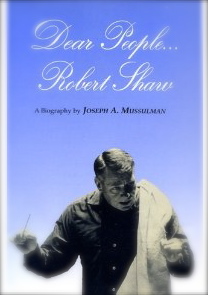
My mentor in my career has been a wise sage by the name of Marv Crawford who studied under many great masters of the 50’s and 60’s and formed his own choirs in the 70’s and 80’s out in Michigan. I met him when I was still an undergraduate, and then and now, he is forever on my case questioning why I do things the way I do them. Initially, I didn’t have an answer (“that’s what I was taught” is no answer…). Then I read Robert Shaw’s biography, Dear People. I realized that the entire book spoke to ME about my beliefs. I formed my philosophy around his ideals – not because it was Robert Shaw, but because I believed in what I was reading and learning from him. This was followed up 7 years later with Conscience of a Profession by Howard Swan. One of the cool things that happened to me this year is that I lent my copy to Jarika a while back to have her read it. When she finished it she said that she now saw where I got so much of what I teach and say. It’s been YEARS since I’ve read it, but being told that the book is still a reflection of the teacher I am today is something I am more proud of than virtually anything I can think of.

Which philosophical approach you take is not the relevant issue (mac vs. pc). The REAL issue is simple: what are the core values you hold as a music educator and rehearsal technician and why do you believe that? There are hundreds of great teachers and hundreds of great books out there and each have something valuable to offer. But before you glean the “whats” from them, you have to identify the “whys” of who you are and what you believe. Otherwise you’ll never be anything more than a mish-mash of whats. Aren’t you MORE than that?!!!

Get philosophical if you haven’t already. ARTICULATE what you believe. Do so in words that anyone can understand. It’s not your job to convince others the worthiness of your beliefs (if they’re any good at all, this will occur all by itself in due time). It IS your job to know why you do what you do. ALL the time. Get away from, “well, that seems to work” and get into “I do this because it aligns with my approaches and beliefs about music education.” Get your nose into books that approach things from a philosophical angle. Read biographies of great teachers… read texts that bend your mind a bit… read suggested readings from teachers you respect… and shape your beliefs through reading.

Our favorite texts: check these out

Posted in Advocacy, Etcetera | Leave a comment

a smattering of thoughts on assessment

J – BEWARE: Read at your own risk. This is a purging of thoughts.

Although I am hesitant to follow Rob’s fantastic post- I simply can’t resist! Lately, I can’t stop thinking about assessment…WEIRD, I know (hence the title goober music teachers).

Anyways…The entire state is working on this marvelous arts assessment initiative; teachers are collaborating and questioning  one other and themselves- sooo much inspiration!! My big question of the year is what happens when you teach in an environment where assessment isn’t required?

This lead me to another question… why do we assess? Is it to make the administration happy? Is it to prove that we are in fact part of the academic core? I challenge that it can be this and more!

In my position this year -most of my classes do not require grades or assessments. This actually bummed me out a little. I was looking forward to tackling standards, objectives and assessments for each grade and really diving into the process.

Who cares.. I did it anyway!

Here is what I discovered through assessment…

1. I know my ensembles better… including each individual and what they are capable of. This helps me to get an idea of who needs extra help in mastering a skill or meeting a standard. Sometimes I found out the whole group needed to review. These included standards on key signatures, reading examples, notation, as well as vocal techniques (posture, low breathing.. etc)

2. The students are more aware of what they are trying to master and what certain set of skills they may be trying to develop. What does it take to be a good singer, member of an ensemble/team, or musician?

3. They get an idea of where they are at, and what they can improve upon.

4. The focus isn’t about nailing them on a test… it is about mastering a skill no matter how long that takes.

5. I would say that most of the kids 4-12 could tell you the basic standards in Chorus. These include.. using head dominant voice, good alignment, demonstration of numbers and speaking rhythms, low, free breathing…I am not sure if they would be able to otherwise.

On another note ( I told you it would be a smattering!)-  a conversation about assessment came up at school last week where a teacher stated “School seems to work better without assessment.”  She communicated that as the students get older and start getting grades, they tend to start focusing on “what do I need to do to get an A?” instead of mastering the material at hand.

Now this really got me thinking! Why do they do it?? I had to agree that I see students do it all the time, but could it be an attitude that we as teachers are passing on to them

I started asking myself…

Are you putting emphasis on mastering skills or are you putting the emphasis on a certain project? Why do teachers give out projects? Do students know why they are working on the task?

If your answer to the first question is that you are grading projects, term papers, test and quizzes, then this could be the issue.

Quizzes and tests are merely ways for them to demonstrate their mastery. Therefore, if they focus on mastering the skills and subject-specific standards they will then in turn do well on tests, quizzes, projects etc…

So to summarize –

Assessment can…

1) Support the arts as  part of the academic core

2) Provide objective feedback

3)  Bring purpose to the classroom

4)  Support your philosophy

5)   Let your students in on your philosophy and purpose

6)   Encourage students to focus on the skills

7)  Work hand in hand with curriculum and learning objectives

8)  Teach students about how important the PROCESS is

9)  Ensure that you know where every student is in their abilities and techniques

10) Help you to bring your entire class to the next level of learning

Isn’t it obvious 🙂

Posted in Assessment, Standards | Leave a comment

the dirty word

R – Assessment. In the Arts. In Music. Could there be anything worse? I mean, come on… squelching creativity? Interfering with students’ sheer love of the art? How about the time it takes from class time to actually DO assessments? And how in the world do you assess aesthetics? After all, if the group sounds great, isn’t that what really counts? When the Maine Arts Assessment Initiative decided to run a statewide Arts Assessment Conference in the Fall of 2011, some of the discussion centered around what in the world to call it because, it was pointed out, “if we call it an ‘assessment’ conference, no one will want to come!” No doubt about it: assessment is a dirty word.

Or is it?

Isn’t it true on at least some level that we’ve been guilty over the years of saying out of one side of our mouths, “We’re just as important as the other “core” subject areas! We’re just as much an academic subject as they are!”. And yet out of the other side comes, “Oh, we CAN’T be expected to assess students the same way as the other subject areas! Don’t people understand that?” Music education has often tried to have it both ways. With legislation having already been passed around standards based education in Maine, and the concept of “alternate pathways” being adopted, that time of having it both ways is coming to an end. And this is not isolated to Maine.

Here’s the issue: we want to be academic but we have difficulty holding music students to the academic standard of other subject areas. And that poses a real problem. Have we largely put ourselves in a position where, when it comes time for making budget cuts, there ARE subject areas that are less academic? Like music??? I would argue “no” and so would you, but the argument falls short the moment the topic turns to summative assessment. Math grades are based on academic content. Music’s is based largely on “participation”. Who do you THINK is going to get cut?

The arts, and music in so many ways, are the champions of formative assessment; assessment for learning (music rehearsals are organized, continual mass formative assessment!) but we have often refused to encounter the realm of summative assessment; assessment of student learning. When we don’t hold our students individually accountable to a wealth of standards, it’s usually due to the fact that we don’t have time for it, don’t know how to individually assess them, don’t see them often enough to actually assess individually, or don’t have the facilities or technology to make it all happen to begin with.

And these are very real reasons.

But to a large degree, they cease to be roadblocks any more. The Fall Arts Assessment Conference in October of 2011 in Portland was eventually called an assessment conference and an overoptimistic cap was placed on it for 200 attendees. Over 230 showed up. Eighteen teacher leaders attended a 4 day Arts Assessment Institute in Portland last August and they have reached dozens more teachers from around the state through regional workshops. They’re still doing so. We’ve heard first hand stories of groups of college students and clusters of district level arts personnel huddled around a single computer and speaker phone for a series of webinars that have been held on arts assessment this year. Graduate courses are being offered – and attended – around the state specifically in arts assessment.

As the national standards revision continues to take place, we need to jump-start our profession in the eyes of our administrators and the general public prior to that by getting serious about diving into the assessment pool. We are as essential as the other subject areas, and it’s time to act it. The skills we develop in our individual students, including in the large group ensemble, do employ real academic rigor. But until we assess those skills, individually, on clear-cut measurable standards, whether grades based or standards based, it’s only here-say. Lets change that.

And by the way, since when did giving our students thoughtful, concrete, measurable ways to demonstrate proficiency in a craft that they really love, result in abject misery or loss of love for the discipline? Just asking…

– – – – – – – – – – – – – – – – – – – – – – – – – – – – – – – – – – – – – – – – – – – – – – –

The Maine Arts Education blog with Argy Nestor – go there and subscribe with your e-mail to receive all her updates. Even if you’re not a Mainer, it’s a “must have”.

Posted in Advocacy, Assessment, Standards | Tagged , , , | 8 Comments

risk taking

“Do you want to be safe and good, or do you want to take a chance and be great?”                                           Jimmy Johnson

R – Right up front I will tell you that the problem with the phrase “taking a risk” is that doing so means so many different things to so many people. I also think the phrase is over used. With regard to music education, there are risks and then there are risks. The small scale ones are important (“I’m going to try a new warmup today”) but the larger ones I’ve seen others take are inspirational to me…

*  A colleague who after 12 years in his first H.S. gig decided to leave a place he enjoyed (and who loved him) to see how he would fare in a new school; a new environment, putting to work the skills he had accumulated to that point in his career.

* A colleague of mine who, under the threat of a proposed budget cut ripping into the music program, suddenly did a planned blackout during one of her choir’s songs in concert and explained to the audience when the lights came back up that this is what would happen to the entire program if the cuts went through.

* A colleague who submitted a CD for her Chorus to perform at an MENC Conference, was selected, and saw the nerve racking experience through.

* A colleague who decided on her own to go entirely to a standards based system of assessment with her Junior High program and has established what is a true model for what the future of music education holds at that grade level.

* A colleague who was a former Dept of Education “teacher of the year” for all of Maine, who left her classroom to work for the Dept. of Ed, working diligently to improve the educational environment, as well as the educational practices for Arts educators in the state.

* Jarika, at the first concert of her career, beginning the concert by putting a sight reading example on a huge screen and teaching the entire audience to sight sing.

There is one single common thread between all these examples of large scale risks that occurred: every single person I just mentioned grew profoundly. They grew as people. They grew as teachers. They grew as mentors. They fostered growth in those around them. Risk taking does not guarantee success, unless you measure that success in terms of personal and professional growth. And if you do measure success in those terms, then here’s the good news: your success rate at taking a monumental risk is right at 100%.

Are you ready to take a risk in your professional life? Connect all the dots below with 4 connecting lines only, without lifting your finger from the screen.

*           *           *

*           *           *

*           *           *

To quote Keene State College’s Dr. Sandra Howard from last weekend, “Imagine the possibilities”.

connect the dots

Posted in Etcetera | 4 Comments