fatigue

R – I’ve never written on this blog before about feeling worn down. I’m feeling worn down. Fatigued. It is the closing of a school year that has been a good one in so many ways. As a matter of fact, if I had to find something to complain about it, I don’t know if I could. But every once in awhile, days seem to overlap, tasks become repetitive, actions feel more like motions. There is so much in our profession to wrap our brain around. There’s the mental fatigue… concert planning and logistics, grades, assessments, accountability, lesson plans, running good classes, et al. There’s the physical fatigue… typing program notes, recommendations, tests, assessments, running classes, running rehearsals, prepping for rehearsals, concerts, et al. There’s the emotional fatigue… every kid is special to you which means you live and die how-to-unleash-your-best-work-every-day-so-that-you-die-emptywith them – two seniors of mine who right now who are currently ineligible to graduate, two other seniors of mine who will not graduate, the senior who is eligible but has so much messed up stuff in his life that there’s no guarantee that he’ll make it three more weeks, the kiddos who are apprehensive, the ones who are angry, the ones who are concerned, the ones who are tired, the ones who are going through the motions, et al. And by the way, all that is a summary of my reflections directly from YESTERDAY, May 23rd. And I haven’t started in yet with the faculty that is superhuman by any measure but is feeling burnt out.

To go one step further with all this, I’m not writing this because any of it is unique to me, I’m writing it precisely because it is NOT unique to me. My suspicion is that this may describe the majority of my colleagues, music and otherwise.

Two recommendations. First, I’m getting some rest. Memorial day is an incredibly special day, and celebrating it will find its just outlet. But I also need sleep and time away from work, and I’m about to do that – mentally, physically, emotionally. Two, here’s a quote by Emerson to lay on you: “The health of the eye seems to demand a horizon. We are never tired, so long as we can see far enough.” The goal is not Summer vacation. It’s to make a difference. I need to get some gas back in my tank. But once I do over the next few days, I’m diving back in there with my eye on the ball – making a difference to the degree that I’m able. I will get tired again, maybe pretty quickly. But that’s different than “fatigue”. After a long weekend of rest I can hopefully hold that off for one more, productive month of the school year.

Posted in Etcetera | 1 Comment

dream come true

R – In the Summer of 2010, Argy Nestor, then the Visual and Performing Arts Specialist at the Maine Department of Education, called me up and asked me if I would be willing to take a week in August to attend an Arts Assessment Institute with her and colleague Catherine Ring in Plymouth, New Hampshire. I had the good sense to Rob, Argy, Catherinesay “yes”. What transpired there changed my life. I found the “hook” I had been spending my career looking for: utilizing student academic achievement as a vehicle to drive my own instruction and curriculum. At the time, “assessment” in the arts was still a dirty word. On the drive home to Maine, the three of us – with our brains on fire – decided to tackle this at a state level, which in turn a Summer later formally  became the Maine Arts Assessment Initiative. Our mission was very straight forward: To create an environment in Maine where quality assessment in arts education is an integral part of the work all arts educators do to deepen student learning in the arts. And the non-negotiable was that it would be a “bottom up” initiative: centered around deep dialogue, peer mentoring, sharing ideas and best practices, all based on research as well as practical application.

We set in motion a plan that had many different layers and parts to it, providing professional development for arts educators in Maine. But we never believed it would take on a life of it’s own. We honestly believed that successful execution of our weird little idea would be a three year plan at most. But all three of us did share a mutual pipe dream: wouldn’t it be incredible if some day we were to host a New England wide Summit on Arts Education? And now as we embark on our 5th year…

… it’s happening! 🙂


The New England Summit on Arts Education – July 29, 30, 31, August 1, 2014, University of Southern Maine, Portland

The New England Summit on Arts Education will provide an outstanding collaborative opportunity for educators to dig deep into teaching, learning, and assessment in arts education including student-centered classrooms and proficiency. Please join educators from Maine and beyond for this fabulous three-day professional development opportunity.

Maine has a commitment to offer a quality professional development opportunity that is customized to meet your educational needs and goals. Consequently, participants will choose a strand to be working in during the Summit.

MAAI has provided professional development during the last three summers to Maine arts educators who wish to take on a leadership role and create a workshop to present to arts teachers across the state. The initiative has been building capacity by training arts educators on the “what” and “how” of arts assessment and finding the balance of formative and summative assessment, so they can provide the leadership in Maine through professional development opportunities.

PHASE IV

During the next phase of the MAAI the goals will expand in response to teacher feedback and is offering a three or four-day summit. The summit is designed to meet the needs of teachers and the workshops will be on such important topics as proficiency, standards-based, student-centered, leadership, advocacy, creativity, 21st century skills and much more.

There will be multiple opportunities for networking as we broaden our knowledge in arts education. The Summit is a perfect opportunity for those who want to learn the core principles or advance further into the Arts Assessment field.

Participants will be able to choose one of three strands based on experience:

Strand # 1 – Developing Teacher Leader
This strand is designed primarily for teachers (teaching artists or arts educators) who have not already been involved in the Maine Arts Assessment Initiative and would like more of a foundation in arts assessment, and connections with teaching and learning.This strand is also for teachers in Maine who would like to become a Teacher Leader for the MAAI. Attendance at all four days is required to become a Teacher Leader.Strand 1 is open to any participant (from Maine or beyond).
Strand #2 – Arts Assessment Team
This strand is designed for attendees to work together as a team during the Summit. These teams will develop a collaborative arts education plan to be implemented when returning to school/district. Consider possibilities when forming your team; the work accomplished during the Summit could be similar to Strand 1 or 3 but will be customized to the team’s needs and unique ideas. This strand is not only open to PreK-12 district Visual and Performing Arts teachers and classroom teachers, but also to administrators, teaching artists, community cultural organizations or institute members, parents, and/or school board members.Strand 2 is open to any team (from Maine and other states, at least two participants per team).
Strand #3 – Arts Assessment in Practice Strand
This strand is designed for the individual who is ready to dig deeper into arts assessment, and connections with teaching and learning. Strand 3 will provide the opportunity to turn collective knowledge and understandings into important collaborative work on benchmarking, proficiency, and resource development.Strand 3 is open to anyone returning as a Teacher Leader, graduates of arts assessment courses, and anyone who feels they are ready to dig deeper into arts assessment.

Optional Day 4 – August 1 – TEACHER LEADERS
This day is offered for teachers from Strand 1 who would like to take an active role in phase 4 of the Maine Arts Assessment Initiative as a teacher leader. The professional development offered on day 4 will help prepare teachers for taking on leadership roles including leading workshops at the regional and statewide level. There is an application process to become a teacher leader that will be available in the near future.
Comments from Maine Arts Assessment Summer Institute participants

“The relationships I have developed have positively changed my life and the ripple will go on for years to come! I loved the activity about a collaborative community and glancing upon that poster throughout the time period; I will use that for my own classroom.”

“Thanks for all the hard work that was put into the planning and developing of this year’s institute. I love what we do. I am so pleased to be a part of this.”

“Thank you for setting up this opportunity for me to really think about how I teach, and how I can expand my practice so my students can have a deeper understanding and appreciation for what they learn in the art program.”

“There are not enough words to describe how appreciative I am of this initiative. It has made me a better teacher, and has made a difference to my students’ art education.”

REGISTRATION IS NOW AVAILABLE BY CLICKING HERE.

Cost: $299 ~ Earlybird special: register by May 30 for a $25 discount

Additional savings: register as part of a team (at least 2 people) for a $25 discount

With both of these discounts the total cost per person is $248

CEUs are available through the University of Southern Maine. Contact hours are available. Three Graduate credits (required for all teachers in Maine to be re-certified) is ALSO available(!) through the New England Institute for Teacher Education at a discounted rate of $950. This is a separate cost from Summit registration. Please click HERE to register for the graduate credit.


This really is a dream come true… three days of professional development for arts educators (music, visual art, dance, drama) BY arts educators, making connections with tons of others who are doing the good work in the trenches just like you, looking for wonderful ways to better learning for students in the arts. Not only is there no financial gain in it for any of us, we are just budgeting for the logistical and physical essentials of running an event such as this! We simply believe in the power of an opportunity such as this, and there is a small army of a couple of dozen of us now working behind the scenes to make it happen! Please come and join us for this event and bring a colleague or two… or three or four… professional development that has been years in the offing, and planned completely with you in mind!!!

For more info, please e-mail me (Rob Westerberg) at mllama4@maine.rr.com

Posted in Etcetera | 1 Comment

unattainable

R – “Let’s realize first that the arts are not an ivory tower of retreat. They are a doing. They are a making. They are sweat, strain, cramps, blisters, tears, blood, profanity and mocking laughter.” – Robert Shaw

Vivaldi’s Gloria, measure 6 of movement 10, “Quoniam tu solus sanctus”. A half rest followed by a dotted 8th followed by a 16th and then two 8th notes on, “Quo-ni-am tu”. Assume a metronome marking of 120. That means that the 16th note is an eighth of a second long. The first syllable in measure 10 has three components to it: “k”, “w”, “Oh”. Each one of these then is less than 1/16 of a second long. BUT, they are not equal. The emphasis is placed on the vowel so the consonants are even shorter. BUT, those consonants have to have an explosiveness to them to be on equal dynamic footing as the vowel. AND they have to be the same vowel across the board, formed with the same shape of the mouth, both inside and out. AND that vowel shape is not allowed to be impacted by the consonants beforehand. And this must be done at the same dynamic level as everybody else. UNLESS the numbers of each section of the choir are not perfectly balanced, in which case SOME have to be quieter and some louder. THEN the tempo must be perfectly aligned. AND the articulation precisely the same – legato? Marcato? Staccato?

And every one of the 100+ singers must do every ounce of all of this at precisely the same moments.

On their respective correct pitches, perfectly in tune.

And that’s for one half of one measure in a work in which the choir sings over 300 measures. In latin.

The miracle of what we do in music is that we do it despite the acknowledgement that we will never achieve what we’re going after, and we go after it anyway. We are not capable of achieving mastery. I often say to my choirs before a performance that, “Never in history has there ever been a ‘perfect’ choral performance by anyone… and the good news is that tonight we’re going to keep that streak going!” I believe Robert Shaw would have corroborated that statement. Why do we do it then? Because of the love of the chase, and the love of the art, and love of what great composers give us and the love of how music changes us when we are participants in that creative and re-creative process. I love the Shaw quote above, because THAT is art. It is too easily perceived by non-musicians (“gee Rob, why do you always preach that music education should be required for all students?”) as the ivory tower of retreat or the passive, “this makes me feel good when I listen to it.” There’s nothing inherently wrong in either perspective, they simply are not accurate representations of what WE go through to produce it. And the joy for us in attempting the unattainable is the transformation we go through in the process of trying to get there each and every rehearsal – physically, emotionally, cognitively.

PCC concert weekend is here and after last night’s performance, and prior to this afternoon’s, I’ve had a difficult time articulating all the emotions I’m feeling about it all. I think it comes down to the juxtaposition of falling short of artistic perfection, just like every other choir in history, against watching 100+ singers bring Vivaldi back to life and seeing how it transformed both them and the audience, even if for a brief moment in our lives. The latter justifies the former, and the attempt at the former makes the latter possible.

Man has never learned to fly. The best mankind has done is to build machines that momentarily bring them to the air where they get to soar for awhile before they descend back to earth. So true is this as well with music. And for those of us who are musicians and teachers and conductors, I think this is the apt analogy. And why we keep going after the unattainable.

943670_10151604726373167_1021592081_n

Posted in Music is work, Performance, Rehearsal | 1 Comment

nhmea

R – I had the joy of presenting two workshops and a reading session for the New Hampshire Music Educators state conference yesterday and it was a blast. Wonderful to see former students-now-teachers, friends and colleagues as we talked shop together and had a great time doing so. For each workshop, I prepared an online pbworks site so that all the files and documents would be downloadable (is that an actual word?) and also so the participants would have instant access to links bringing them to even more resources and sites. It’s all public domain, including my stuff, so for anyone who’d like to access it all, here is the site I used:

http://nhmeawesterberg2014.pbworks.com

The main page gives more information about the Maine Arts Assessment Initiative as well as the Summit on Arts Education we’re holding in July. At the bottom of that page are links to each of my sessions: “Chorus classrooms in the 21st Century”, and “Topics in Standards and Assessment: keeping it manageable, making it relevant!” If you care to access either of these, enjoy the resources and feel free to contact me with any questions or thoughts along the way: rwesterberg@yorkschools.org.

Posted in Advocacy, Assessment, Etcetera, Standards | 2 Comments

building bridges out of witches

R – I had three moments this week that were on the one hand completely unrelated, and on the other completely tied into genuine fears I have about the juncture we’re at in education right now. We’re at a crossroads philosophically, but decisions are being made due to the logistical implementation of what’s convenient. This runs completely contrary to my conviction that the “why” is more important than the “what”, and the opposite results in fads and passing trends. Standards vs. grades? Grades are the most convenient AND least transparent way of reporting ever created. As a matter of fact, our current system of grading in this country was established less than a decade after man learned how to fly (think about that). Student #1 gets a B+, student #2 gets a C+. NEITHER INFORMS THE STUDENTS OR PARENTS WHAT CONTENT KNOWLEDGE GAPS THERE ARE. AND BOTH ARE ACCEPTABLE FOR PASSING THE COURSE! Standards based assessment and reporting rectifies this. I will be assessing and reporting standards the rest of my career because this is the only way abject clarity is achieved in my book, not because it’s more convenient, someone told me to, or because it’s a fad. Planes are no longer made of “wood and fabric”, and I’m done with “grades”. So, into the breach comes Common Core. I’m not opposed to it in concept. I’m really not. As a matter of fact, someone who believes in standards such as myself should be giddy Unknownover them, right? But the idea and implementation of them is beginning to appear to follow the logic of the Witch test from Monty Python’s Holy Grail. Witches burn, and so does wood, so if you can prove she’s made of wood, this proves she’s a witch. How do you prove she’s a witch? “Build a bridge out of ‘er!” And so it begins…

My three “moments”:

1) A colleague of mine was bemoaning the fact that another teacher at their school was giving students multiple opportunities to demonstrate proficiency. One of those students was in a directed study hall for at risk students, and when told to study for that teacher’s test, the student replied, “Oh I don’t need to. I can fail it and take it again as many times as I want.”

2) I’m co-hosting a webinar this coming Tuesday on the “Arts and the Common Core” and was doing some research. I came across this quote: “Common Core standards are by no means perfect, but they are a B+ or A- in terms of standards,’ said Michael Brickman, national policy director at Thomas B. Fordham Institute.”

3) The national Common Core site has an introductory video explaining what the Common Core is. “Like it or not, life is full of measuring sticks (such as) how smart we are… (and) how well we can, you know, compete. But up until now, it’s been pretty hard to tell how well kids have been competing in school.”, “Is a girl in your neighborhood being taught as much as her friend in the next one?” The overt message that is then articulated is that the point of going to school is to get good jobs.

I’m convinced that we’re trying to bridges out of witches.

1) Is it true that standards based education and assessment requires multiple opportunities to demonstrate mastery – meaning “retake”? Yes. But the qualifier is articulated beautifully by Shawn Cornally: “A retake is silly, useless, and gamed easier than a d20. In education, we mean “reassessment” which is an ongoing measurement of a skill/idea that takes a long time to develop. Educators see students grow into skills and knowledge over time while non-educators think of learning as much more episodic. The latter is an unfair application of adult psychology onto children. The idea that we should give students ‘the low grades they deserve when they screw up’ doesn’t serve the fundamental role of school, which is to teach people things they don’t already know, because a low mark that can’t be worked on doesn’t teach anything…”. NONE of this has anything to do with rewarding laziness, passive approaches on the part of students to ongoing measurement, or lowering the expectations bar on a kid. Do we not fully understand these distinctions yet?

2) Brilliant. The national policy director at Thomas B. Fordham Institute just gave the implementation of standards a letter grade. Two actually, because he couldn’t decide which. Also maybe because he doesn’t know what the difference is between a B+ and an A-. Just like the rest of us.

3) WHY do we have schools, and what are their foundational principles? Isn’t it true that a great education is not about getting good jobs, but rather, if we have great schools and great educational systems, our graduates will have great lives which will include great jobs due to a great educational system? Apparently Common Core doesn’t believe that. It’s about competition, not depth of knowledge. It’s about knowing more instead of learning to learn. It’s about appearing to be sequential rather than actually being sequential. In that same video, it shows – SHOWS – how students are not allowed on the next stairstep up until they have reached the one before. How many students do you know who have been held back from attending High School because they didn’t meet the common core standards yet for 8th grade? And how many parents of those students would raise holy hell if Common Core was actually enforced?

Implementation of a philosophy requires adhering to that philosophy, not the tweaking of it so it appears to work or to make it convenient to work. Reassessment becomes bastardized the moment we forget the foundational reasons for doing it (why). Evaluating the success or failure of standards based anything requires looking at it through a lens that focuses on its purpose (why). Changing our schools and what we do in them is a dangerous thing unless we assure that it is aligned with the point of having public schools in the first place (why).

“Can’t we all just get along and go with the recent trends, what’s so wrong with that?” I already have heard stories of music colleagues being forced to use professional development days to assess ELA prompts, and being told that their evaluations as music teachers will be tied directly to their students’ math scores. You tell me.

Join me Tuesday afternoon, April 8 from 3:30 to 4:30 for the live webinar on Common Core and The Arts (the archived webinar will be linked here as well afterwards):

https://stateofmaine.adobeconnect.com/_a827390218/maaiapril2014/


Posted in Assessment, Standards | 2 Comments

denny

R – In a few hours I’ll be heading up to Orono to catch a concert. It’s a particularly special one. Dr. Dennis Cox is one of the formative figures in my life, and he will be retiring this Spring as director of choral activities for the University of Maine. “DC” as his students know him, has been there since the late 1970’s. During this tenure he has transformed the choral program, and established one of the truly special places in the world for people up there to call their home: University Singers. This weekend is that ensemble’s final two performances with him. I’ve mentioned a number of people in this blog the last few years who have had an incredible impact on me. Denny has been included among them and this morning I’m feeling the need to articulate why. His impact on me is in no way unique and I don’t want to imply otherwise; he has touched the lives of literally tens of thousands of people and all our stories are woven with very similar threads.

I had heard about this “Dr. Cox guy” for years as an undergraduate at Keene State College, and student taught with an esteemed teacher (Jean Nelson, who will be getting a blog post written about her in the near future) who had collaborated with him and sang his praises left and right. He sounded like a real character who had a very special gift of bringing out the very best in everybody, musically and personally. I made a mental note to eventually see him at work, and I then moved on with my career. Five years later I was manager for the Vermont All State Chorus, that year under the direction of UConn’s Dr. Peter Bagley. He was sensational, and at the end of the Festival I asked him who I should hire for the coming year who would build upon the work and spirit of what he accomplished. He didn’t even flinch: “Dennis Cox.” By this point I was getting the distinct feeling that somebody was trying to tell me something.

Mothers Day weekend, 1994, I waited for Denny to arrive at a hotel in St Johnsbury, Vermont where I was waiting with a couple of friends of mine including our accompanist, Rob Gattie. I was really nervous. I was finally going to meet him and thought,  “What’s this dude going to be like? How will he carry himself and how will he even treat me, a very young teacher?” We eventually heard a knock on the door and in he walked, baseball hat on his head, a cat-caught-the-canary smirk on his face and he exclaimed, “YA CHA CHAAA!”

THIS was Dr. Dennis Cox?!!!

Yup. Absolutely. It is not possible for a professional in the field to carry themselves more unassuming, engaging and authentically than Denny. I hadn’t realized that, but I learned in a hurry. The Festival began the next day and all weekend I saw two things that mind couldn’t reconcile: 1) he was the first conductor I had ever watched who never mentioned one single word about respect, self-discipline or focus, 2) that choir was the most respectful, self-disciplined and focused choir I had ever witnessed. I couldn’t believe what I was seeing and it made no sense. We had lengthy conversations over meals that weekend how and why he set out to do things the way he did. He was extraordinarily gracious in answering so many questions from me (those who do know me understand that I can be an awful pest that way!).

Why was all this really all that significant? Unknown to Denny, at that moment 6 years into my career, I had started to believe that I had failed as a teacher and was in the wrong profession. I had enjoyed much of my time at my first gig in Bellows Falls, but the program had stopped growing. I couldn’t accept that. I was actively looking to get my Masters degree to become a guidance counselor and leave teaching altogether. I was that close to doing so. That Summer however, Denny sent me a letter thanking me for the All State experience, and offering me an assistantship with him to get my Masters with him a year down the road. Supported by an enthusiastic response from my fiance, we left Vermont a year later.

My 14 months in Orono was the most pivotal of my career because I finally “got it”. Observing and learning from Denny, I WAS able to finally reconcile how he was able to elevate singers and people in an extraordinary way without telling them to sc007d54fecow-tow the line or “do what he says or else” or any other type of phony motivational tactic. In doing so, he unlocked in me the type of conductor and teacher I always wanted to be but couldn’t get to. I learned that loving your singers, valuing them as musicians and as people and everything they bring to the table is the single most important thing you will ever do as a director. Everything else flows from that. Hold them accountable musically, hold yourself to being brilliant musically, but then invite the singers in to do the same. And lead them there by their own choosing.

Nearly 20 years later, there is not one single success I’ve enjoyed in my career that is not directly attributed to that year up north. I sang with University Singers and experienced that “family”. I remember smiling in rehearsal til my face hurt. I remember watching Denny wryly turning odd stories into remarkable musical results immediately after telling them. I remember lip syncing in concert with tears in my eyes the verse in Cape Breton Lullaby, “Daddy is on the bay, he’ll keep the pot brewing” thinking of my Dad who had passed away a couple of years earlier. I remember endless wonderful moments from Spring Tour including an impromptu concert in a corner sandwich shop and being snowed in, in Tuxedo, NY. I remember making friends with people who are and always will be a special part of my life. I remember DC benevolently fostering all of it, just as he had done for the previous 18 years, and just as he has done in the 18 years since.

Steve Smith taught me that an educator must spend their lives dropping apple seeds. The great ones yield the most. Denny has yielded the most. He didn’t accomplish this because of the number of letters he has after his name, because he had any ego attached to the endeavor or because he was somehow “lucky”. He accomplished this because he’s DC. And he puts his singers first. As people. And because he understands the transformative power of music and how to connect it to everybody. Retiring is a neat time, but Denny will never be “retired”. His fingerprints are permanently etched in the fabric of New England choral music.

Tonight is going to be a very special concert. Like everyone else who will be attending this weekend, I can’t wait.

Posted in Etcetera | 3 Comments

concerts and reflective thinking – part 2

R – One of the wonderful things to happen in my career has been the establishment of the grassroots, Maine Arts Assessment Initiative. The mission statement is, “Creating an environment in Maine where quality assessment in arts education is an integral part of the work all arts educators do to deepen student learning in the Arts” (a blog post on this soon, btw). And while summative assessment on a large group ensemble is not an educationally valid endeavor (Math teachers and Science teachers don’t pass out one test for everyone to collaborate on and then give everyone the same grade – – – and if we want to be an academic subject standing on equal ground with them, we can’t either), formative assessment on the other hand is essential, especially in the large group ensemble. We do it all the time. The combination of the MAAI mission statement and formative assessment is what led me to the idea of the post concert #1/pre concert #2 reflective thinking model I articulated last week in concerts and reflective thinking – part 1. We have two classes between those concert performances: one to score which performance indicators we are falling short in, and one after that to shore them up prior to the second performance.

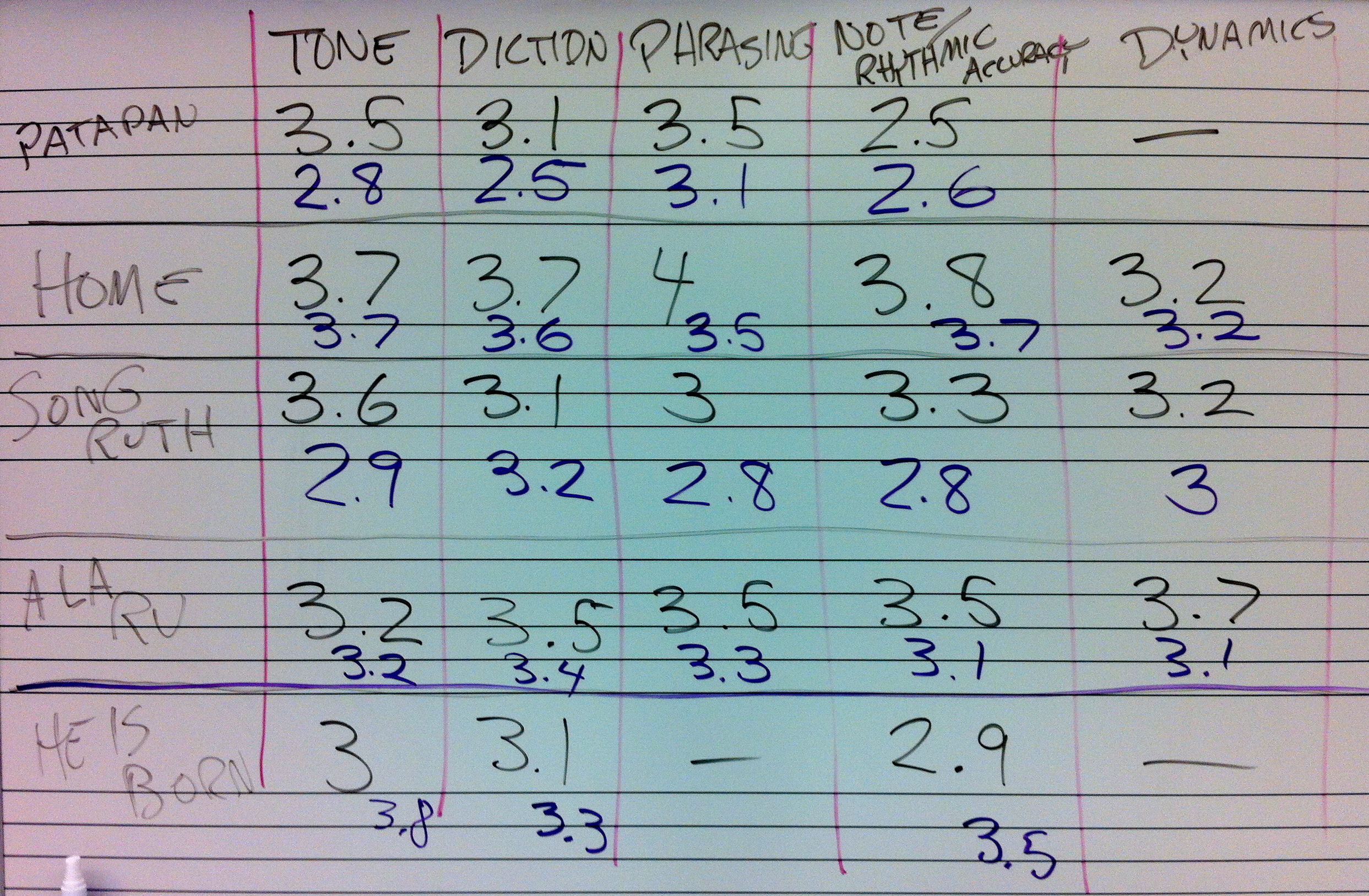
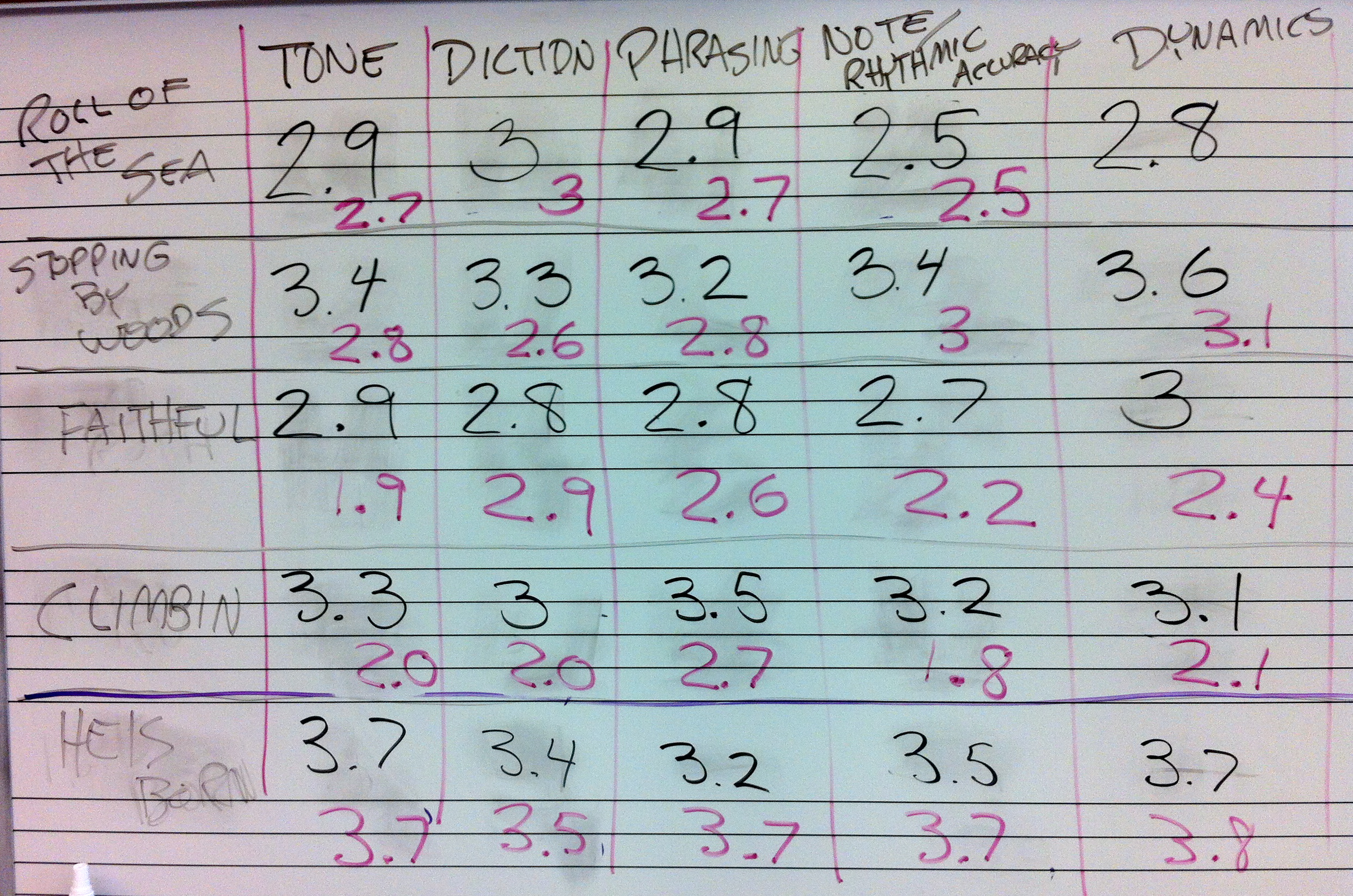
Below are two visual examples of this process from last term, first by my Freshman Treble Choir, and next by my general Chorus. You will note: the column on the left are the selections, the row across the top are the performance standards we were able to give feedback on by listening to the concert recording of each. The black numbers refer to the POST reflection performance (performance #2) and the purple numbers refer to the PRE reflection performance (performance #1) of that same song. The picture is of the white board after the class did an analysis of the second concert, and only after completing the entire board did I THEN add the purple numbers to reveal what their scores were of those same songs after the first concert.

photo 1

FRESHMAN TREBLE CHOIR. The first observation is that the weakest performance indicators for the first concert (purple numbers) were not the same for each song. Diction was the weakest indicator for Patapan, dynamics for Home, phrasing/note accuracy for Song Of Ruth, etc. This was cool for the singers to see, because as directors we know that each selection has its own unique challenges and needs. The kids could see a visual of that (after all, it was their own scores!). It informed the singers that they couldn’t just concentrate more on one overall indicator, they had to apply unique goals for each song.

The next observation is that, post concert #2 (black numbers), 14 of the 22 indicators showed an increased score, 3 stayed the same, and 5 went down. What was really fascinating was the rationale behind the lower scores. In Patapan, I dropped a cue in concert and it led to a very weak entrance on the second page. The kids heard it and commented that it brought the score down (as it should). But it was fascinating to hear them say that, because they did clean up the note issues from the first concert! Instead, they became hyper critical of that one spot on page 2. We discussed that: does one mistake do in the entire indicator for the entire song? Song of Ruth diction –  we focused SO much on tone and phrasing before the second concert (and the scores bore that out), that they felt the diction dissipated a bit. I actually agree with their assessment, but it was worth the trade off. Their phrasing and tone was much better and made that particular selection sparkle (it’s by David Childs… if you don’t know it, check it out). We discussed that: can focussing on one or two components more than others hurt the rest, and is it worth it? Finally, I laughed when they assessed He Is Born after the first concert. I was really unhappy with how it went, but it was a combined piece with the chorus and chamber singers – and singing it in concert was the first time they had ever sung it all together – – – and my Freshman girls were in awe of the male voices! Their scores for He Is Born was subsequently off the charts!!! Too funny…. so we talked about that. And though the second concert was much better for that song, by then the novelty had worn off and the girls had become much more analytical. The scores dipped way down as a result. We discussed THAT too.

Third, I’ve used standards scores exclusively for a few years now and the kids know that the target is always to achieve a “3”. Anything above that is gravy and a nice indication that at times they are exceeding expectations. Even at their most critical, the girls rarely gave scores lower than a 3. They felt that, across the board, using criteria we had spent months working on, they were meeting expectations for each indicator. That was really nice to see because I largely agreed with them. I felt that they were capable of more, but that they were meeting the indicators right where they should have. When they gave  “4” for phrasing in Home, it was because they were blown away by how successful they were and what the effect is when you pull that indicator off with just the right song. I got chills listening to them articulate what we heard in the recording, and I was really, really proud of them for it. They caught the emotional content of the selection and they could identify, from an artistically technical standpoint, why that was the case.

Finally, we can look across indicators and discover general strengths and weaknesses of the ensemble as a whole. The scores for both performances suggest that the Treble Choir strengths (relatively) was tone and phrasing. I’m in agreement with that, and it’s certainly the two indicators I spent the most time trying to develop in 4 months of rehearsals other than notes. Best song for them overall in performance? Clearly it was Home. It was perhaps most age and ability appropriate for them, and it was the earliest song they mastered as well. Would they have been better off with one fewer song and mastering the other three better? A good reflective question I had to ask myself in retrospect.

photo 2

GENERAL CHORUS. Half the singers in this chorus were brand new to singing at the High School, and the other half had sung with me at least one semester before at some point (YHS choruses and treble choirs are semester long classes only). So, unlike the gals, many of them had a prior reference point for YHS concerts and they were very unhappy with the first performance. Notice how low the purple scores are for their 4 songs they performed by themselves: 20 indicator scores overall, and 17 were BELOW a “3”! I really pushed the envelope a bit too much with my programming for them, and consequently they were a good choir in pockets. Depending on the day. And the hour. And the phase of the moon. In other words, they were a young choir that was very inconsistent. What happened the night of the first concert was that they froze up. They knew it too, and noticed the effect of it  in their sound on the recording. The second concert was a different story because instead of being wigged out by their substandard first concert, they brought a remarkable sense of focus to the second concert that kept them on point and worry free. I would argue that focusing on the indicators helped to accomplish that; they were an entirely different chorus the second night.

The next thing I notice here is that their second concert scores underscore the quality of the rehearsal they had after the first reflection. Hands down, no exaggeration, it was their best rehearsal of the term by far. Not even close. They were incredibly focused and driven to patch up the weakest elements. The improvement on some of the indicators was an entire POINT (or more!) in some cases.  Check out the scores for tone and diction in Faithful Over A Few Things and virtually every indicator in Climbin’ Up The Mountain between the two concerts. The latter was an interesting case where we decided that the tempo was just too fast to accomplish what we wanted, so we slowed it way down both in rehearsal and in the second concert to really focus on the indicators more. The results speak for themselves.

Can you tell by the scores the one song we did not work on between the two concerts? We had so many fish that needed to be fried (Sandi Howard humorously calls it “triage”), that one of the songs had to take the hit. I think we merely ran the middle of it once to keep it fresh, but Away From The Roll Of The Sea, while mildly better the second concert, was fundamentally the same performance the second time around. The kids and I talked about that after the second concert: where should attention go with limited time and more to do than time to do it? Did we make the right choice?

He Is Born was that weird event – again – where the kiddos listened with a more critical ear the second time around because, as was the case with the Treble choir, the novelty of having finally sung it with the others had worn off. The scores were close, but consistently lower even though the second performance was superior to the first. We talked about that phenomenon too. It also brought to light for me the need to have at least one rehearsal with combined forces before a concert, even if just once. It was a logistical impossibility for me this time around, but I need to rethink the entire idea if the dress rehearsal for it can’t happen.

In closing, this process was extraordinary because of the depth of conversations the kids and I had around authentic topics that real musicians have about their craft. The mere act of doing so made this entirely worth it by itself; them leaving my program with this level of dialogue is significantly more important than anything else. They have have the rest of their lives to sing again in other choirs (and if I did my part, they will be more motivated to do so), but they only have one shot with me to establish a musician’s foundation on which to build.  That the students also got to see the correlation between focused, directed work on specific indicators in specific songs and the increased musicality that comes as a result, well that just makes it even more lasting an impact, doesn’t it? I go back to that component of the MAAI mission statement, “quality assessment in arts education is an integral part of the work all arts educators do to deepen student learning in the Arts”. I believe Reflective Thinking as applied to multiple concert performances really brought this to life for my students. I know it brought it to life for me.

Posted in Performance, Rehearsal, Standards | 4 Comments

concerts and reflective thinking – part 1

R – I’ve been meaning to write this blog post for over a year now and I’m pretty pumped about finally doing so. Every semester my choirs perform two concerts – the same one replicated over again for a different audience – and each concert is intentionally placed about a week apart from each other. The reason for this is so that we have enough time to have two rehearsals or more between each one. I have utilized a “standards based collective assessment” between the first and second concerts each term and it has quickly become one of the most dynamic components of the entire course (YHS choruses are single semester classes). In essence, incorporating reflective thinking into the concert performances themselves.

Reflective thinking is what we employ daily as music educators. It’s not a new concept to us. Is it even possible to hold a legitimate rehearsal without asking our students to do so? But rt2unfortunately for ensembles, this is largely limited to the rehearsal process. Yes, we can revise our work as the same ensemble performs different concerts during different seasons, but we often don’t revise that same literature. Some do – large group festivals, state and regional jazz events – but we usually don’t get the chance to.

This partial list of reflective thinking characteristics is from the Hawaii University System:

Provide enough wait-time for students to reflect when responding to inquiries.
Provide emotionally supportive environments in the classroom encouraging reevaluation of conclusions.
Prompt reviews of the learning situation, what is known, what is not yet known, and what has been learned.
Prompt students’ reflection by asking questions that seek reasons and evidence.
Provide some explanations to guide students’ thought processes during explorations.
Provide social-learning environments such as those inherent in peer-group works and small group activities to allow students to see other points of view.
Provide reflective journal to write down students’ positions, give reasons to support what they think, show awareness of opposing positions and the weaknesses of their own positions.

A few years ago, I decided to incorporate reflective thinking into my YHS concert season. This is very different from concert critique, because reflective thinking leads back to re-performance (the APPLICATION piece!), critique does not. That is the frustration I always felt with my students critiquing their performances; as valuable as concert critiques are, they do not in and of themselves inherently lead to revision discussions. So this is what I started doing:

After the first concert performance, we listen to the concert recording in class. But before doing so, I write the titles in a column on the left, and the performance standard indicators we have worked on during the term in a row across the top, creating a spreadsheet of sorts. Next, we listen to each song, one at a time. At the conclusion of the first song, the students are not allowed to say a word. Instead, I call out an academic indicator that they are to self assess as a choir. For example, after listening to the first song, I will say the first indicator that I wrote across the top of the white board, such as “tone”. I will then say, “raise your hand if you would score it a ‘1’ (does not meet the standard).” I then do a quick visual of the class and determine a rough estimate of how many raised their hands. I then yell out “2” (partially meets), then “3” (meets), then “4” (exceeds). By the end of this, I have a numeric AVERAGE for that indicator, by that class. So for instance, if no one raises their hands for “1”, three kids raise their hands on “2”, forty kids raise their hands when I say “3” and ten more raise their hands on “4”, I will assign a numeric average of 3.3, give or take a percentage point. It is not at all intended to be overtly scientific, and it is not relevant if I give a 3.3 instead of a 3.4 or a 3.2. What matters is that it reflects an accurate representation of how they felt they did. In the previous example, many more thought it was a “4” than a “2”, but the vast majority identified the score as a 3 for that standard. A 3.3. is justified.

Next, I give the students the opportunity to raise their hand if they have specific feedback they want to give for that indicator on that song. I might call on a bass who says, “The tone was okay but it wasn’t consistent and sometimes the basses sang with too much loft”. It initiates a nice dialogue, especially between those who voted “2” and those who voted “4”.

Now, for the next few minutes, I do the same process in reflection of that same song for the remaining indicators until there is a score underneath every single one for that song, and the class has had a chance to articulate specific feedback for each. At the end, we can see a neat visual of what the strongest and weakest elements were for that selection in concert.

Then, we move on to the next song. I play that recording for them and we repeat the entire process for that song as well. We do this for their entire portion of the concert until the entire board is filled out.

Next, we do a complete visual and collaboratively design the lesson plan for the next chorus rehearsal (the one before the second performance)! For this song, what do we need to shore up the most and how are we going to do that? For the next song, what do we need to work on to bump the lowest scores for that?

The following rehearsal, you’ve never seen a class so self directed and focused on learning targets. They identified the needs themselves, they identified how to address those needs, and the next rehearsal carries through on doing so.

Finally, the second concert performance comes along, the students APPLY what we worked on the last rehearsal, they and I REPEAT this entire process after the concert, and then we compare scores from the two concerts! Next week I’ll show you some pictures of my white board with the spread sheet numbers, the results of the reflective thinking process incorporated into the CONCERT SEASON, and feedback that I get from the students after seeing all this through.

concerts and reflective thinking – part 2

Posted in Etcetera | 4 Comments

epiphany

R – After two and a half years of verbose blog postings, here’s a nice brief one for you! This thought came to me a couple of Wednesdays ago while I was drinking my morning coffee and just waking up:

Rehearsals are where the work of the composers are utilized to elevate the performer. Concerts are where the work of the performers are utilized to elevate the composer.

What do you think?

And the role and reaction of the audience? If the goal is entertainment, the quality of the performers will determine that. If the goal is to showcase an educational product (school choir), the quality of the rehearsals will determine that! If the goal is to elevate the audience, the quality of the literature (in conjunction with the performers’ successful execution to present it the way the composers intended) will determine that.

Hmmmm… I think I just articulated my choral philosophy, my educational philosophy, AND that I am a more coherent thinker when I’m only half awake! 😉

Light-bulb-moment

Posted in Etcetera | 1 Comment

three strikes part 2 (and 3, and 4, and…)

R – “The brick walls are not there to keep us out. The brick walls are there to give us a chance to show how badly we want something” – Randy Pausch. Last week I did my best to articulate what I feel are the three strikes many music educators confront as they begin a new gig. In three strikes part 1 I outlined specific hurdles and challenges that seem to be common threads. But how do you confidently step up to the plate knowing ahead of time that the count is oh and three? This morning I’d like to take a shot at articulating some ideas around how to overcome them. See what you think:

* Have conviction. No great leader went into battle thinking, “I don’t know how this is going to turn out… I don’t even know what I’m doing here.” Ben Zander has a great quote in a presentation he did for a TED lecture: “It is one of the characteristics of a leader that he not doubt for one moment the capacity of the people he’s leading to realize what he’s dreaming.” Have a conviction of purpose. Have a conviction of philosophy (if you were smart, you got that message across in your interview so the school already knows what that philosophy is). Have a conviction of compassion for the kids who you will be serving, regardless of what they think of you. Have a conviction that what you bring is that important. And finally, do all this with a firm conviction that you too will learn much about yourself along the way. Missing one or more of these convictions? Man alive, you are gonna have problems.

Anticipate the problems. What is the history of the program? What are people’s perceptions of it – students, staff, administration, community? What are people expecting? Why are they expecting it? What have past expectations been? What have past expectations NOT been? I didn’t heed this advice when I began at Winnacunnet High School in 1996 and I paid dearly for it. I did heed the advice when I went to York and it saved me. I knew the Hallelujah Chorus tradition at York, I knew the pop music tradition at Bellows Falls. I had battles galore when I got to both places, but they were over making changes that I knew were going to be difficult changes for others to accept. There’s a difference.

* Do your homework first. I would argue that the single most significant variable leading to success or lack thereof in a new job is directly correlated to the prep work done in the weeks and months prior to your very first day in school with kids. And I’m not talking about writing curriculum here. If you have done an adequate job at the previous point I just made, what are you going to do about it? Yes, getting logistically organized – REALLY organized – before the students show up is a good thing. But is there also a letter that needs to be written and sent to them (and their parents) articulating what you will doing and why? In York, I sent a letter to the kids telling their families that the Hallelujah Chorus would be done away with, and I did so prior to school beginning. That didn’t endear me to anyone, but it did successfully accomplish the goal. Are there meetings with administrators – including athletic directors and guidance counselors – that you’ve scheduled so everyone knows where you’re coming from? Summer vacation is only vacation if you allow it to be so. How much time off do you really need, and isn’t the time better spent doing sick amounts of prep work that will pay dividends over and over again as the school year unfolds?

* Be proactive; don’t avoid, confront. Along those lines, if you know someone or some body of people who are going to have a cow over a change you plan on making, anticipate that and bring it to the forefront. But do so with compassion for where others are coming from! I think the error of many teachers ways is to either avoid the conflicts, which merely postpones the inevitable and making things worse in the interim, or going the opposite extreme of confronting others with a chip on their shoulder – which is absolutely as bad. “I don’t like confrontation though.” Neither do I, but if you’re not willing to bring it, you’re in the wrong profession. Listen: loose the chip, get off the rampage, do your homework and approach the situation with a clear head and an engaging demeanor. Center the dialogue around, “this is what will be happening and why”, as opposed to “you need to see things my way.” The town of York has bought in to what Dan Sovetsky’s and my beliefs are around music education, but it didn’t happen by lashing out. It also didn’t happen by not pushing forward and anticipating the pitfalls along the way. There were plenty, but in many cases they were diffused before they could gain traction.

* Be competent in your execution. It really is folly to walk in and tell everyone, “Hey, I know what I’m doing”, and then not. Know what you don’t know and fix it so you do. Know what your weaknesses are and turn them into strengths. My students have affectionately referred to my piano playing as “the claw” over the years, and for good reason. But I couldn’t play when I began my teaching career, and spent hours after school, during the weekends and even on my snow days sitting at the piano in the chorus room learning to play and sight read chord symbols so I could become functional. This is only one small piece of being an adequate rehearsal technician, but it was my biggest weakness and so it received the greatest attention. Within a few years I was playing the entire score for the musicals we did at Bellows Falls. I wasn’t great and I was reading chord symbols, but I became an acceptable accompanist. If you know there’s an achilles heel or two in your execution of your plan, shore them up. Immediately. I was able to withstand a lot from my opening days in my new jobs, primarily because at no point was anyone able to accuse me of being incompetent. They got on me for everything else under the sun, but not for lack of competence. I can live with that.

* Lean on your colleagues. What fun it has been to be there for colleagues across northern New England, and how grateful am I for all the times I’ve been able to lean on others along the way. It makes no sense whatsoever to be going at it alone. Find a colleague or two who can be real mentors and sounding boards and engage them in your work, often! You can either be prideful or effective. Your call.

* Run the marathon, not the sprint. My job at York High School is a teacher’s dream come true in so many ways, musical and otherwise. I could do a lecture on why York High School “gets it”; I could never have dreamed up a job as wonderful as the one I currently have. But after my first semester there in the Fall of 2000, I vividly remember sitting in my mom’s living room at Christmas, telling my brother Glen that moving to York High School was the biggest mistake of my career. There’s no way – no way – I saw coming what has transpired at York in the last 14 years. And I guess that’s my point. If you judge your success or failure on a small sample size, you’ll get a flawed answer. You really have to take a mindset that says the journey is twice the fun. It’s also the point. And if the journey is carried out capably, honoring your goals and philosophies about what needs to be done and why, the destination will always take care of itself. I have a firm conviction about that.

* Stay the course.  I hesitate to put this point in here because it just sounds so trite. But it’s an essential piece. I mentioned last week the letter that I received from my chorus a few weeks into my very first job, threatening to drop the class if I didn’t change the music in their folders (it was too religious). I responded by not backing down. The next class I went through song by song with them why I educationally selected each title. Then I DID apologize for the for the amount of sacred music in their folders: it was 50% sacred and I told them that since 70% of all choral music was sacred, I was selling them short – but to please bear with me, and I’d see if I could add a little bit more as the semester went on. OOooohhh, they were mad! End result? Two kids dropped the class, and three others joined when they heard there was a choral director who was willing to stand up to them. Removing the Hallelujah Chorus from York? I removed it, began presenting annual masterworks with the Chamber Singers, eliminated the pop music culture, and within 3 years our audiences quadrupled. Stay the course, you won’t regret it.

* Celebrate the victories. Little by little, there will be victories. Share and celebrate them. The kids just sight read for the first time? Show them how excited you are. The concert went well, gush over it. You successfully implemented a policy that supports the direction you’re bring the program? Call your mentor colleague(s) and share it. Trust me on this, the peak experiences can be few when starting a new gig somewhere, and taking in the scenery from even a few hilltops from time to time can be enough fuel to get you through a lot more.

* Look beyond what you see. How’s that for a metaphysical point?!? All I mean by this is that you have a perception of how things are going and what people are thinking. More often that not, you’re completely wrong. A couple of years ago, I got a phone call from a first year teacher I had been mentoring the first Friday night of June, and she was crying. Obviously concerned, I waited for her to calm down and tell me what happened. Well, wouldn’t you know that all those Seniors (and their parents) she thought hated her were gushing over her at their final Senior event and telling her what a positive difference she made in all their lives. Pouring out of her came ten months of pent up frustration and worry and belief that she had been failing all this time! One thing holds true: people will tend to be vocal in their criticisms, but will hold their compliments close to the vest until the right time comes along… I’m not suggesting that’s a good thing, just making note of how it is. If you’re looking for affirmation in the process of establishing your program, don’t waste your time. That doesn’t mean however that it isn’t being affirmed. Drop the apple seeds and just trust that some of them are starting to take. If you don’t see a tree springing up immediately or even over a period of time, that doesn’t mean it hasn’t taken root.

* Keep moving, don’t loose your focus. Using a baseball analogy, Johnny Bench is a Hall of Fame catcher from the 1970’s, one of the greatest ever. But in the 1972 World Series, with three balls and two strikes on him and first base open, Manager Dick Williams went to the mound to tell his pitcher to intentionally walk him. The catcher stood up, held the glove well outside and the pitcher pitched: a strike over the corner of the plate for strike three. Bench had been fooled into thinking he was going to be given a free pass and he fell for it. Moral of the story, if you think you’ve slayed your dragons and it’s clear sailing ahead, let your guard down at your own peril. It will also be easy to loose sight of your fundamental principles that you were building everything on to begin with. Don’t. Keep reminding yourself of your philosophical pinnings, and keep all your actions and decisions flowing from those.

* Love. Your. Kids. If you stop doing this, you’ve lost the battle. I already articulated that caring for them regardless of how they treat you is a must. Don’t forget at any point that THEY are the reason you are there, and every one of them deserve your faith and love and support. My first year at Winnacunnet, I had a Senior in chorus by the name of Nick, who was a football player (his 6 other football player friends dropped after 1 week with me – I’m not kidding) and set out to destroy any attempt on my part to run a functional rehearsal. It would have been so easy to begin wishing this kid would just go away. But there’s a key that unlocks every student… and if you care about them, you’ll be looking for it. With Nick, it became so commonplace for me to tell him to “be quiet” or stop fooling around, that one day I just made a big sign that said, “NICK, EYES ON ME/PLEASE BE QUIET” in an attempt to use humor. I taped it to the front of the rehearsal piano. That next rehearsal, every 5 minutes I stopped what I was doing to address Nick’s behavior, as always. But now, each time I did so, I smiled a big goofy grin and simply pointed to the sign. The kids LOVED it, and it even made Nick laugh. It wasn’t long after that when Nick started to work as hard as the others. He realized that no matter what, I enjoyed having him in class and I took the time to value him. The others saw that too. That Spring, he was one of the 16 seniors who skipped a portion of their own senior skip day to attend our chorus rehearsal in preparation for the upcoming concert. He also reamed out the one senior who didn’t show up when he saw her the next day. Anybody can love the “good” kids… but are you willing to love all of them? If you are, you’ll discover that they are ALL “good” – and you’ll gradually unlock in them what you went to that school to do in the first place.

To conclude, here’s the deal: the sailboat traveling from New York to England does not do so in a straight line. Wind direction, ocean currents and weather considerations play a role in the exact course. But at no point does the person at the helm say, “Gee, this trip isn’t going so well, I think I’ll just head for Argentina.” For anyone starting a new job, remember this analogy. You’ve gone in there with a plan, stay with it. There will be twists and turns along the way, that’s to be expected. To extend the analogy however, tacking is not the same thing as changing direction. To the outsider looking in, they may appear to be the same thing, but they are not. One will lead you to where you want to go, the other won’t. Don’t forget that. And once you’ve done so over time? The Randy Pausch quote that started this blog post continues with the line, “Because the brick walls are there to stop the people who don’t want it badly enough.” Over the course of time, each one of us will discover if we “want it badly enough” at our current teaching jobs. To reference Stephen Sondhem, there is an art to making art, and it is our job to engage ourselves fully in that art – physically, emotionally, cognitively. The price of doing so is high but offers its own extraordinary rewards. If we reach a point after having authentically done so where we decide it is not worth the fight anymore, that is a very legitimate choice to make. But lets not start off by believing that beginning with three strikes means impending doom. Go after it with your eyes wide open, stay true to at least some of these fundamental suggestions, and love the process of being a teacher in this amazing profession.

“My own heroes are the dreamers, those men and women who tried to make the world a better place than when they found it, whether in small ways or great ones. Some succeeded, some failed, most had mixed results… but it is the effort that’s heroic, as I see it. Win or lose, I admire those who fight the good fight.” – George R.R. Martin

No3strikes

Posted in Etcetera, Music is work | 1 Comment