three strikes part 1

R – One of the great joys of my life is catching up with alumni who have moved on and begun their adult lives. Over vacation I had a chance to sit down with one of my alum who is also a first year music teacher, and she was sharing war stories of her experience to this point. There are threads to her year so far that are painfully familiar to me, having experienced them myself and seen other music teachers go through the same thing in their first year in a new job. The overarching concern I have is that new music teachers are by and large set up for failure before they even begin. Not always, and not often in ways that can’t be overcome and turned around, but set up for failure just the same. Here are the three strikes that music teachers have on them before they even step up to the plate in a new job setting:

strike #1) There’s no set definition of what music education should look like. My alumni was telling me that her mentor teacher (a science teacher) told her before school began how amazing the chorus was and how she had such big shoes to fill from her predecessor. She got in there and lo and behold, the kids had no idea how to read music, had never sung 4 part harmony before (they struggled mightily at 2 part – – – this is at a High School by the way), had NO idea of tone, and routinely had their problems fixed by having their accompanist play louder. This was “the big shoes” she had to fill? And this scenario is remarkably common. The problem is significantly greater than the fact the program was a sham: the bigger issue is that it was accepted as what music education was supposed to be. The pointy little apex of the problem is that incompetence in music education is rarely viewed as such; nobody knows any better to call it out, or the problem is viewed as a lack of talent on the students’ part. Other academic subjects can track their teachers through performance standards, and often do. Matter of fact, this is now being implemented formally across the country. Music? “I went to the concert last night and the kids were ADORABLE! What a great job that teacher is doing with them!!!”

ugh.

Issues of competence aside, go into any 5 schools of the same grade range in Maine. Take a peek inside their classrooms and tell me if I’m wrong here… every English class is fundamentally identical. In curriculum and content and perhaps even delivery. Math and Science? Even more so. Music? You can’t get more diverse. Scheduling, staffing, pull out programs (I always laugh when I hear of pull outs being eliminated due to the “academic” teachers throwing a fit – it must be awful having students pulled from your classes from time to time to do other things… music teachers have no idea what that must feel like), concert expectations… none of this is set in stone in Maine. And precious few administrators know what should be happening in the music classroom. Consequently, music education is perceived as a rather subjective endeavor with subjective outcomes. Which leads me to my next strike.

strike # 2) Communities have a preconceived notion of what music education should be.  “Hi, nice to meet you, we’d like to hire you to teach a subject that is completely subjective, but we’ll question anything you do that we don’t like. You know, since you’re just making it up as you go anyway. And we already know what we want from the program.” Yeah, good luck with that. Strike two is a pretty brutal reality for many music teachers in their first year at a new gig. When an incompetent music teacher does their damage before moving on, they’ve established a “norm” that the new teacher coming in has to eradicate. But for the more normal scenario of a new teacher coming in to replace someone who did a good job, perhaps the dilemma is even bigger. “You can’t do it that way, ______ did it this way instead and it was awesome!” My alumni was talking to me about how she is battling this very problem with regard to class policies on academic expectations and attendance. My first year at York I was easily the most disliked person around, for a variety of reasons. Not the least of these was that I eliminated the traditional audience sing-along of the Hallelujah Chorus due to the small, inconsequential detail that it turns High School sopranos and tenors vocal folds into shredded wheat. I wasn’t “allowed” to make this change in the mind of the community though, because it was an essential part of the program. I had one person tell me that people would stop coming to the concerts if they couldn’t sing it! And administrators? If I had a nickel for every elementary or middle school teacher who has told me stories about their administrator making it clear to them that the role of music class is to provide the other teachers’ prep time. I had one colleague last year at a Middle School tell me about an initiative that the administrator there asked the staff to undertake. She did so and found a way to implement it to a high, successful degree! She went to the administrator to tell him about it and was told, “Yeah, but, I wasn’t talking about your classes, I was talking about the academic classes.” Alrightythen. Sound familiar? Preconceived notion of what the music education program is or isn’t? Now, to make things even worse, this second strike is tied in closely to the perception that the music program is personality driven. And unfortunately, there is a lot of truth to that, and this leads me to strike three.

strike # 3) Students have a preconceived notion of what music education should be. Students’ involvement in music beyond 4th or 5th grade is based largely on how much they like doing so (and the other academic subjects whine because of pullout programs?!?!). If the student likes the teacher, they’ll stick with it. If they don’t like the teacher, it becomes more of a problem. But the problem is even worse than that. Students often arrive in school with a preconceived idea that music is fun, they know what they like, and the music program’s job is to perpetuate both. I would argue that this point is compounded in choral music. Instrumentalists inherently understand that they need to practice their instrument in order to improve; an accepted rigor component. But singers just “like to sing”. I’ve written before on this blog: music class academic rigor = co-curricular activity. Music class + academic rigor = academic subject. Students do not instinctively view music as academic, and there’s the rub. Take 3 strikesout the academic rigor, and you’ve got the kids. Add the academic rigor, and all of the sudden the kids either dislike music or think the teacher is mean or that they’re “being told what to like”. On top of all this, students don’t like change – they like what they already know and are used to. My predecessor at York changed the name of “Select Choir” to “Chamber Singers”. She was raked over the coals for that! My first month at York, one of my Chamber Singers raised her hand as I was attempting to rehearse and said, “Excuse me, but we won’t sing music until you play it for us first”. This was the auditioned ensemble, mind you. Many of my students over the years have heard of the love letter I received from my very first choir in Vermont three weeks into the job telling me that if I didn’t change the music in their folders they were all going to quit… “and we’re not kidding!” This third strike is the one that virtually every new music teacher will have to confront on a weekly if not daily basis. Sometimes it’s in the form of passive aggressive behavior, sometimes it’s overt lashing back (my first two weeks at Winnacunnet High School in 1996 was World War III…. and you can ask any of those alumni if I’m over-exaggerating here). But at every turn, there’s going to be push-back in some form.
This blog post is intentionally being written in two parts for a reason. I believe that these three strikes are very real and very daunting. I hear and read all the time how my colleagues battle each of them in many different guises and variations on a regular basis. But the second part of this blog post will be to talk about strategies in addressing and overcoming them. That will be a fun one to write!

three strikes, part two

Posted in Etcetera | 3 Comments

new years resolutions

R – Tis the season for New Year’s resolutions, right? So here are my top ten music teacher resolutions for 2014. Here we go!

10) remember that process is more important, and more fun, than product

9) be less weird be more weird

8) try and maintain even half the enthusiasm and energy and initiative that the newer teachers are bringing to this profession

7) get out of my room more often

6) don’t loose the “balance” to my life that I’ve worked so hard to achieve

5) stop trying to push my ensembles beyond what they are actually capable of doing (and paying dearly for it), but keep pushing them beyond what they think they are capable of doing and what I know they are capable of doing

4) practice piano more often

3) convince myself, for once and for all, that “coffee” is not a food group

2) don’t get overwhelmed, just stay organized

1) remember that no matter how fortunate I’ve been so far in my career to have “peak” experiences with my past and present students, I’ve achieved none yet with my future students – – – and I owe them at least the same opportunities

Happy New Year!

happy-new-year-la-12-21-11

Posted in Etcetera | Leave a comment

letters from marv, part 2

R – Here is the second set of excerpts from of a set of articles I published just over 20 years ago for the Vermont Choral Directors association. In part 1 I gave some background on Marv and his impact on me as a 230682_1051560643644_3853_nsignificant mentor in my career. To this day, Marv has strong feelings and opinions on all elements of the choral art. But his perspectives come from years of working with Robert Shaw and Norman Luboff among others, as well as conducting his own professional choirs along the way. Here are some more snippets of his thoughts and writings through the years.

Letters From Marv – part 2

* (as a result of rehearsing together) I’m hopeful all of us are much more, as human beings, than what we were back in January.

* problems of intonation comes from just singing notes—not content. When you sing content, you understand “what” you are singing about—you understand “why” you are singing what you are singing.

* If the singers cannot take personal pride in his/her individual preparation of the music, then how in hell do we expect them to bring otherwise to the collective preparation for performance?

* Content——line——–emotional aesthetic, collective consciousness, terrace dynamics, breathing, vocal phonology… harmonic rhythm… pulse, rhythm, articulation within the line…… resonators…. phrase endings and phrase beginnings….. emotional pauses….. SO much to talk to those singers about…

* Why are we singing? Once answered then the collolary questions are, Are we singing? Are we singing?

* In a few days, you will be asked, through my conducting, to create, anew, variations of those elements of music that can bring about a revealing musical expression…and a rewarding musical experience—for you as performer and listener, and our listening audience. I submit to you that the art of re-creation is the most exciting temporal art this writer knows. Each of us has been involved in that penultimate moment of performance which is truly unique. And although we’ve sung our music over and over again, at that very moment of performance, it has a uniqueness all its own. Do we ever ask why? Do we just expect the usual obligatory score reading? I THINK NOT!

* I not only want to work with singers who have great personalities, but singers who also have great intellect, because I approach singers from a psycho-philosophical point of view. When I say to a group, ‘The notes are already in this room; all we need to do is join them”, I need singers who have some cognitive ability to grasp some of that idea.

* If a singers does not believe in the fundamental integrity of a song, then that singer is “in the way” of the communicative process. We get out of the way by understanding our role as COMMUNICATORS! We have to be the mind of the music. We have to be the composer.

* I submit to you that all of music is an attempt at communication between human hearts and minds-bringing performer and audience together. It is essentially a time that does not differentiate us, but a time which integrates us; it is a time which does not divide us but rather a time which identifies us. In essence, it is MANKIND-coming together to reaffirm its humanity as a collective—socially, intellectually, artistically, and religiously.

* When we sing fortes it must be for a reason. We don’t do it because there is an “ff” on the page. We must do it because of why the composer put it there, in context with the words we are singing at that time.; in context to what has been sung previous to that moment, and to what will be sung after that moment. Do you understand what I mean? (smile)

* These young singers have to walk off the stage feeling that they have given the audience a musically revealing and rewarding choral experience.

* I believe only one thing ever counts: the acquisition of perfection. Nothing less than that is worth our trouble. Sure—it’s good to get together to sing for fun. But offering 90% or 95% of ourselves is NO accomplishment and NO happy memory.

* Music is great not because some self-appointed personalities decree it be so, but rather because it calls out to that some thing deep and persistent at the human thing; music is great because it carries that some thing so native and true to the human spirit—and not even the sophisticated intellect can deny nor destroy its miracle.

Posted in Etcetera, Performance, Programming, Rehearsal | Leave a comment

letters from marv, part 1

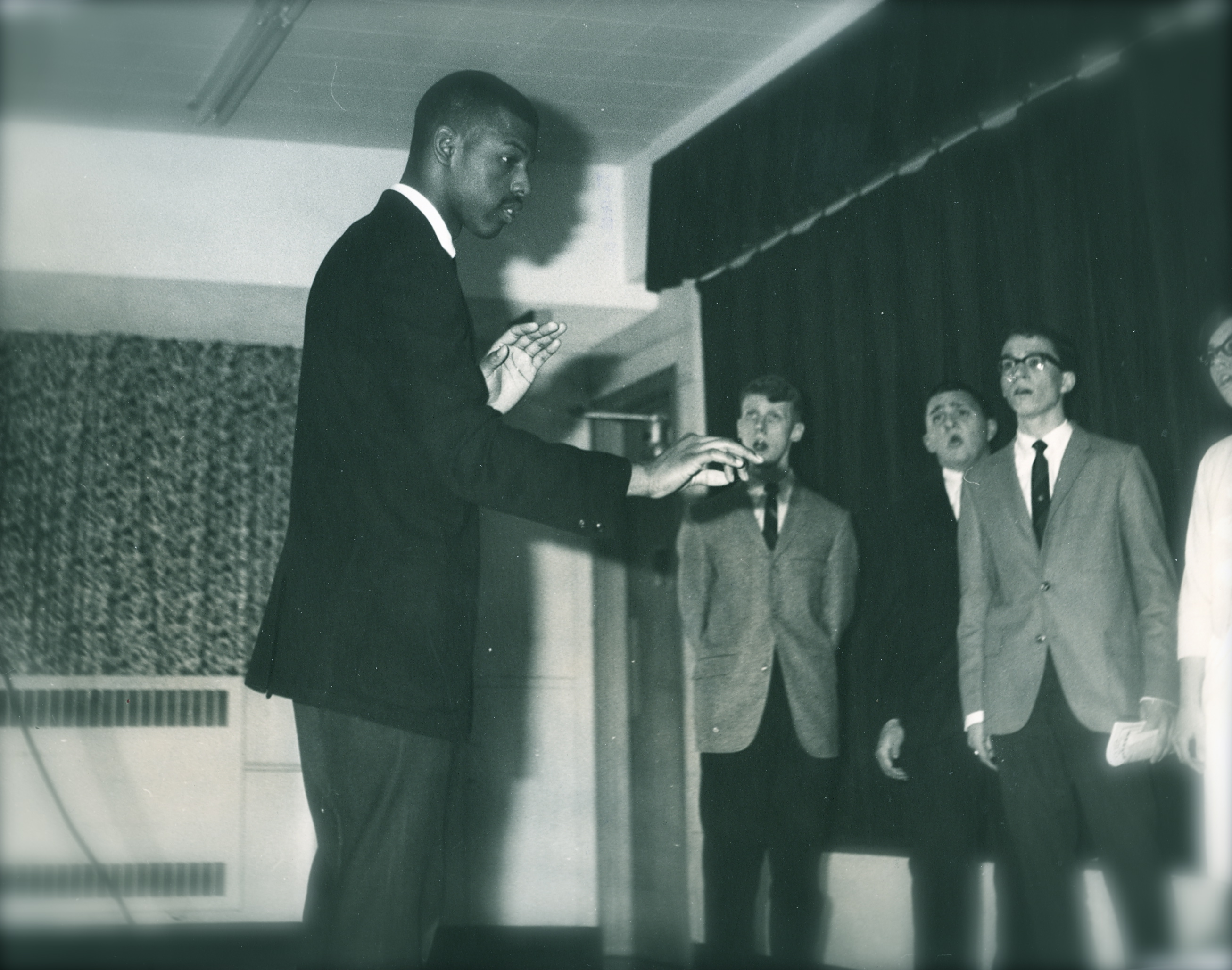
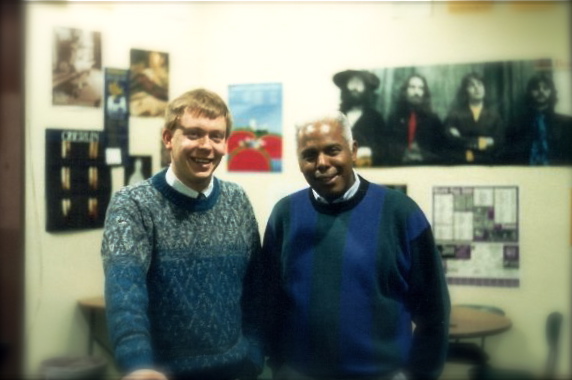
R – Everybody needs (deserves) a mentor. I’ve had several who helped mold me into the director I am today. But when I began my career as a choral director, I found an amazing one; someone who challenged me intellectually and questioned everything I did. His name was Marv Crawford. Long before I met him, he sang with the Robert Shaw Chorale, studied choral music with an intensity I had not encountered before or since, and formed several choral groups known as the “Marv Crawford Singers” out in the Ann Arbor, Michigan area. In short, he has spent his entire live sc0252d845living and breathing choral music. When I tell you that he pretty much owned every professional choral recording that was released in the 1950’s and 60’s, I’m telling you everything you need to know. And he knew them! Inside and out. As an undergraduate in the mid 1980’s, I met Marv when he visited Keene and decided to stick around for a few months. We became fast friends and he took me under his wing. What followed has been 25+ years of learning from a master.

The turning point in my thinking around choral music happened when he was visiting me out in Vermont one Fall, I believe 1991. He had been trying to get through to me for a few years that original interpretation by the conductor was at the core of how the ensemble sounded. I couldn’t get past, “well, this is what the music says to do and these are my singers doing it!” So, listening to some choral recordings in my living room he brought east with him, he set me up. He said, “Okay hot-shot, I’m going to play 10 minutes of music and then I’m going to ask you one thing about it that you must answer. Think you can handle that?” Sure I was! He dropped the needle on this record and for 10 minutes and I listened attentively. He didn’t tell me the name of the piece or anything about it. I was supposed to listen. Well, I analyzed the entrances, the tempo, the nuances, everything I knew how to do. At the end of the ten minutes he took the needle off, sat back in his chair and said, “I’ve not only sung under this conductor before, I’ve prepared this very song under his direction. I’ve played you MORE than enough for you to answer this one question: what is this director’s choral philosophy?”

~Doh~

And my education began 🙂 What followed the rest of the visit was hours upon hours discussing the choral philosophy of Shaw, Luboff, Wagner, David Thorsen, Howard Swan. I’ve never heard choral music the same way since, and I’ve never prepared choral music the same way since.

In the early 1990’s I was the editor for the Vermont state ACDA newsletter and I wrote a couple of articles entitled, “Letters From Marv”. He wrote volumes to me on his thoughts and beliefs around choral music (rarely was one of his letters shorter than 6 or 7 pages long) and praising and chastising me in equal measure in response to recordings I sent him of my own choirs. I recently came across some edits of those articles, and below is a readers digest version of the articles and of Marv’s writings. Agree or disagree, he always made me think. I believe we can always use a little more of someone asking that of all of us. Enjoy.

Letters From Marv – part 1

* Vowel coloration is what gives the music its emotional content.

* Can’t wait to talk to the singers about phrase beginnings and phrase endings!

* We will NOT be “chorally cute”—singing loud because we can sing loud, or pausing just for the sake of pausing, or singing rubato because we can do it WELL. For well over 20 years now, I have sat in on rehearsals, choral festivals and concerts only to be perplexed as to why? Few seem to understand the difference between that and Robert Shaw taking a simply arranged folk song and singing with such musicality and intelligence, you’d think he had prepared, “His Yoke Is Easy” from Handel’s Messiah. Singing good music and being chorally cute does not make you a good choir. These are the differences between choirs that sing “music” and choirs that sing musically.

* The tone must reflect the emotion we want to share; the disposition of the mind as it relates to what we are trying to communicate.

* Study your video tapes from school, Rob—notice your conducting. Very vertical! Yes? (smile) You must sing some polyphonic music next year! You must develop the “long line”, YES? (smile)

* Words are always CLEAR EXPRESSIONS of MEANING, rather than simply vehicles for vocal sonorities. Too often, choral directors forget this.

* Once you understand what the words mean, in context, you will discover a flow—a poetic flow. And from that flow you will discover TEMPO and gradations of that tempo. Once you begin to speak the words, you’ll also begin building phonetic speach which, in turn, builds rhythmic speach that gives singing vitality and bite. When ALL singers feel the SMALL units of beat, together, then, and not until then will there EVER be an EXCITING ensemble. It is not enough to make pretty sounds in time and space!!! It is the obligation of the choral musician to make pretty good sense as well.

* We don’t have to sing hooty “ohs” nor raspy “ees” (as I have heard unendingly when I attend choral festivals) to make ourselves understood.

* Intensity? Our “ff”s are sung with intensity and weight because they have focus and coloration, in terms of context. How loud you can sing means nothing. Intensity? Bach wrote some of his finest music for two great human beings. I’ve experienced some of my greatest “ff”s in passages that called for 90 great singers singing “pp”s at the same time. You understand what I’m saying here? (smile)

* So we must choose our music carefully—with definite goals in mind for each selection.

* I think we have selected music in which the singers can take individual pride in preparing and collective pride in performing.

* Yes, we should select music from an educational point of view—but how about an emotional point of view as well; how about an enjoyable point of view too?

* I have some different opinions (from the “norm”) relative to programming and how a program should be presented. Many choral directors feel you begin with the early century music and bring your audience into the 20th century—ending with a spiritual to ensure the audience will “come to its feet” with a “standing” bravo. Relative to what we’re attempting to do, I feel a sacred composition should end the entire program. I really like Britten’s “Jubilate Deo” as an excellent selection. Why? It has rhythmic energy, it has a recurring melodic statement, the dissonance is ample enough, it has ABA form, good unison and range, and it says something religiously different than our per usual ecclesiastical rah, rahs.

* Get yourself a spiritual (or two) that would require some serious psychological implications rather than the “happy Slave spirit” songs we usually hear at many festivals.

* So what does Rob Westerberg want to say about the vocal and choral arts through his philosophy? Will a master composer be amongst the chosen literature? And will that master piece of music, if included, be from a masterwork? What do you want these kids to take home—that Mr. Westerberg was “awesome” or, “we sung the hell out of that music… with Mr. Westerberg?”

* (lousy) performances are the reflection of a poor conductor or one who just doesn’t understand fundamentals. It’s like a football team—either the line can block and tackle or it can’t. And that line IS fundamental to a successful season. Vince Lombardi – blocking and tackling: Fundamental. Shula – blocking and tackling: Fundamental. Patriots – blocking and tackling: Fundamental. Singing in tune: Fundamental! Rhythmic precision: Fundamental! Clarity of words: Essential! Unison singing!! Essential!! Conductors without techniques or concepts to ensure all of this is learned, one will hear a piss poor performance. Enough!!! (smile)

Posted in Etcetera, Performance, Programming, Rehearsal | 1 Comment

the case for letter grades(?)

R – Jacob Shore is a literature Professor at Wagner College in New York. I came across an article he wrote for globalpost.com, in which he carries the argument that letter grades should not be banned in schools. My rebuttal is the topic for this weekend’s post. I will preface this all with the following statement: none of what I’m about to say means I’m “right” and he’s “wrong”. I also don’t claim to know more about education and assessment than Mr. Shore. As a matter of fact, I’m sure I don’t. The only point to this post is that I respectfully disagree with him on this topic, and in doing so I’m going to articulate why. Mr Shore’s article is in black, my comments are in blue.

Why School Letter Grades Should Not Be Banned From Schools

by Jake Shore, Demand Media

  • For the vast majority of educational systems, whether it’s K-12, higher education or anything in between, letter grades are the accepted means of assessing a student’s place in the context of a class, institution or the educational system at large. Even though letter grades have been and continue to be utilized by a great number of educational institutions, there is a lingering question about their value and efficiency. By examining the positive ramifications of letter grades, it becomes evident that letter grades should not be banned from schools.

Competition

Letter grades form a system for students to compete with each other in a way that’s healthy and positive. At the core of students competing for the best grade is the search and desire for knowledge. With all due respect, this is theory and not practice. The goal of the vast majority of students today is not “learning”, it’s “higher grades”. If that wasn’t true, no one, ever, would cheat on an assessment. No one. They’d never WANT to cheat! “That would be a misrepresenting what I actually know!” Riiiggghht….do YOU know more than a few students you have EVER worked with who think that way? Me neither. Competition has it’s place, but it ain’t here. Are we trying to perpetuate the understanding that education is it’s own reward; being able to meet essential standards multiple times over the course of a semester, or are we perpetuating just getting “better grades”? Each new assignment offers an opportunity to attain the highest grade, and the thirst for such an achievement is tied intimately to the desire for learning and broadening one’s perspective. You tell me: does this sound like YOUR students?

Goals

Letter grades make it easy and practical for a student to set and chase goals. By examining a teacher’s feedback, following directions and working hard, students are not only able to track their progress by identifying gained knowledge, but are able to see their grades getting higher. That’s right Sarah, if you work hard enough you can elevate your grade from a “D” to a “B”… an “A” is out of the question of course because you blew it the first few weeks of class.” Woot. Really? And since teachers who give grades do not allow their students to re-take each exam –  multiple times if the student wishes – and “count” only the best one, the student knows that thorough understanding of the material they missed the first time is irrelevant because they now can only get things up to a B anyway… and that’s if they’re perfect the rest of the way, which isn’t likely because they already got a “D”! Standards scores are intentionally fluid, Grade scores are intentionally static and permanent (“…how can we determine class rank if we don’t?”). Which of the two authentically fosters students to meet our academic goals for them? The formation of a goal and the desire to achieve it doesn’t only help students grow within their educational institution, but is a lesson that they can use long after graduation. “The desire to achieve it”… my students have so much going on in their lives with co-curricular activities and jobs and family obligations that they don’t have time to start their homework until 9:00 at night half the time. My students ROUTINELY tell me how they stayed up til 1:00 in the morning doing their essay on a book they only read two thirds of. Their “GOAL” at midnight was not to “learn”, it was to finish! “It’s okay if I don’t do well on this, the quizes will bring my grade up.” (their words folks, not mine) So the lesson they learn and apply long after graduation? “It doesn’t matter if I know it, just so long as I look like I know it.”

AND IF I HAD A DOLLAR BILL FOR EVERY TIME I HEARD A SECOND SEMESTER SENIOR TELL ME, “GRADES DON’T MATTER ANYMORE BECAUSE I’VE ALREADY BEEN ACCEPTED INTO COLLEGE”, I’D BE WRITING THIS BLOG POST FROM MY VACATION HOME IN CANCUN!

Motivation

Despite the fact that many parents hope their child will enter an educational institution and strive for excellence, many students aren’t as concerned with what they are able to get out of their school experience (I thought “competition” and “goals” had already prevented this?). For students who aren’t motivated, low grades can provide a significant wake-up call. If a middle school student receives a D on a report card, it could be the motivating factor to pay attention in class and get homework done. If this was true, why would parents have to use external punitive measures? Aren’t students already inherently motivated by poor grades??? I have never – not once in 26 years of teaching – heard a student ever tell me they were motivated to learn the material they had just assessed poorly on…. until I transitioned to standards. But before then, for 26 years? “Yeah Berg, I’ll try to do better from now on.” Oy.

Justification

In addition to the reasons why grades are positive for students, teachers also benefit greatly because of the system. The letter-grading system provides teachers with a concrete and efficient way of evaluating students. Please read my blog post from last week. Oh, sure, it ABSOLUTELY provides the “efficient” part alright… divide how much correct by how much possible and type it in powerschool underneath “Vocab quiz #7”. The problem is that letter grades also provide the APPEARANCE that students have been “concretely” evaluated. They don’t actually tell you how, or even what. Whether it’s quizzes, tests, midterms, finals or group projects, the letter-grading system offers an organizational method that’s been proven to be effective. The justification of grading is to offer an effective organizational method even though it’s blatantly vague and subjective? I thought it was to accurately report student understanding and proficiency?!?!?? 

This great picture of the grade yelling for help comes from a blog post from Kent State University which stated advice from teachers how to properly gallery_bad-grades_galleryhandle bad grades. These are, 1) “Ask yourself if you really deserve an above average grade for the work you turned in” to which I say, define “average”, and 2) “Talk with your teacher about why you received the grade.”

If you even have to ask why you got a certain grade, you are making my point for me.

Bottom line: the case for letter grades still  looks as solid as a big ol’ piece of swiss cheese to me and I have yet to be swayed. Apparently I’m not alone:

 http://www.debate.org/opinions/should-letter-grades-be-eliminated

Posted in Assessment, Standards | 3 Comments

letter grades: the big farce

Rwarning, lunatic ahead. If you don’t want to read a rant by someone certifiably crazy, please close this window of your internet browser now before you read any more and get sucked in. Or at least read it through a pinhole box.

One of the reasons I seem to find myself happily writing about standards based assessment all the time on this blog is because it helps me keep my mind off of a negative: letter grades. I think I’ve finally hit the breaking point of my tolerance for them. The problem is that the further I move away from them, the more of a righteous sham they appear to be.

The biennial Maine Arts Assessment Conference occurred this week with over two hundred attendees driving to Orono, Maine to take in workshops by over 30 teacher leaders – fellow colleagues – who have immersed themselves in arts assessment. It was astounding to see and hear how many arts teachers routinely utilize standards in their classrooms. As recently as two and a half years ago, the leadership of the Maine Arts Assessment Initiative had some very pointed discussions over whether or not we could even DARE to use the word “assessment” in the title of our state conference; in the Winter and Spring of 2011, it was still largely considered the dirty word. And while I still hear concerns and criticisms about standards based assessment from time to time, the  difference now is that those who swear by them are beginning to outnumber the ones who avoid using them. But it goes deeper than that. They too are viewing letter grades with a wary eye. And the “a-ha” moment stories about letter grade inadequacies are growing. Here’s a smattering of my realizations about grades over the past 6 years since I first began implementing standards in my work at York.

Grades are irrelevant. Steve gets a 90% on the 5 paragraph essay assignment. Joe gets a 78% and Zach got a 64%. Question: whose spelling was best? Whose use of conventions was spot on? Who is able to compose that essay seamlessly in the 5 paragraph essay format that was requested? Wanna guess? That’s my point: all you can DO is guess. The parent doesn’t know what “Essay #4: 87%” means. And I bet you all my Tom Seaver baseball cards that one month later, neither does the student. And I’ll bet you all my Carl Yastrzemski cards that two months later, neither does the photoTEACHER. The reason I use this example is because I assign a 5 paragraph essay to 200 teenagers each year, scored with English department criteria. Until I went to standards, this is precisely how I assessed them (and trust me on this, precisely how long we remembered what the grades meant!). When I went to standards based reporting, everything changed. Zach’s spelling and use of conventions was immaculate. But he didn’t actually stay with the writing prompt that was given. Steve wrote the most amazing essay and made me so proud with how articulate he was on the given topic. Best one I read all year. And he didn’t go two sentences without a spelling or punctuation error. When I went to standards based reporting, he was referred to his English teacher for remedial assistance. Standards: Steve, there are some foundational things you need to work out before you can really move on in High School and beyond. Grades: great work Steve, you just made honor roll!!!

Grades draw attention to a “bell curve”. Grades tell you how a student measures up against other students. Standards tell you what a student knows and to what degree they know it. But we live in a culture where it is more important to have winners (valedictorians), runner-ups (salutatorians), lesser winners (honors students) and not so much winners (“but-at-least-you-got-your-diploma” and did particularly well in a class or two that you found interesting or enjoyed). Consequently, it would be unfathomable to have an educational climate where the diploma and graduation meant, concretely and merely, that every student had demonstrated proficiency in every single essential standard of every single subject area. Wow. That would be pretty awful….

Grades are static. You enter a grade in your grade book, it’s there forever (unless, of course, for some teachers, it’s the lowest grade – in which case it simply “disappears” at the end of the term… keep reading). It means that understanding on time is what’s primarily valued. Have you ever heard of a quiz grade being eliminated a month later because someone took that same quiz again and scored higher the second time around? That’s because in GradeWorld, it’s called “cheating”, or “playing” the teacher… or rewarding laziness. Or something. You know what it is in StandardsWorld? Learning. Student demonstration of academic content (not to mention growth!). Man, I really hate grades.

Grades have always been a problem. If grades have always “worked”, then why are our schools in such trouble academically? Why “A Nation At Risk”? Why “No Child Left Untested Behind”? Why “Common Core”? Did it ever dawn on anyone that holding students accountable to the specific learning targets we want them to know and be able to do would result in student knowledge and understanding of the specific learning targets we want them to know and be able to do? That really requires a membership in MENSA or a last name of “Marzano” to understand???

Grades bypass actual learning. Let’s look at this from a specific example that every teacher confronts: the “lowest grade” as it translates to the overall grade. Maybe the lowest quiz grade, test grade, whatever. The lowest grade. How do teachers view it? If a student gets a 64% on a quiz, but gets all 90’s on the remainder, the overall grade ends up being around an A-. No problem, right? Wrong. There is material the student does not know or understand. Traditional grades absorb that shortfall into the fallacy that an A- is really good. What it REALLY means is that the student did well on most material, but not all. But because the verbal score is good, the material the student didn’t know is considered completely irrelevant in the long run. “The kid got an A-, what’s wrong with that?” I’ll tell you what’s wrong with that: 1) you have just sent a message that the material you assess is not that important because it’s OKAY if the student doesn’t get pieces of it; each individual piece isn’t reeeaaaallllly essential knowledge, 2) the grade doesn’t identify the piece(s) along the way that the student was unable to show proficiency in. Are you aware that if a car is built absolutely perfectly, with the greatest degree of manufacturing skill ever known to mankind, it’s powered by sunlight, the seats are made of silk… and the steering wheel was never installed, it won’t get you anywhere? Grades aren’t concerned with that. A perfect car with one piece missing out of the thousands that are required to build it? Hey baby, that’s A quality work!!! Standards would have never let it roll off the assembly line until every essential part was in place. Grades not only would have allowed it, they would have been unable to articulate the missing piece. You don’t believe me? Ask yourself this question: did you ever have a teacher drop your lowest quiz grade before calculating your final grade? Me too. To this day I have never been held accountable for that material I didn’t know – – – because I did well in everything else! Standards based assessment? Not only is the lowest quiz grade not removed, there was no lowest quiz grade to begin with, just a standard score of 1 or 2. And standards requires the learner to show proficiency of a 3 in that before they can pass the course. Lack of comprehension: Standards teacher draws attention to it, Grades teacher removes or buries it. Have I mentioned that grades make me angry?

Grades are subjective. This last year, for those of you who teach in a state with a leader who is competent enough to avoid bringing this train-wreck upon themselves, Governor LePage decided to assign “grades” to every single school in the state. Yup, he did. Some schools got an A, some got an F and others got everything in between. Here’s what some of the concerns were from the field: “He didn’t tell us what the criteria would be ahead of time”, “we don’t know what the grades refer to”, “these grades don’t tell our communities what is going WELL in our schools”, “these grades don’t reflect WHAT is going well in our schools”, “these grades don’t factor in external criteria we have no control over”. In essence, these grades were looked at as bogus. Further proof? My school was one of the “A” schools… and WE thought it was a joke! Reread that last sentence. Here’s the REAL hoot about this – ready? 1) this is the same Governor who just passed into law a requirement for schools to transition to standards based reporting (you can’t even make this stuff up) and 2) which one of these complaints about the grades doesn’t align with what I’ve been saying this entire blog post about the mere assigning of letter grades to begin with?

If you want to make the argument that in practice we have to align with what higher ed still requests of us, go ahead. This isn’t a debate of what we need to do to feed their agenda; if they actually authentically cared about education in this country, they would be joining us at the table in this dialogue instead of still requesting class rank and grade point average for admission. That they don’t is proof enough of where their priorities lie. Just  please don’t try to tell me that’s “okay”. It’s not. If you believe otherwise and want to argue the point, bring it. The winner will be the one who articulates best exactly what they mean on every single point.

Unlike grades.

ps, I found an article online this morning articulating why grades should not be banned. My rebut is the topic for next Saturday morning. I’m not sure I can wait that long.

Posted in Assessment, Standards | 2 Comments

think different show different be different

Part of the art of teaching is the ability to rearrange the world for students – to force them to see things in a new way. I’ve known too many stupid intellectuals to believe that education and wisdom come as a package deal along with facts, it’s your perspective that counts – your ability to see differently, not just to see a lot.” – Sunny Decker, An Empty Spoon

R – I love reading quotes by other people, because they synthesize and implore us to expand our own ideas about things. I’ve spent no shortage of time and space on this site articulating my beliefs about spot on teaching, that it must embody developing the student as a person, developing a love for the subject area and developing (and assessing!) functional literacy of the subject area. But I’ve also talked often about my undergraduate education professor, Stephen Smith and his insistence that education is about getting students to “unlearn the irrelevant”. Sunny Decker brings these two distinctly independent views together for me in her quote. She wrote An Empty Spoon, describing her first year teaching experience at an inner city school in the late 1960s. In that single year she developed a “perspective” that I will never achieve in my entire career. But it’s a perspective we can learn from…

“More” does not equal better, “better” equals better. It’s one of my favorite tongue-in-cheek statements that, “he who dies with the most ‘stuff’ wins”. We know that’s not true. Can the corollary also be drawn that, “he who dies and knows the most stuff wins?” I’m concerned that our schools are teaching students “more” instead of getting them to dream. Our schools are teaching students “more” instead of getting them to think deeply about things. And having them discover the joy of doing so. Our schools are teaching students “more” instead of teaching them about themselves. Our schools are teaching students “more” instead of igniting their minds. Sometimes the biggest difference between the “A” student and the “B-” student is not one of academic accomplishment but one of mental and emotional health… and in my experience, the “A” student has not usually been the better off of the two.

In 1997, Apple created the “think different” campaign and it included many different posters that displayed influential figures/events in recent American history. I love these for the slogan, but especially for the choices of subject matter. Jim-Henson-Muppets-Think-DifferentThese posters didn’t feature presidents or senators. They didn’t include people “hired” to be leaders. They featured people like Cesar Chavez. Miles Davis. Pablo Picasso. And the one who graces my office at school, Jim Henson. None of these people on the 29 variations of posters were born as any great thing. But they had one common thread… Steve Smith would have called every one of them, “responsible radicals”. Steve Jobs would call them people who thought differently; they reflected their different thinking in their actions, and were different people as a result. Sunny Decker would say that their unique and outside the nine dots perspectives were the overt diving boards from which they jumped, morphing them into the people they were destined to be. Steve Jobs laid this quote on his audience in a speech he gave in 1994:

When you grow up you tend to get told the world is the way it is and your life is just to live your life inside the world. Try not to bash into the walls too much. Try to have a nice family life, have fun, save a little money.

That’s a very limited life. Life can be much broader once you discover one simple fact, and that is – everything around you that you call life, was made up by people that were no smarter than you. And you can change it, you can influence it, you can build your own things that other people can use.

The minute that you understand that you can poke life and actually something will, you know if you push in, something will pop out the other side, that you can change it, you can mold it. That’s maybe the most important thing. It’s to shake off this erroneous notion that life is there and you’re just gonna live in it, versus embrace it, change it, improve it, make your mark upon it.

I think that’s very important and however you learn that, once you learn it, you’ll want to change life and make it better, cause it’s kind of messed up, in a lot of ways. Once you learn that, you’ll never be the same again. 

Jim Henson was not necessarily any great man, and he didn’t stop or prevent wars. He didn’t offer the world any spiritual foundation either. He made puppets. But you know what he did do? He thought different. He behaved different. He was different. And instead of conforming to life as he knew it, he took a dream and a passion and created a new reality for millions of people. But consider this: if he had created a whole new reality that positively impacted only one person, would he still be legitimately considered a “success”? You bet your life he would. And if we’re not embodying and teaching our kids that, what have we been doing with them?

Posted in Etcetera | 2 Comments

professional development

R – The older I get, the more I find myself asking this question: am I a better teacher this year than I was last year? Was I a better teacher last year than the year before? Why or why not?

One of the many benefits (and joys!) of working with student teachers is constantly having the dialogue around, “why did you do that?”; “why did you make that choice in class today”; “why did you approach teaching the song that way?” And please note, the mentor and the mentee are both the ones asking those questions of each other. I’ve said on more than one occasion that Jarika taught me more during her student teaching than I taught her. How can that possibly be? She questioned everything I did – brilliantly –  and I had to resolve why I did things certain ways. In doing so, I realized that I could do many of those things better. But here’s the catch: unfortunately, we live in a society and culture where asking questions is perceived as either weakness, or a passive/aggressive way of saying “I think you might be wrong.” Consequently, more often than not, whenever I question people, they don’t actually hear me, they instead obsess over reading between some imagined lines.

And that pisses me off.

Why is questioning met with so much reticence and skepticism? And is there a bigger detriment to growth in our profession than the failure to accept questioning as a healthy and welcomed thing?(!!!) When I ask, “why did you do that”, or “how do you think that accomplishes your goal”, or “what is the point to that”, what I actually MEAN is, “I WANT TO KNOW WHAT YOU KNOW, AND I’M TRYING TO GET INSIDE YOUR HEAD AND LEARN FROM YOU AND YOUR PERSPECTIVES!” I may or may not agree with you, but that’s not the point and I’m not judging (there’s the word!) you! I just want to learn more!

Where am I going with this…. well, one of the safe havens for questioning and learning and poking around the edges and diving into less charted territory is professional development. Not in the, “you’re going to learn all about Common Core today and we’re going to teach you how to incorporate it into the ridiculously, already inadequate amount of time you see your kids each week” kind of way, but rather in the digging deeper and gaining new perspectives on what you do kind of way. On Thursday, October 24th, there is a statewide arts conference being held in Orono. This blog post isn’t an advertisement for it; there isn’t an arts teacher in Maine who hasn’t already had that information passed on to them several times prior to reading this (if they chose to ignore it, that’s a different story, but that does tie into this post…). There are over THIRTY teachers in Maine presenting workshops. These aren’t outsourced “professional speakers”, but real teachers, who work in our same state with our same kids, struggling with our same struggles, confronted with the same challenges. 3rd year teachers. 37 year teachers. The Maine Arts Assessment Initiative was established to get people everywhere to ask questions and learn from each other for the purpose of moving forward in their craft. The irony of course being that doing so means that our own students become the real beneficiaries.

I do not get why an alleged professional educator would not be jumping out the window to get at attending a conference like this. “I’m already attending another.” Oh. So there’s a limit as to how much you’re willing to grow as a professional. “There’s nothing there that interests me”. Good call. Let’s perpetuate a culture based on instant gratification (“likes”) as opposed to actually working to get better at what you do. “The only presenters are other teachers… since when did they become the experts I should have to listen to?” They aren’t experts. They’re teachers. And they have something to share with colleagues… things that will cause people to question and to grow. I though THAT was the point of professional development?!!! “I’m not going to learn anything new”. Then do us all a favor and leave the profession, there’s enough mediocrity in education without you contributing to it.

There are legitimate reasons not to attend every professional development opportunity that comes along, I know that and so do you. This blog post isn’t debating that point. But in the final analysis, it’s not about October 24th or any other conference (there’s a general music conference going on TODAY in Augusta that promises to be a sensational professional development). It’s about questioning. It’s about growing. Am I a better teacher now than I was last year? Derek Lawrence was one of my Chamber Singers when I began my gig at Winnacunnet High School in the Fall of 1996. He’s an extraordinary person and I’m blessed to be able to still be in contact with him. This morning I came across this on my facebook newsfeed; Derek wrote the following, and he basically says it all:

When people say “I really want to learn X” it seems a more accurate statement should be “I really want to have X skill. I want to have this skill developed to a high enough level that it is effortless for me to accomplish those things that I want to be able to do.” Skill does not develop in the absence of work however. The difficulty is that those people who seem to possess this skill in high degree also discipline themselves daily to maintain and build on this skill. It is never something that can be stored in a drawer and pulled out for show; it is something that must be consistently pursued each day and in that sense – the dedicated beginner and the master have much in common.

Can I hear an “Amen!”?

Conference flyer4

Posted in Etcetera | Leave a comment

performing ensembles

R – My friend and colleague Jen Etter drove 600 miles with me the last couple of days, to and from Presque Isle to work with some of the region’s arts teachers up there. A delightful time. And as our travels came to an end last night, our brains both hurt after talking for hours and hours about practical and philosophical topics around music education (she won’t mind my telling you that we’re both geeks like that). One of the topics we hit on yesterday was the role of performing ensembles as academic in nature, and when they become so.

One of the fascinating things about music education is how the emphasis K-12 gradually transforms from “creation” to “re-creation”; general music generating personal musical experiences, leading eventually to performing ensembles performing other composer’s works. The skills – academic skills – that are developed early on are developed and amplified through song, creation of original material and explored through music and musical instruments. This next statement is an over-generalization, and I know that, but it isn’t until 4th or 5th grade that formal, more “traditional” instruments are usually introduced, and hopefully by then there is an academic foundation that is in place for those kids (if there isn’t, the elementary music teacher needs to take a close look in a mirror and ask some difficult questions). 5th and 6th grades introduce the performing ensembles as classes. But academically, are the kids ready to be held accountable for rigorous content in those courses and how does that relate/compare to simultaneous general music expectations? And more to the point, what is the student retention rate when academic expectations are placed on them at that level? My suspicion is that it drops. So then is that really the best way to service those kids? By 7th and 8th grade, how have academic expectations shifted for those ensembles? Or have they? By High School, have those academic standards been established for the students and how are they being met: with disdain? Apathy? Confusion over, “since when did this become academic?”

(And keep in mind, I’m talking about “academic” as individual student growth and accountability, not evaluation of the ensemble as a whole – it’s bunk to suggest that evaluating the ensemble is a valid evaluation of all the individual kids in it. A math teacher with 25 students in a class doesn’t make 1 copy of an assessment that all the kids do together and they all get the same score. The math teacher actually takes the time to make 25 copies of that assessment. There is a reason for that.)

The topic here is an interesting dance on two fronts. The first is around student retention in the ensemble. If I push the kids too hard, too soon, they might not “like” or enjoy the performing ensemble and they will drop the course. If this happens too often, I may even loose the course entirely, an administrator will notice that my numbers are down, and my position will be cut. Of COURSE I can’t push the kids too hard, I’ll loose my job! The other dance is around being an academic subject. Hypothetical conversation, scenario #1:

teacher: I just want my students in chorus to love singing.

me: are there any academic expectations for your kids?

teacher: yup, they have to sing on pitch with good tone and sight read.

me: and how do you know if each individual student is accomplishing those goals and to what degree they’re doing so?

teacher: other than listening to and evaluating the group as a whole?

me: yup.

teacher: I don’t… but I just really want them to love singing anyway.

administrator: sorry, I’ve been eavesdropping. Since you aren’t holding individual students accountable, let’s move chorus outside of the school day to make more room for subjects that do hold students accountable.

teacher: THAT’S NOT FAIR!!! YOU’LL BE HEARING FROM NAfME ABOUT THIS!!!

Scenario #2, teacher starts holding students academically accountable… and 47% of the kids drop the class.

Can we really even win? Is there a logical time for our performing ensembles to become academic in nature? If YES, then when do we make this transition, how do we make this transition, and how do we also transition the public mindset from, “…wow, weren’t those 2nd graders just adorable at that concert last night?” (concerts are “entertainment”) and how do we do so without driving kids away who just want to enjoy the experience of being in an ensemble? If NO, then how can we call what we do “academic”? I’ve said recently that not all that is essential in the arts can be assessed. But all that is academic can be. And if we occur during the school day for academic credit, all that is academic must be. But at the risk of loosing the very students who we’re trying to assess?

I wish Jen and I had recorded our conversations the last two days – or at least hired a stenographer to ride in the back seat with us. But as opinionated as I can get in these blog posts (I’m allowed to, it’s Jarika’s and my blog), I don’t have a strong feeling of direction on this topic. Other than having HS and MS ensembles as required courses (there’s a reason that Math, English and Social Studies teachers don’t have these same conversations), it’s a battle either way, and it’s a battle that could end in disaster either way. Perhaps this is why generations of music teachers have said out of one side of their mouths that they are academic and out the other side that they can’t hold their students academically accountable. If they have to sacrifice academic content OR the concert, I don’t know a single teacher who has ever sacrificed the concert. There are so many things wrong with that. And yet, there are also so many things right about that. I guess this blog post is not about my standing on a soap box for once. It’s just merely raising a topic that that Jen and I hit on while riding in the car, on which neither of us have a satisfactory answer. But it’s worth discussing.

old-canada-road

Posted in Etcetera | Leave a comment

goal setting

R – I am reaaaaallllly tempted to hate goal setting. Not in a “I gotta sit down and do this and I don’t wanna” kind of way, but it just seems like every Fall that’s what we all get in the habit of doing and it simply gets… old. I set goals and then I spend time whining about other things. Doesn’t it seem that way for all of us sometimes? Past goal settings of mine have gone something like this:

* My second year of teaching: I am going to get more acclimated with better literature for my students. I am going to work on my piano skills. I am going to concentrate on more professional development. I am not going to allow my students to get the best of me this year.

* Year 4 of teaching: I am going to get more acclimated with better literature for my students. I am going to work on my piano skills. I am going to concentrate on more professional development. I am not going to allow nearly as many of my students (and their parents) to get the best of me.

* Year 6 of teaching: I am going to get more acclimated with better literature for my students. I am going to work on my piano skills. I am going to concentrate on more professional development. When my students and their parents get the best of me, I will hum softly to myself while eating Ben & Jerry’s and dream of warm islands in the Caribbean.

* Year 8 of teaching: I am going to get more acclimated with better literature for my students. I am going to work on my piano skills. I am going to concentrate on more professional development. I am going to go at least 7 days over the course of the school year where my students, parents, administrators and/or school board members will not get the best of me. I will also aim to get fewer speeding tickets driving home from school this year.

* Year 10: I will walk out of my office and show my face to the world at least twice daily without trembling.

Okay, so I’m over-exaggerating a bit, but do you see any similarities here with what your goal settings have been in the past? There can often be a dull redundancy in this exercise (or is it “exorcise”?!!), all the while knowing that within a few weeks of the opening of school, we’re all back in a reactive mode to whatever is shaking in our schools and districts. So it’s time to stop this exercise of goal setting right? Well, I still do it anyway. At this point in my career though, I really only have one primary goal each year, and that is to internalize a quote by the great teacher Howard Swan:

“Those of us who work in the classroom or in the concert hall will be required not only to be fine musicians but also educators, planners, listeners, interpreters, communicators and sincere lovers of everything in this world that is beautiful. And the ‘everything’ includes people – who are the most beautiful and wonderful of all things that inhabit this globe.”

If I accomplish this goal, with every person I come across, every subsequent goal I set will be better off for it, and significantly better aligned. We are here for our students first and foremost, and we have a deep obligation to foster them – and their parents and our colleagues and administrators, etc – as people. Perhaps you’ll find this a helpful perspective as well as you continue through the beginning of your own school year.

4

Posted in Etcetera, Rehearsal | Leave a comment