aesthetics and academia – part 2

R – I’ve heard on many occasions over the years that, “not all that is important can be assessed”. I know, I’ve often been the one who has said it. I still do, and I still mean it when I say it. But this blog post is an attempt to add the caveat, “not all things that are important are academic.” And there’s the rub. Things like Beauty are important. Even essential. Aesthetics are important and essential. Breathing oxygen is important and essential. NONE of those things, however, are academic. The mistake we too often make in this country as arts educators is this: trumpeting that what we do in the arts is the all-important essential stuff that isn’t connected to academia.

Tell me again what message this sends to our communities who largely believe that the arts aren’t academic to begin with?

Check out this article on Rafe Esquith, a 59 year old elementary school teacher. His accountability standards are HIGH, but the level of engagement, love of the subject matter, allowing it to impact his students as young people – this is all evident in his classroom. There is intense imagination and self expression being fostered in his classroom. they live in the moment. It’s because he’s a good teacher. He’s not young, he’s not an arts educator, he doesn’t have the “talented” kids and he doesn’t have just those who choose to be in his class.

Why in the world do some arts educators possess the egocentric belief that they – and their subject area – are the ones who corner the market on enriching a student’s life experience? I’ve seen talented musicians just kill a classroom full of students because they are poor educators, and Math teachers who engage students creatively and imaginatively, building them up as people, getting them to see things and others in a new profound way.

The following excerpt is taken from an essay one of my students submitted to me a couple of years ago as a Senior preparing to head off to College and reflecting on her experiences in the YHS choral program. She wrote, “This approach to work has changed the way I think about every project, class and task that life throws my way. Work is no longer drudgery, but an opportunity to dedicate myself to an idea, to feel like a part of something bigger than myself. Because of this approach, I’m also not afraid (to go off to college), where I am sure the workload will be intense and I will be surrounded by people far smarter than myself. So that’s the final miracle: I have found joy in work.” Do you think this revelation occurred because of the avoidance of work???

And if you think this transformation occurred because of me, you’re missing the point (you’d also be very wrong). It’s because there is no short-cut or substitute for academic rigor… but within this, there is extraordinary opportunity for students to discover more about themselves and each other than they could ever have dreamed possible.

These deep discoveries and revelations don’t occur in the absence of academia, they can occur profoundly within – and due to – the context of academia; the peripheral impacts reach someone much more deeply when they have to earn it.

To me, the arts are core academic subjects. Sure, just like math and writing clubs, there are certainly elements of the arts that lend themselves naturally and wonderfully to co-curricular outgrowths as well, and the emphasis for those activities are not academic. No debate there at all. But at it’s fundamental basis, I believe that the arts are core and academic. So, accordingly, as a classroom music teacher, you can only choose one of two paths this year: #1) your highest priority is academic… and then through that your students fully realize expression, self expression, aesthetic connection, creativity, imaginative thought process, self esteem building, collaboration, teamwork and personal meaning as a result of YOUR reflective teaching practices, #2) your highest priority is that your students fully realize expression, self expression, aesthetic connection, creativity, imaginative thought process, self esteem building, collaboration, teamwork and personal meaning… and then if some of them happen to learn a few nuts and bolts about music and music literacy along the way, that certainly doesn’t hurt.

If your academic program gets put on the chopping block for some reason next Spring and you have been following path #1 – meaning that you have documentation which includes rigorous learning targets and ongoing assessments – contact me. If the same scenario happens but you’ve been been following path #2, don’t bother. I won’t be able to help you.

aesthetics and academia – part 1

chart

Posted in Advocacy, Etcetera | Leave a comment

aesthetics and academia – part 1

R – The title of this post: oil and water? Democrat and Republican? Ke$ha and Beethoven? Yankees and Red Sox? Okay maybe not that far apart… Well, here’s the scoop: aesthetics is not the deemphasis of academic instruction, it’s an abject emphasis on academic instruction coupled with inspired teaching. There’s a profound difference.

I’ve heard it said by many colleagues in the visual and performing arts that we are the only subject areas that really involve aesthetics. I’ll buy that. Yes, there is an aesthetic to a number of other subject areas, but I would argue that none of them them offer this to the same degree as the visual and performing arts. So would you. I’m okay with this premise so far. But many visual and performing arts teachers also believe that this is ultimately their primary purpose. I couldn’t disagree more.

I got these definitions for aesthetics online:

1. pertaining to a sense of the beautiful or to the philosophy of aesthetics.
2. of or pertaining to the study of the mind and emotions in relation to the sense of beauty; of or relating to the science of aesthetics.
3. having a sense of the beautiful; characterized by a love of beauty.
4. pertaining to, involving, or concerned with pure emotion and sensation as opposed to pure intellectuality.

The first three definitions align with everything I see from colleagues around the state. But want to talk more about definition #4. I have two Robert Shaw quotes to share: “I am amazed again and again how the mastery of successive minute technical details releases floods of spiritual understanding.” The director of the finest choir in this country’s history made it clear that spiritual understanding flowed from the mastery of the details (pure intellectuality), not the omission of them. Obsession over the details is obviously, in and of itself, not aesthetic (“anti-aesthetic”???). Yet that was Shaw’s foremost responsibility and concern as a teacher. He was criticized for this at first, with an article in Time magazine from January, 1952 about his Robert Shaw Chorale entitled, Too Much Perfection?. The premise being that the choir was so technically perfect that the spirit (aesthetic) was too limited as a result. But Shaw also said this: “At every instance wherein we achieve this exact balance, or that unequivocal intonation, or yea rhythmic meshing, or an absolute precision of enunciation, or an unassailable propriety of vocal color the miracle happens—the Flesh is made Word, and dwells among us. We put in muscle and blood and brains and breath—and out comes a holy spirit.”

I dare you to find a better application of aesthetics in the classroom.

Here’s my problem with many arts teachers who claim to teach aesthetics: they think it’s an either/or proposition. They would argue that teaching aesthetics is at the core of their jobs as educators, but they do so at the omission of actually teaching the building blocks… they do so at the omission of student accountability… they do so at the omission of every student having equal capacity (“but, gosh, some are just more talented!”)… they do so at the expense of academic rigor… they do so at the expense of Shaw’s “minute details”. And, frankly, to me, this all just bastardizes arts education.

So am I opposed to aesthetics? Am I opposed to the concept that at our core aesthetics is in part what makes us “essential for every child”? No. I’m opposed to the belief that educational accountability cancels out the aesthetic component of our classrooms. I’m opposed to the belief that holding students accountable for learning concrete curriculum detracts from an aesthetic experience. I’m opposed to arts educators watering down curriculum so that the concerts (the product) becomes the focus… just like I used to. I’m opposed to the belief that aesthetics cannot coexist in a profoundly academic environment.

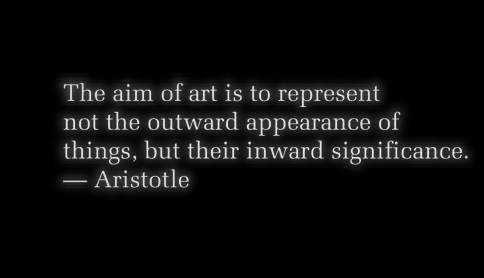
Here’s the difference. Some believe that we are here to educate the arts by providing the aesthetic experiences, first, foremost and finally. Others believe that the arts – as an academic subject – must be held to the same standard as the other subject areas with regard to academic rigor and accountability. But doing so as a practitioner of refined, rigorous, reflective and student centered education – which creates an aesthetic opportunity for students – makes the alternative seem superficial by comparison. My effectiveness at accomplishing all this day in and day out can always be debated, and I’m not claiming to be held up as an example. At all. But I’d rather go after the good stuff this way than attempt anything less. I LOVE the quote below by Aristotle. But can you really “represent” the connection to the inner stuff without a prerequisite of fully grasping all its components first? And if YOU’RE not teaching all (all!) those components, who is?

55611324_640

Posted in Advocacy, Etcetera | 1 Comment

moving on

R – My Spring concerts were held last week and I must confess that as happy as I am with how they went and what the kids did, I am profoundly grateful that they are over. I feel somewhat the same as I do at the end of each season in New England, “Okay, that was great, but let’s move on.” My favorite season is the Fall but I can’t wait for the first snowfall or Christmas and December and everything that comes with it. Yet two months later I’m dying for Spring. And how great is it to finally open up the windows a bit and let the fresh air in! But it’s only a short matter of time before I’m holding out for temperatures in the 80’s and weather nice enough to spend a day at the beach. And yet, you KNOW that by the time I hit September, I can’t wait for sweatshirts and turning leaves.

And you know what? I wouldn’t have it any other way and neither would you. And that’s the beauty of the school year to me. It has its own set of seasons. But now it is time to go through a season of recharging and removing the brain from school activities for awhile. I feel guilty to a degree that I’m happy to have my Spring concerts over with. But that season has ended and that was great, but let’s move on.

Reflecting on this year now closing, the best we can ever do is to simply drop those apple seeds for 10 months and then hope and pray that some of them took root. Just knowing that we attempted this is our reward. Looking back on this school year of successes and failures, happiness and disappointments, progress and regression, highs and lows, we know that next Fall we will go on that journey again. And that’s a good thing. It is a blank canvas ready to be painted. I was having supper with a couple of alumni of mine earlier this week and we were talking about broadway shows and I mentioned that one of my very favorites is Stephen Sondheim’s Sunday In The Park With George, based loosely on the work of George Seurat. The closing song is in fact called “Moving On” and I think the lyrics are appropriate for teachers everywhere as they reflect on the school year just passed and the new one beckoning ahead. In that spirit, I hope you have a peaceful and relaxing Summer.

~ ~ ~ ~ ~ ~ ~ ~ ~ ~ ~ ~ ~ ~ ~ ~

Stop worrying where you’re going, move on
If you can know where you’re going, you’ve gone
Just keep moving on.
I chose, and my world was shaken–so what?
The choice may have been mistaken
but choosing was not.
You have to move on.
Look at what you want,
Not at where you are,
Not at what you’ll be.
Look at all the things you’ve done for me:
Opened up my eyes
Taught me how to see
Notice every tree!
Understand the light!
Concentrate on now!
I want to move on . . .
I want to explore the light.
I want to know how to get through
through to something new–
Something of my own!
Move on!
Move on!
Stop worrying if your vision is new.
Let others make that decision . . .
they usually do!
You keep moving on.
Look at what you want,
Not at what you are
Not at what you’ll be
Look at all the things you gave to me.
Just keep moving on.
Anything you do, let it come from you–
then it will be new.
Give us more to see.

Posted in Etcetera | 1 Comment

flipping the music classroom

RJennifer Etter is my friend and colleague at York Middle School as Choral Director and General Music teacher grades 6 through 8. She has not only been an extraordinary partner as we continue to develop our K-12 music program, she has been an innovator and driving force in exploring ways to up the ante with regard to our craft as music educators. I asked her to submit a blog post and below is her offering. I hope you will find it as thought provoking as I do!

As music teachers, we believe deeply that we are an academic subject. We want to be held to the same standards as other subject areas and we want to be regarded as “Core”. For this reason, I wish we collaborated more with different academic areas more often to improve our teaching practices.

When I first started teaching I realized quickly that there were many things that college had not prepared me for in regards to the day to day of classroom teaching. Ironically, the most valuable experiences that I drew from were not even experiences I had student teaching but rather as an Educational Technician in the non-music classroom. Since that time I have found repeatedly that I am more inspired to be a better music teacher when I attend non-music professional development than music-related professional development! I can’t help but wonder where the disconnect is.

In the past year or so, I have learned so much from taking ideas that were designed to be implemented in a classroom of 20 or so students and modifying them for the large ensemble. Through this process I have found that my classroom has become much more centered around learning and less centered around teaching. I have become increasingly more interested in the student centered classroom although I have to admit in many ways I am at a loss as to how to embrace it within the large ensemble.

I have an idea though…

I recently read Andrew Lupien’s (Cape Elizabeth High School, Math) write-up in the Middle Link Newsletter. His article is entitled Flipping the Classroom. The phrase “flipping the classroom” refers to reversing the learning process, with instruction happening at home, individually on the student’s own time and the practice (what has traditionally been the homework) happening at school with the teacher there to guide the students and be of assistance when needed. This idea really resonated with me as I have had such a hard time trying to wrap my brain around the idea of individualizing instruction for a classroom of 100+ students. Why not flip it around and put the task of the instruction on them and then be there on the other side to help them digest the material? The idea makes a lot of sense in any classroom, this way the student can work through the instruction on their own schedule and at their own pace, but to me it seems almost essential within the large ensemble.

I am lucky to work with 7th and 8th graders in the state of Maine where we have a plethora of technology at our fingertips, otherwise this task may not be as straight-forward as it seems. By no means do I have this figured out yet but for next year I’ve decided to flip, for at least one or two of my classes anyway. Rather than teaching lessons in class where students are more likely to be distracted by their peers, I’m going to try to pre-record the lessons for the students to watch as their homework and then come to class with a knowledge base already. I can record separate lessons for each voice part or lessons on music literacy. Our time in school can be used to practice and assess the material that was introduced to them at home. Using this model students can be free to access the material at their own pace. If it’s done through video, they can watch it as many times as needed and can pause or rewind if they would like.

I do not envision this making my job as a teacher any easier. I will need to be a strong leader and provide structure for the students so that they can make the best use of their working time in the classroom. It is my hope however to try to put the ball in their court in terms of learning material and that way when it comes time for class…. we can run with it!

you can contact Jen at jetter@yorkschools.org

498451-1900361-26

Posted in Assessment, Etcetera | 1 Comment

difficult intervals

R – A couple of weeks ago I was getting ready for school thinking about how singers, at the heart of it, only struggle with singing specific melodic intervals. In other words, harmonic considerations completely aside for a moment, there’s no such thing as “difficult notes”, just difficult intervals. Then I thought about how much I’d love to have a warmup that truly isolates specific problem intervals for singers. And in thinking about it, I came up with one. I’ve never seen a choir do this before, though I believe I have seen bands do a variation on this.

Basically it has to do with pitch accuracy of reference notes in relation to all others around them. I routinely have students sing back random numbers of the scale to me so I can see if they can accurately do so, but this is more for making sure they have the correct note/number, it doesn’t really test their intonation of that correct note. This one does. Simply put: sing “1” and then every number that follows it: 1/1, 1/2, 1/3, 1/4, 1/5 etc and back down again on an eighth note/quarter note rhythm. Once they have done so on “1”, they do the same exercise but now utilizing “2” as their reference note. Then “3” and so on.

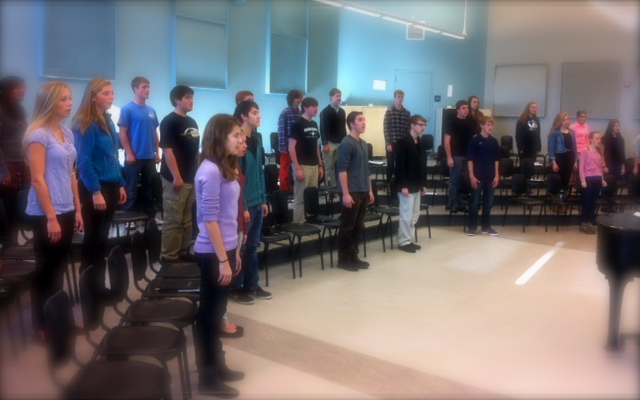
I tried this with my Chamber Singers and they did well (see the video of them trying it out for the first time), but it exposed weaknesses – predictably – when 4 was the reference note. “4” started to become “3”. I also noticed intonation issues throughout on “7”, both as the reference note and also when it was sung against one. Certainly I could have predicted these would be issues, but this exercise got them to work at the deficiency. Today I ran the exercise after having done so a couple of times since, and they did significantly better. They are now aware of the “4” and “7” deficiency to a unique degree, and are focused on keeping those notes better in tune. This translates powerfully to their music when I point out relationships in their voice part that are exactly the same as the interval they had problems with in the warmup. With that as their reference point, they can approach the interval with more thought and awareness of the issue at hand.

I also tried this with my non-auditioned choirs. I discovered that they aren’t ready for this level of minutia as they are still mastering assimilating the intervals at a more rudimentary level. My male singers for instance will still often sing “4” where “5” is being asked; they aren’t ready to be hammered with a warmup that addresses intonation at that level yet (crawl before you walk, walk before you run, run before you sprint).

The component of this warmup I REALLY liked was that MY ears had to be good enough to actually catch the intonation issues! Those who know me know that I have a firm belief that a choral warmup should be about developing the ears and the eyes as well as the voice. But a warmup that doesn’t also challenge the conductor’s skills in some way (aural or visual) is an inadequate warmup. Trust me, this warmup was a challenge for me because I had to truly utilize my ears (calling the students out on intonation issues THE MOMENT they occurred) for it to be successful.

Consequently, I like this warmup but I don’t think it’s for every choir. I’m gonna try it with the MSYM Chorus in July and my Community Chorus next Fall and we’ll see how it goes with those groups. It appears to be a useful warmup for getting a choir with finely trained ears to work on intonation when confronted with difficult intervals.

I would be curious to get your feedback. Watch the video if you get a moment (just the first half of it is sufficient) and tell me what you think. If you try it with your choir, please tell me how it goes! Let me know if you thought it accomplished anything, and if so, what. e-mail me at mllama4@maine.rr.com.

intonation warmup

photo

Posted in Rehearsal, Warmups | Leave a comment

george seurat and choral performance

R – The first of my two Portland Community Chorus performances was last night and I was really pleased with how it went. There were gobs of moments where I feel the chorus captured the artistic intents of the composers to a very high degree and countless moments of very intelligent singing. By any measure, I’d call it a success. But I also know my singers. While I think they were happy with it overall, after months of nit-picking every possible detail on every single measure, they knew what they didn’t nail. Every single performer could identify measures, notes, perhaps even entire pages that they weren’t happy with. I know that’s certainly true for me and my conducting. So this leads me along a natural progression of thought to the eventual question: why should we be happy with a performance we know we didn’t perfect in execution or in concept?

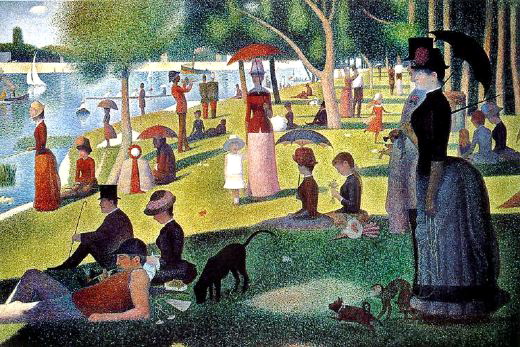
My answer lies in the work of neo-impressionist painter, George Seurat. Seurat (while he was still in his early 20’s no less… re-read my earlier post on beginning teachers) devised a systematic approach to painting that exclusively employed dots without the use of any brush strokes at all. It was his belief that colors jump off the canvas to a remarkable degree when the human eye is the entity that mixes the pigments, not the painter. For example, a traditional painter would paint an amethyst with purple pigment. Seurat would have painted it with blue and red dots. From a distance, each amethyst would appear purple, but Seurat’s would be so via the observer’s eye. I love this concept. The foundational concept is that the observer gets to create the painting, the painter merely sets up the opportunity for them to do so. The other corresponding concept is that the observer must stand back from it to truly “see” what has been accomplished. Consequently, the creator who is at the same time working out the minutia up close is juxtaposed with the observer who does not see the minutia but receives the desired effect.

It is this design that I think perfectly defines the relationship between the chorus and an audience in performance.

Seurat’s most famous paining is Sunday Afternoon on the Island of La Grande Jatte. A brilliant work, it was composed on a canvas 7 feet by 10 feet long. SEVENTY square feet! And he pained with DOTS! Are you kidding me? But the wonderful result is that an observer must stand way back to take in the whole, thus removing the minutia that created it all from the naked eye. Yet without the minutia, there’s no painting to even observe. That, my friends, is the role of a chorus. This instructs what to rehearse, HOW to rehearse, how to present material, how to convey musical ideas… and it impacts pitch, tone, rhythm, inflection, phrasing, harmonic balance and diction. And it does so for each of these elements multiple times every second of every song a choir sings. I’ve often said that in the history of mankind there has never been a “perfect” choral performance by anyone (I’m sure Robert Shaw would have agreed with me… I’m sure of it), and considering the prior statement, it’s not hard to understand why. Doing so would require odds that rival getting struck by lightning. More than once. Every week for a full month.

So the bottom line for me is this: Seurat himself would not claim that in his grand painting every single dot has been perfectly placed. He would not claim that it was flawless, he would in fact be critical of many elements of it in hindsight. But what he accomplishes far transcends those details. Choirs are not to ignore those details in performance, quite the contrary. But they have to be willing to allow the audience’s ears to fuse together the intricate parts to accomplish a whole that has musical integrity and meaning. And that means letting go of the details the moment they’ve passed, it means not slaying one’s self over the missed B flat on measure 47 and instead understanding that not only did other members of their section cover for them, but that the missed note is inconsequential to the audience at that moment in time. Don’t get me wrong: a choir that hasn’t established that minutia at some point should not be performing that song. What I am referring to is the imperfect human element of performance. And our choirs can either torment themselves as they reflect on the imperfections, or they can bask in the glow of an artistic agenda that has been successfully achieved despite the imperfections. It’s often a tough sell for them, and sometimes a tougher sell for the conductor… but the only approach worth having is Seurat’s. And, to me, that is a wonderful artistic goal in and of itself.

georges-seurat-sunday-afternoon-on-the-island-of-la-grande-jatte-82998

Posted in Performance | 3 Comments

the interconnected circles

R – As a follow up to my initial discussion around spot on teaching, I want to elaborate on my thoughts around that true balance between the three domains (circles) of 1) developing in students an interest and love for the subject, 2) developing in students a growth of a more personal nature and 3) developing and assessing (being held professionally accountable in) academic skills in that subject.

My concern in music education is that music educators must truly embrace all three elements, just as any social studies teacher would. Just as any English teacher would. Just as any Math teacher would. “But music is different”, I always hear said. Well, it depends on the context. And I begin with this premise: there is no such thing as an “academic subject”, but rather fields of study that become academic when presented within the parameters of academic instruction. Is Math academic? I know of plenty of school math clubs and so do you… and none of them are “academic”. What’s the point to them? To have an outlet for students who are interested in that subject to love it even further while growing as young adults in the process. The same holds true for athletic teams, doesn’t it? They foster a love for the sport while embracing elements of personal growth and maturity (responsibility, teamwork, commitment, and so on).

These activities are called “co-curricular”; they are “extra-curricular”. And it has NOTHING to do with the subject area or WHEN it takes place. Yes, they may happen before or after normal school hours, but that is not WHY they are co-curricular. They are co-curricular because they bring together only two of the three circles. What do you call a Math club where there is a curriculum, learning targets, instruction toward those targets, assessments to determine if students are meeting those learning targets and accountability on the part of both the student and the teacher to see that this is all taking place on a daily basis while imparting a love for the subject and causing students to grow personally? A math class. What do you call athletic activity where there is a curriculum, learning targets, instruction toward those targets, assessments to determine if students are meeting those learning targets and accountability on the part of both the student and the teacher to see that this is all taking place on a daily basis while imparting a love for the subject and causing students to grow personally? Phys Ed class.

Love for the subject + personal development of the student academic accountability = co-curricular activity.

Love for the subject + personal development of the student + academic accountability = essential academic instruction.

Which of these do your music classes fall under? Your chorus? Your Band? Your general music class?

I’ll go one step further: every other core subject area in federal education legislation BEGINS its premise with the academic, rigorous skill development AND ASSESSMENT circle first, and then makes it a point to articulate how good teaching brings the other two circles together with it. Why do those of us in the Arts insist on going at it the opposite direction… and then get pissy when we’re perceived as less academic???

We have been guilty for generations of trying to run co-curricular activities where our students play instruments and sing together and pass them off as academic whenever that third circle is not entrenched in our course work. Principal: “Chorus is not an academic class”. Teacher: “Of course it is! Studies show how students grow and develop as people, music is a life-long language, and everyone should have music in their lives!” Principal: “That’s why we have co-curricular offerings in music. Where are your learning targets for each individual student, how often do you assess each individual student, where is the data on that individual student and how do you tie that all into your curriculum and instruction?” Teacher: “whaaaa?”

The sad thing is that when that same Principal proposes the same premise to every one of the other 7 content areas, the answer to the Principal’s last question is at their fingertips. When it comes to arts teachers, I’ve actually encountered colleagues who get offended at being asked. And we wonder why WE are the ones on the chopping block each Spring, and why we STILL have a one year High School requirement when the others have two, three and even four.

THIS is why I have been on fire for several years now about that third circle. It’s not that the other two circles are not as important, if not more so. Instead, it’s the difference between having co-curricular offerings in music disguised as classes merely because they happen during the school day, and instead having academic courses in music that are held to the same standards as every other academic course in that school. The difference is in the incorporation of that third circle, not the omission of the other two.

chart

Posted in Advocacy, Etcetera, Standards | Leave a comment

leschetizky had it right

R – My standards based head exploded a little bit when I read a great blog post earlier this morning over my Saturday coffee which really resonated with me: are you a diametrically opposed teacher.

Natalie is referring to Theodor Leschetizky (1830-1915), a piano teacher who devised exercises to help his students overcome technical difficulties when playing the piano. It became known as the “Leschetizky Method,” (though he never referred to it as such) which helps develop agility especially on the weakest fingers. He had many followers (it couldn’t have hurt that in his later years he looked like Santa…) and they preached his method of instruction. The blog post simply draws out that the “method” was to meet the needs of each student in a unique and thoughtful approach. I had two basic takeaways from reading it, one articulated, one inferred: 1) meeting the needs of the individual – by individualizing instruction – is fundamental to what we do, 2) it begins by identifying concrete standards. I came up with an analogy that I already used in a prior blog post, but to paraphrase it here, A person finishes a piano jury. TRADITIONAL GRADING: ”Congratulations, you did pretty well!!!! I’d give that at least a B+!!! Now go practice more…” STANDARDS BASED ASSESSMENT (Leschetizky): “With regard to your right hand, four of your fingers are fine but the pinky needs some serious help. Let’s focus on IT for awhile and get it working as proficiently as the others.”

Leschetizky didn’t have different standards for each student, he had different individualized approaches to each standard so that every student could meet all of them.

Standards based assessment can be perceived as too rigid or impersonal. Well, we are in the business of moving students towards targets, aren’t we? The target may be rigid (“Instead of having “answers” on a math test, they should just call them “impressions,” and if you got a different “impression,” so what, can’t we all be brothers?” – Jack Handy… well, guess what: 16th notes and A flats are not “impressions” people, they are fixed, exact entities) but the delivery of instruction, the delivery of curriculum, the delivery of content that moves students toward those impersonal fixed targets do not have to be. Leschetizky came up with specific exercises to develop the weakest links/greatest needs of his students. The first step in his process however was establishing standards that all his piano students must meet so he could identify their weakest links/greatest needs. Standards! But the point to the blog I read this morning is that development of these needs can (must?) be personalized to the greatest degree possible, and that has to to with teaching technique and pedagogy. The diametrically opposed teacher is as malleable and personalized in their instruction as they are rigid in their goals.

My colleague at York Middle School recently integrated some “non negotiable” understandings/standards into her curriculum in a unique way, basically saying that all her students will be held accountable for some very specific, fundamental knowledge. She messaged me yesterday, saying how excited she is because of the positive changes she has seen in her students, their engagement and their understanding of the articulated concepts. I guarantee you that these changes are being brought about because, as a teacher, Jen’s that good. But what I think she is experiencing is one of the things that can come out of articulating clear targets that every student must meet.

I’m going to follow this up soon, but the blog post above really reflected some good stuff that I know is going on in music classrooms everywhere: clear, non-negotiable targets – standards – being attacked from every possible angle for the expressed purpose of meeting students where they are at individually. Leschetizky had it right.

lesch003

Posted in Assessment, Standards | 2 Comments

spot on teaching

RYesterday I had correspondences with two colleagues of mine, both of whom coincidentally are former students as well. One of them forwarded me a wonderful blog post on the value of music education to 21st century learners (please take a moment to read it, you won’t be sorry). With the other I had an awesome conversation around the goals for Jr. High/Middle School music students… philosophical beliefs as well as tangible outcomes. Here’s the crux of the issue I was thinking about by the end of the day: do we have music education in place a) to impart a love for the art form, b) to have students become literate in the art form or c) to develop our young adults as people to an extraordinary degree via our art form as a means to that separate end?

Love for the art form… the joy that can be obtained from playing and listening to music is profound. “Music was my refuge. I could crawl into the space between the notes and curl my back to loneliness.”  ~Maya Angelou, Gather Together in My Name. Everyone I know who has a passion for music wants (needs?) the world to know that same joy and love for it. They somehow have it so intertwined with their mere being that they can’t stand the thought of being alone in that joy; enveloping the world – everyone around them – in that same joy is an essential part of their being. For many, this is the reason they entered into music education. It is not difficult to understand that this is, in the end, the only outcome that ever really matters to them when it comes to their students. And they teach accordingly: imparting their love for music at the core of everything they do as music educators.

Music literacy… “Basically, we live in a non-literate society in terms of functional music literacy. We know that children who are not read to or who have little experience seeing their parents or other role models read and write don’t learn as readily themselves. So, as (Bennett) Reimer says, music literacy is irrelevant in our current society. As someone committed to music literacy then, I see the job I have as a music educator is to make music literacy relevant. ~ Kit Eakle, Teaching “Whole Music” Literacy. Many believe that music literacy is as essential a component of music education as it is to any other language. If a French teacher has a classroom of students who speak fluent French but can’t read a word of it, that teacher will get fired. And we get that. We might even applaud it as an active way to remove an incompetent teacher from the profession. But no one has ever explained to the proponents of this goal how that corollary doesn’t apply to music teachers as well. Anyone in this corner will tell you that literacy is the cornerstone to any language, of which music is included.

Means to an end… Education is not preparation for life; education is life itself – John Dewey. Steve Smith taught me that if you’re not careful, you might just make a permanent life impact on someone for the better, and it won’t have anything to do with your subject matter. Humanistic education. His references to Peter Pan were apt. Those who teach with this goal in mind understand that the role we can play in our students’ lives can transcend the mere dissemination of curriculum. Along a parallel train of thought, that blog post I allude to above really speaks to the value of music education to the whole person; the value of the arts to people who don’t actually go on in the arts but who have received transformative instruction that can translate to any field or profession. Is it not true that the deepest value of music education goes well beyond music?

Do you see where I’m going with this?

It is my belief – through experience – that the motivation for music teachers becoming music teachers has been due to the first and third items: love of the art form and/or music impacting them as people and they want to impact others the same way. I’ve NEVER met a music teacher who decided to devote their entire life to the profession because they remember the first time they successfully read the treble clef (those teachers may exist but they are well hidden… 🙂 ). The “love” piece tends to be in place for teachers of any subject area, and the impact that music can make on a person is tied to that. So why bother with the literacy piece? Here’s my thesis: public school music programs are not in the business of developing future music educators. This may be a wonderful byproduct of our programs (re-read my first sentence) but I don’t believe it’s an overt goal. Consequently, the reasons WE became music teachers really becomes irrelevant to me. 98% of our students will not teach music. So why then are we even teaching it and what are our goals? I came up with the following chart: chartFor me it comes down to whether or not we are an academic subject. Developing a love for music and/or developing people further via music is not academic! There, I said it!!!!! Chess Club. Math Club. School Newspaper. Athletics. All these are venues through which students can develop a love for what they do, and develop personal characteristics that will benefit them as people throughout their lives. Music is in the same boat (co-curricular at best) until there is formal curriculum, instruction and assessment that involves rigor, demonstration of concrete skills and application of deep knowledge. I would argue strenuously that music has the capacity to be enormously academic and essential to the education of every child. And NONE of it has anything to do with whether or not the student loves music or applies it to their personal lives.

But here’s the punch line: we – ALL music educators regardless of grade level or circumstances – have an obligation to transfer that rigor to the other two elements despite its inherent disconnect. Rigor/academic content does not have to negate the other two elements… rather, it can bring the other two elements to life in an extraordinary wayMy involvement with the Maine Arts Assessment Initiative and my philosophical shift towards standards, etc, etc has been founded on enhancing the other two elements through academic rigor; not to diminish the other two goals but to give them greater meaning via academic demands. The chart above displays the missing elements if only two (much less one) of the broad goals are addressed. The green circle is the odd one. The other two are more easily connected. But I believe that we must have all three to be effective, truly effective, in being “spot on” teachers. I’ve often said that singing is fun but music is work – and the reason we commit to the work is because it’s a labor of love. We love the subject, we grow via the subject, but the greatest value is when we connect both to the rigor. To me, Robert Shaw said it best:

“The wonderful thing about the amateur chorus is that nobody can buy its attendance at rehearsals, or the sweat, eyestrain and fatigue that go along with the glow…”

Spot on teaching (in my humble opinion) fosters the glow, the personal connection and the fatigue. And each of the three enhances the other two. I would submit that this is a great recipe for any teacher in any subject area. Yes, accomplishing all three as they relate to music is a difficult balancing act for us. Absolutely. It requires continuous reflection and revision of how we carry out our craft. Perhaps it’s not even realistic to think that balancing all three is perfectly attainable. But neither is presenting a “perfect” concert performance, and I don’t recall ever seeing anyone striving for anything less than that. So keep going after it. Foster the love for music, develop the person, and insist that your students experience how the rigor and fatigue connects to both – – – that to me is spot on teaching. That to me is Music Education.

Posted in Music is work, Rehearsal | 7 Comments

process vs. product

R – “We should not judge people by their peak of excellence; but by the distance they have traveled from the point where they started.” – Henry Ward Beecher. There isn’t a music teacher alive who doesn’t already understand the significance of the title of this blog post, so this isn’t an attempt to “enlighten” anyone. It’s just a smattering of my thoughts on it recently.

My favorite thing to do for the past 25 years has been to climb Mount Monadnock from the old Toll Road trail. I could climb it in my sleep I think. I’ve enjoyed climbing it on my own, with one or two close friends, with alumni, with a group, with siblings, and even one Easter Sunday when I brought a roast beef sandwich (with Honey Mustard) and hot cider along for my Easter “dinner” at the summit. It is not a strenuous climb as mountains in northern New England go – I remember one day when I was at the top and watched a MtMonadnock2-AmpitheaterTrail1-summit-4-21-02-JBgroup of college students arrive from Keene State carrying a sofa just so they could say they did – but it’s a wonderful, picturesque mountain that makes a beautiful day that much better by being on it. I used to enjoy it most for the time I spent at the top. I would eat, take a nap, walk around, take it all in, relax, and eventually head back down. As time has gone on though, I’ve enjoyed it more for the journey to and from. And that is the metaphor I’m using for my process vs. product comparison.

I can’t put my finger on it, but I know in my career I now enjoy actual concerts much less than I used to. Presenting a concert – or the product – was my focus when I began teaching…. and everything led up to that event. Standing on the mountain top. But I have so much more fun now preparing a group for that concert than I do presenting it. There was a concert about 5 years ago that I had the epiphany: if I could just pay someone to conduct the concert for me, I’d be in heaven. Prepping the group, and then just watching them fly. And I think the reason for this is that the journey, for me, has become twice the fun. I ALSO know this is due in large part to working at my dream school (no kidding), working for a Community Choir executive board that is extraordinarily supportive, guest conducting festivals that provide for enough time to really get inside the kids’ heads, a summer music camp that allows me the opportunity to try out new rehearsal techniques and approaches while fine tuning old ones, and on and on and on. I have a pretty blessed career. But the downside, if there is one, is that concerts have ceased to hold the emotional weight that they used to. I’ve never been an avid “performer” and maybe this is just a manifestation of that. I don’t know.

But it might have more to do with the quote by Beecher.

My frustration with concerts is that no one ever gets to see the “growth”… the distance the group traveled to get to where it is in concert. And that bothers me. The audience only gets to see a picture of the climber standing at the summit. But they are missing the point. With apologies to Shakespeare, the climb is the thing. The journey is where the magic was. The concert is certainly a celebration and a feel good experience; a peak experience, pun intended. But that’s all it is. That’s not to diminish its importance or significance, it’s just to put it in it’s rightful perspective. And I wonder if we do that enough. I know that conceptually we understand the difference, but do we practice putting the emphasis on the rehearsals over the performance? Do we communicate this to our students and our singers? Do we communicate this to our parents and communities, or do we use our concerts as our big buildups and sell them as such? These are rhetorical questions meant for nothing more than food for thought. But I really would prefer that our programs be judged by the distance our students have traveled, our choirs be judged by the musicality they developed and applied, than by the peak of their excellence displayed for all to see in concert. The reality is that we can’t have one without the other, any more than I would choose to climb Monadnock without ever seeing the summit or standing at the top having been placed there by a helicopter. The climb makes the mountaintop inspiring, the mountaintop makes the motivation for the climb. The title of this blog post should have been “process and product”. I just hope that the importance of both elements in equal measure is the message we are indeed transmitting to our concert audiences and to our communities. I would argue that we’re cheating them, as well as ourselves, if not.

I say as often as I can whenever I’m speaking to an audience or a group of people, that the problem (read: misunderstanding) with music education is that it is a process based discipline in a product oriented society (think about it). We can either conform to the inherent societal value by perpetuating their desire to have music education be what they expect it to be, or we can morph our society into changing their thinking when it comes to what we do and why it’s essential for every student. I think we need to choose wisely.

Posted in Etcetera | 2 Comments