shifting sands

R – When Jarika and I started this blog a few years ago, the landscape as it applied to music assessment in Maine was still a pretty static entity. A few teachers here and there were invested in it, but it was something most people wanted to find out more about (the 2011 Arts Assessment Conference had well in excess of 200 attendees). Yet it was still in infant stages of “how do we do this and why?” Now in 2015, the state has implemented its proficiency law and we are all in the throes of “assessment” and standards and proficiency.

It’s been an amazing shift. But where does it leave us? No one is utilizing the same standards (national? MLR? hybrid?). No one is reporting out the same way (standards? 108558973grades? hybrid?). No one is invested the same way (“I do it because I value it”, “I do it because my administrator told me I have to”, “I’m seeing the value even though I don’t fully believe in it”). No one does it the same way (paper/pencil tests, performance assessments, one time shots, multiple opportunities). No one reports it the same way (power school, infinite campus, mastery connect, who knows what else).

MAAI held its annual Winter Retreat for the assembled Teacher Leaders from across the state a couple of weeks ago. We collected feedback and data and it is flat out overwhelming what we have in front of us for needs. We know we want to link up with other organizations to further assessment in the arts. We know we want to further advocacy efforts and utilization of Teaching Artists. We know we want to offer professional development opportunities for every teacher in Maine, but that the needs of each are very, very unique.

Where is this all going and where does it end?

Well, I don’t know the answer to those two questions, but I do know for a fact that we’re moving and progressing and developing and morphing. And shifting. MAAI’s mission has been a simple one: Creating an environment in Maine where quality assessment in arts education is an integral part of the work all arts educators do to deepen student learning in the arts. The goal has NEVER been to utilize the same standards, report out the same way, invest the same way, do it the same way or report it all out the same way. It HAS been about deepening student learning in the arts.

As we individually and collectively continue our work, I’m imploring all of us to keep our eyes on the target. Get through whatever filters are in front of us – or imposed brick walls  – etc. etc, and keep making our work more meaningful and integral for our students. If we make our work authentic and see to it that it furthers the cause, let’s keep moving. The alternative to movement is standing still. And even though we’re in the middle of a morass of assessment soup right now, I’ll take this every day of the week as opposed to standing still. The sands are shifting and that doesn’t have to be a bad thing.

Posted in Etcetera | Leave a comment

getting off islands

R – Visual and performing Arts educators are in an extraordinarily unique situation in Maine. True for all arts educators, but especially so for PK – 8 and dance and theater of all grade levels. The situation is one of isolation. Physical and educational. It’s too easy to overlook this as a fundamental concern, due to the fact that it’s always been like this. At the conclusion of the Maine Arts Assessment Initiative’s Summit for Arts Education this past Summer, about 80 educators and teaching artists spent three and a half hours presenting closing action plans and professional development workshop proposals based on their work during the week. I left the experience inspired in many ways.

Individuals are furthering their work based on deeper understandings and discussions. For many, this took the form of changing how they will be delivering instruction. For others it ties into the logistical bear of reporting out progress towards proficiency of standards and indicators. Others still are tying in assessment strategies for the first time or redesigning their assessment practices. This has staggering ramifications for Maine’s arts classrooms and our students. Where there is a transformation of thinking, or reporting, or managing, or assessing, or delivering, there is a furthering of the Arts in Maine.

Professional Development will continue to be offered. The growth opportunities that will be available to everyone in Maine via regional workshops are tremendous, both in number and in scope of subject matter. We used to have a state that does annual “one shot deals” at state conferences for Professional Development via organizations such as NAfME or the Maine Art Education Association. Many of these workshops had little to do with assessment or standards or proficiency. Today however, that is not the case. As a matter of fact, you have to work really hard to avoid opportunities year-round to further professional growth as arts educators, particularly in standards, assessment and proficiency. The Maine Arts assessment initiative has organized and announced its Mega-Regional workshop schedule for the 2014-2015 school year. You can see what is being offered and register online here. The afternoon sessions at each of these is being devoted entirely to music educators talking to music educators about how they are doing in their transition to proficiency based assessment; visual art teachers and even drama and dance teachers doing the same. The morning sessions allow you to plug into workshops that focuses your thinking on a specific topic or strategy. Our hope is that the combination of the morning sessions coupled with the afternoon roundtables will result in attendees leaving charged and filled with practical new ideas and approaches that can immediately be applied and implemented in meaningful ways in their own journey with their own students.

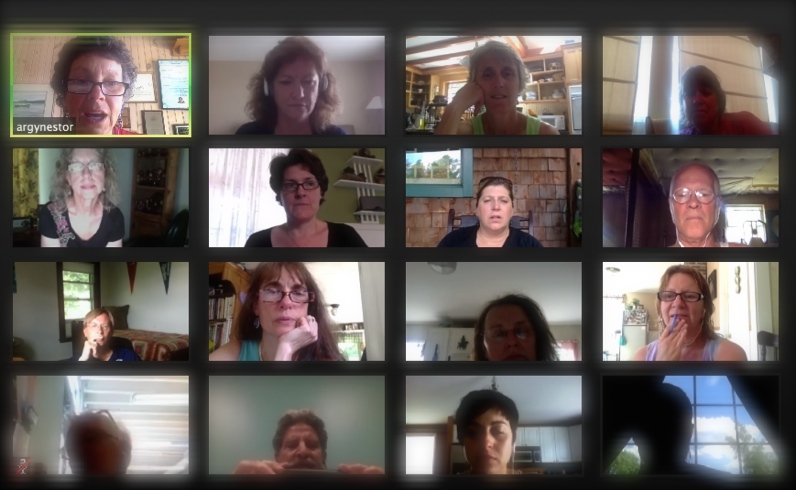
But what in the meantime? Technology. Google Hangout, Skype, and my favorite: Zoom… among others to choose from. My colleagues at the high School? I talk to them all the time already, but that’s because we’re on the island together (YHS). My choral colleague at York Middle School? We google hangout twice a week. Minimum. And it is almost always random too. “I wonder if Jen’s in her planning block right now…” *Rob clicks on the video icon next to her name in gmail* She often does the same. We quickly bounce ideas off of each other or ask quick questions. Sometimes we start one at 2:30 and by 3:10 we realize we’ve been talking for 40 minutes and we are still bringing up things we want to discuss. The point is that Jen and I are no longer on our islands. We never will be again. We’ve actually had our choirs digitally perform for each other, do warmups for each other, it’s been great and we don’t even do it all as often as we want. But we make it work within our own unique confines of time. The leadership and teacher leaders of MAAI have also enjoyed great success with Zoom meetings. How great is it to be in a meeting, IMG_0907talking about the “good stuff’ while sitting in your favorite chair at home and drinking hot cider with your feet propped up on the coffee table? Let me fill you in: it’s really great!!!

I don’t mean to bore anyone to tears in the above paragraph talking about technology that I know most everyone already uses. But 2014 is the 100 year anniversary of the start of a war in which its Generals at the outset made it clear that the airplane was neat but served no strategic purpose (bonus literary points on my part for comparing google hangout to a world war). We need to be looking at strategic purpose. Why aren’t we skyping with our colleagues from the other schools in our district once a week? “I don’t have time”. Really?? You don’t eat lunch? Why aren’t we skyping every two weeks with a colleague from a similar grade level schools as ours in another town? You already know who they are, I moved to Maine in large part because of the District structure for music educators. We know our neighbors, why aren’t we talking with them more? How about skyping once a month with a colleague in a different county or part of the state. How about skyping once a quarter with a colleague from out of state??? “I don’t know anyone well enough to ask.” Don’t even go there. Are you telling me that if a music teacher from Connecticut e-mailed you and said they’d like to meet you and talk for 15 minutes about what is going on in Maine, your school and your classroom as it relates to music education you’d say “no”? Guess what – neither would they. Reach out!! Do it!! Don’t be that World War 1 General!!!

Get off your Island and keep furthering your thinking and your craft. A great reminder this past week from Hall of Fame receiver Michael Irvin who said that his coach told him throughout his career, “Either you are always working to get better, or you are automatically getting worse.” Not bad advice. Get off the island and access your colleagues in person – physically or digitally – routinely to keep furthering your growth.

Posted in Etcetera | Leave a comment

happy 3rd birthday

R – A rare midweek blog post (and on this post-election morning I could use some humor) to self-congratulate and wish a Happy Birthday to the blog! Jarika and I launched this three years ago today, and it has served as a fun little soapbox platform for us to shout from, for anyone seriously unstable enough to take the time to listen to us.

The reviews have been off the charts since we started this thing! Here’s just a few snippets of what people have said about goobermusicteachers.com over its first three years:

– – – – – – – – – – – – – – – – – – – – – – – – – –

“And now, the Top Ten Reasons a person should have to be granted a permit before starting their own blog…” – David Letterman

“Congratulationsh on the chthree yearsh chapsh. I chust cantch get enough of it.” – Sean Connery

“Of all the blogs I’ve read, this is definitely one of them.” – Ashley Smith

“Where’s the beef???” – 1980’s Wendy’s commercial

“Really weak in all three phases.” –  Bill Bellichick

“You want to confuse these two? Ask them to spell ‘mom’ backwards.” – the late Joan Rivers (rest her soul)

“One does not normally encounter prose of this quality without seeing it written in crayola.” – Maureen Dowd

”                                                                          ” – Marcel Marceau

“If only I could learn to write things this scary!” – Stephen King

“The greatest contribution to Insomnia research in the last fifty years.” – Dr. Howard Terduckin

“There are many fine attributes to a blog such as this. Of course, none of them actually pertain specifically to this one, but there are indeed many fine attributes to be found in a blog such as this.” – John Cleese

“This would be far more entertaining – and enlightening – if their typewriter keyboard were replaced with emojicons.” – Al Gore

“This blog should be pay per view” – – – “Yeah, they should pay us every time we view it!!” – – – “Hahahahahahahahahahahah” – Muppets Statler & Waldorf

“The Delorean of blogs” – Lee Iacocca

“All right! This blog is TOAST!” – Bill Murray

“It keeps going, and going, and going, and going, and….” – Energizer Bunny

“I don’t always read blogs. But when I do, it’s not this one.” – World’s Most Interesting Man

“I went to a restaurant that serves ‘breakfast at any time’. So I ordered French Toast during the Renaissance.” – Stephen Wright

Posted in Etcetera | 1 Comment

choral foundations – vocal technique

R – Jarika and I teamed up for this followup post to the one from September where I submitted that in our performance classes – especially in our grade/middle school and high school entry level ensembles – perhaps we might be guilty of placing a disproportionate emphasis on literature and concert performance (application and display of skills) over what must come before it all in our academic classrooms: development of skills.

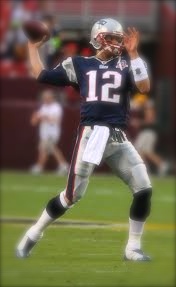
Tom Brady was asked a few years years ago what he works on in training camp now because, obviously, he can already do it all and is already a first ballot Hall Of Famer. “Fundamentals. I work more on fundamentals now than I even did when I started my career because now I know even better how important they are and how they always need to be reviewed and practiced… every single day.” How are we missing the boat if our rehearsal strategies don’t align with that philosophy?

With regard to establishing, and practicing good vocal technique for every singer regardless of aptitude or ability, shouldn’t this be one of our highest priorities… every single day? More to the point, what are our singers singing with as they practice their concert selections if the technique isn’t established and practiced in our warm-ups every single day?

If you line up ten different choral directors and ask them what their philosophy of good vocal technique entails, you’ll get at least seven different answers. But as long as they are founded in sound pedagogy, all seven can be correct. Question: what is sound vocal pedagogy? Here is an awesome list of resources and articles for you to peruse by the Peabody Institute.

What comes to mind as I look through these is, covering all these wonderful foundational pieces is a semester-long endeavor in itself – at LEAST!!! Where do I come off saying in my last bog post that focusing on concerts is a flawed approach? Here: you can apply proper vocal technique to great literature, but you can’t introduce it. And my fear is that too often we do what we can to “get them to sing well” but our focal point is elsewhere (the sheet music/performance). If we’re academic in nature, and we are developing skills that last a lifetime, not just in our classroom settings, why WOULDN’T establishing and practicing proper vocal technique be our highest priority? And why wouldn’t our management of rehearsal time reflect that? Jarika is teaching full time as a sub in a junior high school this year, even as she has simultaneously begun her own vocal studio in three separate seacoast towns. She has done real-time application of our approach and the results have been profound (would you believe she didn’t pass out sheet music for the first four weeks?).

J – So gathering my thoughts has been impossible for this one. I feel so strongly and have had so many “amped up, car ride home, isn’t it obvious conversations?!!?” with Rob and other colleagues about this… And my sister. Poor Kendra has probably listened to hours of this nonsense. If it is even possible I feel even more strongly after working with individual singers (many of which take part in school ensembles).

During my 3rd lesson of the week I realized that I was hearing a trend among several singers new to my studio (4 students in particular- one 5th grader, one 8th grader and two high school students). I listened and listened and tried to diagnose…. then asked them many questions pertaining to cognitive perceptions of the voice, physical sensations and weekly experience with their voice.

They were singing in a fairly strong voice but every note they sang above b4 was raspy and cracking and sometimes stopping. This is when I stop to speak with them about when do they feel this? How often do they feel this? In the middle of the warm up one student in particular stopped and said, “I wanted to talk to you about something: Should I sing if something doesn’t feel good. We warm up really high in chorus and we don’t stop to work on it and our teacher just keeps having us do it over and over again. I don’t think we sound good and it sometimes hurts.”  She said, “Should I sing if it doesn’t feel good, doesn’t sound good and really none of us feel that good? We just go up there to warm up…” I heard very similar stories from the others as well. They were singing up high without the tools or technique to produce a good sound. Yes, some students can’t sing higher naturally, free of ease. However, just like any subject we have learners on every extreme of the learning spectrum.

Bringing your sopranos up in a high “unhealthy” uncomfortable, constricted voice is not warming up! Warming up your voice is singing anything gentle and free and slowly making your way up to each end of the spectrum. Strengthening exercises fall within the warm up, but not at the very beginning. These exercises need feedback and adjustment. Hearing a sound and providing them with techniques and tools to create a free sound is worth your time and will help them in developing good vocal technique. The singing environment within your classroom needs to be one that fosters the open dialogue between teacher and student so that they feel comfortable. I acknowledge that you cannot hear every voice and understand where each one is at, but your classroom has to focus on the pedagogy so they can do one of three things: Tell you it doesn’t feel good. Try one of the “warm ups” or strengthening exercises to be able to understand and identify a free sound. Or just start a conversation

So, not only is it important for the sake of tone and the sound as a whole… but for themselves. Its a tricky vocal world to navigate right now. You are their compass. What an inspiring position.

The more you focus on function and technique up front, the less you have to work on it in your repertoire. The end. If they sound out of tune up high, you review. What does it take to sing high notes? Good breath support, space and energy. Good… now do it. When working with an instrument in any sense of the word (voice, musical instrument, a car)  to get “this” (outcome) you have to do “that” – – – and if you don’t get “that”, then there are a series of problems that could be occurring. In order for it all to work properly you need to go through the check-list and address/identify each one. In order to address them however,  you need solutions. And in order to have solutions, you need to understand the human voice, its needs, its optimal sounds, and then finally the warm ups and practical applications to get you there. If you know how to identify a problem but just keep having the students sing in that register or volume, then you probably won’t fix the problem. You may instead make it even worse and discourage the singer. If you don’t quite understand all this and yet have to teach 800,000 kids every day, I’m not sure what I can say. Go to this institute at Shenandoah University http://ccminstitute.com/. It is life changing.

So here are my three steps for a successful healthy choral classroom which provides students with a healthy environment to explore, strengthen and navigate their individual voice.

  1.  Listen… listen, listen. Listen. Observe. Try not to impose your thoughts on what the students are experiencing. If something doesn’t sound good, ask how it feels. Ask what it sounds like to them. If a few sopranos in the front row are singing out of tune, ask them what it sounds like and feels like to them. If they aren’t saying something along the lines of easy, free, open, smooth, then there is your problem: the function, not the tone. You can work tone all you want. But if there is constriction in their tongue or throat they may never get the optimal tone.
  2. 40/40/20 rule: 40% Vocal Pedagogy/Function (this may change in your honors or more seasoned groups), 40 %Musicianship/Literacy/Aural Skills, 20% Literature. Not broken down in time but in process, teaching and application.​ Be proactive. Develop skills during the first weeks or months of the school year. Take time to develop the ear and the voice and start from the ground up. Scales, patterns, interval drills, literacy decoding and encoding, performing a steady beat, responding to the conductor, sitting with good alignment, lower breathing listening for texture in music, part songs, harmony, chords, key signatures, time signatures, head voice, chest voice, mix, style, Some of these things took us, as professional certified music teachers more than a few years to really master and understand… don’t shortcut them! Don’t make the students relearn a few things every song. Teach these as foundational pieces so they can then apply it all in every song. Inform them. At bare minimum, every student should understand (to a certain age appropriate level each of these):
    1. Pedagogy- Head voice, chest voice, simple anatomy, lower breathing extending the inhale sensations during the exhale, breath control, dynamics, vowels, high notes vibrate faster therefore require a bigger breath (altos, you can sing the high notes you just have to give your voice time to get used to it and breathe, breathe, breathe). There are not students who have “low” voices and “high” voices. Rather, just at that moment in time they may have an area of their voice that is strongest, and providing the greatest vocal energy (every time you sing you have to have an energy. It’s not that your voice isn’t “good”, it’s the technique that supports the work that needs fixing).
    2. Music Literacy/ Musicianship skills- Symbols, notation, scales, key signatures, time signatures, intervals, dynamics, note values, responding to the conductor, maintain a steady beat, independence… you know, the good stuff!
    3. Style/ Repertoire- composers intent, interpretation, emotion, style, performance practices… etc.
  3. Establish an open dialogue about vocal progress. Middle schoolers are honest. Too honest. Which for me at this point in my work is fantastic. It has been fascinating working within both the private and public communities allowing myself to have some pretty candid and open conversations about singing and the students experiences. I’ve realized a couple of things. 1. Most boys are super uncomfortable singing through their voice change. They don’t know if others sound like them (well duh :-)) 2. They become more comfortable when you call it for what it is. Your voice will crack. It will do things. Some days you can sing one note, sometimes eight. You have a head voice (not a feminine voice) but a higher range. Use this when you can. As it’s changing sometimes you can’t.

Make this all the norm. I had a football player in 8th grade stand up and demonstrate his mid- changing voice and how it cracks and does weird things. It is no longer about them… it is about science. The kids were silent and appreciated his vulnerability. They listened and we discussed why.  They liked it. This week a few boys said.. “Umm today I can do this” or “YUP today I only have a few notes.”  It becomes part of the environment and they will do it. It’s not just where “I” am at. It can be fostered anywhere over time if you demand it. It’s not about can and can’t. We all have good, bad and better sounds with varying abilities. We all can make a pleasant sound with time and instruction. You have the ability to establish this open dialogue. THAT’s WHAT’S SO AWESOME!!!

I admit to be on a semi-soap box and apologize if this came off as a rant. But I guess that is what blogs are for. I just want the world to see that we are not divided into the people (students!) who can or can’t sing well, but those who need a differentiated learning plan when it comes to the use of their instrument. I see too many people in the dark about their voice. It starts with us…Music Educators. And, unfortunately, it sometimes ends with us.

For a great blog go to thevoiceworkshop.com. I will post a list of awesome vocal pedagogy books and resources in the near future 🙂

R – Tom Brady does NOT develop fundamentals during the game, and he doesn’t work on them during practice week. He applies them. You don’t develop choral fundamentals by singing literature, you apply them. I’m not proposing abolishing Patriots games or even limiting them. But Tom Brady spends weeks and MONTHS developing and practicing skills and fundamentals specifically before he ever brings them to so much as a scrimmage! If this approach is good enough for him, isn’t it good enough for our singers? Shouldn’t we consider putting the sheet music on the back burner more often and emulate his same approach towards establishing foundations: vocal technique for our kids?

imgres

Posted in Etcetera | 2 Comments

dinosaur farts

R – “What are you going to do with your life to be more than a dinosaur fart? Think about it! Can you imagine what that must have been like back then? A big deal, right? But what lasting impact did it have, and how are you going to be different than that?” – Stephen Smith, Keene State College Education Professor, Spring, 1985.

I’ve always wanted to write a blog post with this title, but I never had the guts. Now I’m just too stupid to care 🙂 But I want this blog post to be more than one too, so here’s an application of the point: what are we doing in our music programs that linger long after the concert is over?

I was fortunate enough to spend the last year and a half of my own High School experience in a program where pride in the music program was simply overwhelming. In a school of 400, 180 were in the choir. The concerts were not only phenomenal, but one of them was THE reason I transferred from a private school halfway through my Junior year. Yet if seeing that Christmas Concert in December, 1981 made me switch schools and in the end determined my professional life path, I want to assure you that the lasting gift of that program was not, in fact, the concerts. It wasn’t even the pride that it developed in students or the community for the program.

Jarika and I have talked a lot this month about developing foundational building blocks as the primary purpose of our rehearsals right now. As she articulated last week, she has moved back north to begin a new set of adventures, but alas in the middle of it all she has taken on a full time, choral director sub position at a Middle School in New Hampshire. We’ve shared notes on how we’ve been approaching our students and there’s a lot of similarities.

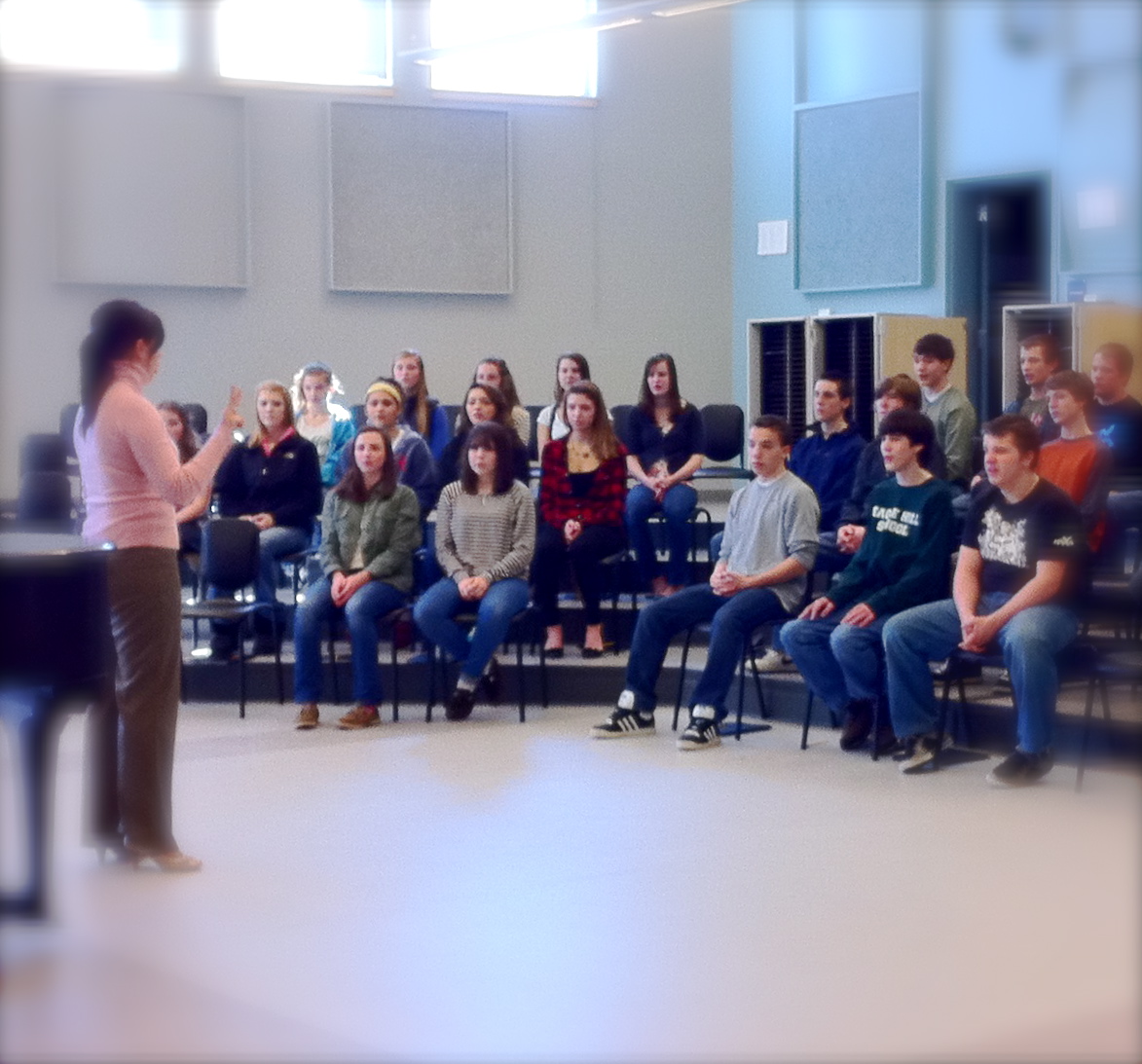
Essentially, in a standards based approach to ANYTHING, it’s about skills. In the choral classroom we’ve broken that down to: tone, visual interaction with conducting, physical alignment (posture and open, relaxed jaw), ear training (accurately singing intervals and forming chords with precision) and literacy. The literacy piece includes identification/application of key and time signatures, and physically being able to read/interpret musical notation. Jen Etter at York Middle School has worked diligently to make this all a grade 5 through 12 priority. How lucky am I?

None of this is “news”, and it certainly isn’t original. But if I want to have a program of value beyond a dinosaur fart, it is a program that is going to have to put the concert performance a distant last place in deference to developing in my students all these other priorities. Take a triangle and stand it on it’s tippy-top (I like that word). At the top there is now room for lots of things. But as you get closer and closer to the foundation, there is less and less room, and you have to prioritize what’s most important. As long as I live, that tippy-top priority will be the interpersonal component that makes the performing arts so extraordinary when carried out accordingly. But just above that are all the building block elements I listed. The last priority is concert week.

Quick: from Spring 2012, name ONE song you performed on your concert program. If you can’t, neither can your students. And I don’t even want to get into what their parents don’t remember! Want another example of a dinosaur fart? The undergraduate music ed paradigm. Go ahead, name one art song some well intentioned studio teacher EVER made you learn in college that helped you one iota in your first year of teaching. I DARE you to answer this honestly and come up with even a mediocre answer (“…it’s completely acceptable that you haven’t mastered the tenets of Robert Shaw or Howard Swan yet Timmy, but you better make damn sure that you’re ready for your jury!!!”). What if the undergraduate jury was a Q & A with the music ed (and ed) faculty asking of learned and applied teaching strategies and philosophies? Nahhh, that would actually make undergraduate music ed majors prepared.

So then, think back to your own High School experience: what skills did you learn? What skills didn’t you learn but the moment you hit college you wish you had learned?(!!) There’s not one song I sang in High School that made me better equipped for College. There’s not one song I ever learned in college that helped me become even an adequate teacher. But I could write a book on all the other elements that did… and this certainly includes how the literature often reinforced those skills. Concerts can be more than dinosaur farts, but they rarely are. Skill building is the polar opposite and lasts for a lifetime.

Listen, I know the value of the concerts, and so do you. But have we given them such a place of preeminence in our programs that we – and our students and their parents and our communities – have lost sight of what is most important, and why we are academic and not co-curricular?

So as this year begins, Jarika and I will be writing some blogs on each of those building blocks, NOT because they’re news, but because we love sharing how we integrate them into what we do with kids in the choral classroom (food for thought). We may have a guest blogger or two along the way. In the meantime, If you’ve already started rehearsing sheet music in your choral program, is it because there is public pressure to perform a concert with “x” number of songs in it and, “man, I’ve got to get going on this stuff to get it all learned in time!”, or is it because you’ve already spent days and even weeks first establishing the building blocks and now you are systematically integrating them into choral literature as a practical application? Do you spend 5 to 10 minutes on warmups so you can quickly get to “the music”, or do you you spend 20 to 30 minutes on warmups/sight reading/skill building because you know that is where the good stuff is developed?

nTEB4A5TA

Posted in Etcetera | 2 Comments

As you think you travel, as you love, you attract. – James Allen

JAs you think you travel, as you love, you attract. – James Allen

This quote is speaking to me right now and is really the premise for writing… well finishing this post 🙂

I am alive. I gave Rob a two year head start in this blog adventure and I am ready to get back into it and share some adventuring with you.

WARNING: I rewrote this blog post 7 times. So this is what you get. I could probably rewrite it 1,000,000 more times.

I have spent the last year reflecting on purpose and happiness and what fulfills me. I have been and in some ways still am searching and seeking for something. This “something” needed to be big-  travel some where, maybe get a masters degree, do something epic. You know… accomplish a few monumental things every 20-something thinks they need to do before they hit 30. It would prove that I was successful. I would get the best experience possible. It all sounds great except for the fact that I wasn’t pulled towards any of it. That really made me mad.  I was upset that I couldn’t find direction and that I really didn’t know anything. Basically a 1/4 life crisis.

So I just started applying to grad schools and filling out job applications. I have probably filled out thousands. Okay, maybe only one hundred or so. I tend to exaggerate quite a bit, but it always makes for a good story. I have to confess something… I am impatient. I am a big picture thinker who is driven by purpose.  I don’t know what I want but I want it all now and I don’t want to wait. I keep beating  myself up over the fact that I need know what my next move should be. Maybe it’s my generation. Maybe I’m a masochist. I have to believe all of us creative types go through this at one point or another. I somehow know all of the things I don’t want in life but none of the things I do want in life. I’m going to pause this dignified rant to tell you that this no longer matters to me.

A brief history…

In May of 2011 I graduated and landed the most fantastic job at a private school in Portland, ME. Portland… Folks! Like 2nd best place on earth to Disneyworld. I had all of these ideas as to what it was going to be like…. magical, empowering, challenging in all of the good ways. After going through a lot of self discovery, intense testing of bravery, courage and willpower.. I needed to get out. As my second year rolled around I came to the conclusion that I just couldn’t be there any longer. So I applied down the east coast and moved to a small suburb on the beaches of Florida. Side note-There are very few stipulations as to where I would move EXCEPT for I must always be on a coastline. So I taught down in Jax Beach for a year. This elementary school was basically the most beautiful school in the world; fantastic people, fantastic parents, supportive administration, and wonderful kiddos, great music…. but something was missing. I was not me. I was not excitingly throwing myself into every aspect of the job. I started thinking grad school and applied to a couple. Did I even want to go? I don’t know. Do I want to leave the music teaching profession? I don’t know.

I do know that in my year of teaching at the most fantastic school I could ever imagine I was lonely, unmotivated and feeling lost. That is the flippin problem here, if you haven’t noticed this beautiful theme already. Whenever I get into this deep dark hole of questioning I make a list of things that I absolutely love in life and possible career choices. Here is what I came up with.

Things I absolutely love to do. By Jarika Olberg

SingingPerforming, Reading self help books ( I am totally addicted in all of the wrong ways), Kayaking (although I never really go), Biking, Amateur dancing, Going to the beach, Cooking, Baking, Learning, Cake-decorating, Singing with others, Reading, Talking shop/life with anyone, Helping people, Teaching singing, Going to concerts, Hiking, anything fall related, Shopping, Traveling, Thrift shopping on occasion, going for long drives while singingReading books about the voice, Drinking Pumpkin Coffee

Welp. I then realized most everything on this list was better done in New England ( You seriously can’t find good pumpkin coffee anywhere in the South!) and better done with a different job. So I quit my full-time gig, moved back home and started building a voice studio. I am sure many of you seasoned teachers have long figured this out, but this here is big for me. Happiness is not a destination, it is not success in the minds of others, it’s not accomplishments, it’s seeking truth in your heart and just finding what you can give the world. No more “what’s next?” Not only am I having the time of my life setting up my ideal schedule centered around my ideals and passions as a teacher, but I am finding time for myself as a singer and performer and just person.

I’ve set out some guidelines for myself this year and I thought that I would share them with you and perhaps reflect on them every so often.

  1. No should of, could of, or would ofs. Either do it or don’t and move on.
  2. Sing for myself.
  3. Find all of the things that make me happy and don’t spend time on the rest.
  4. Help people. Make connections. Meet people..Good people. Surround myself with people who fill up the world.
  5. You either can or you can’t. Either way you are right.
  6. The grass is not greener on the other side. It’s greener where I water it.. so get going.
  7. Be 25.
  8. Choose love. “There are two basic motivating forces: fear and love. When we are afraid, we pull back from life. When we are in love, we open to all that life has to offer with passion, excitement and acceptance. We need to learn to love ourselves first in all our glory and our imperfections. If we cannot love ourselves, we cannot fully open to our ability to love others or our potential to create. Evolution and all hopes for a better world rest in the fearlessness and open-hearted vision of people who embrace life.”    John Lennon

Long story short. I have no real words of wisdom for you today. This is where I am at in my journey and I am hoping to share along the way. I have always been a person who feels stuck doing the “right” thing because it is right and I should do. Here’s to throwing these ideas out the window. So expect the unexpected in some upcoming posts.  🙂 J

Posted in Etcetera | 1 Comment

failure

R – I embarrass easily. It is not one of my finer traits, and even less one I’m particularly proud of. What that has meant in practice – throughout my entire life – is to resist the opportunity to take chances. I’ll dig in like a bulldog if there’s something I deeply believe in and want to fight for, but if there isn’t firm footing ahead, my tendency is to be pretty tepid. I have to laughingly add that my ingenious solution, at least in my career, has been to continuously put myself out there in precarious positions with the understanding that I’ll either a) succeed in a marvelous way against all odds or b) I’ll fail – – – and if I fail enough times, I’ll get more used to it and I won’t be so embarrassed by it anymore!!

I’m pretty sure it was advanced logic such as this that caused highly educated people for centuries to believe that the world was flat.

But I’m going somewhere with this. I was talking with a colleague of mine mid-week who told me that her Principal’s primary message to his faculty this year was to “fail”. They are implementing standards based grading for the first time with a brand new online program to boot, and the Principal’s message to them is to please fail. Huh? Well, it’s actually pretty cool what he’s suggesting: go after the good stuff, knowing that your path won’t be a straight or even a consistently successful one, and then SHARE your failures so we can all learn from them, saving everyone one else from the same fates. In other words, we’re in this foxhole together. No war was ever waged without both sides loosing some battles between them. The victors however are the ones who refine their strategies and grow from their setbacks, the losers are the ones who ignore them, dismiss them or fail to learn from them. My friend and I commented further that perhaps that is the debilitating kernel of truth for us as educators in Maine as we are faced with new and challenging tasks in front of us: fear of failure. “I don’t get this – how can I move forward?”, “What if it doesn’t work?”, “How do I know if I’m doing this right or not?”, have become common threads among educators of all subject areas the last year or so, and particularly this Fall.

You know what? Failure will get you there… as long as you are analytical about what happened, why it happened, and how you can potentially refine your strategies. And then you must also share your story with others, because that’s how we all grow.

Oscar Wilde said that, “No great artist ever sees things as they really are. If he did, he would cease to be an artist.” (btw, I defy you to name an artist who never failed) Be an artist. Look at what you are being asked to do, and then ask yourself what it could look like down the road if implemented successfully. And then start walking there, knowing there will be failure along the way. That IS how you get there. Watch the Princess Bride and ask yourself if Westley was having a grand old time while he was walking through the Fire Swamp (helpful storyline hint: he wasn’t). There was a LOT of failure along the way. It didn’t stop him and it can’t stop us.

And either way, I took a chance by wrapping this blog post up with a Princess Bride analogy. I think I just made my own day. I think I may also need more coffee.

Good luck on the start of your new school year!

princess-bride


Posted in Etcetera | Leave a comment

be bop a lula

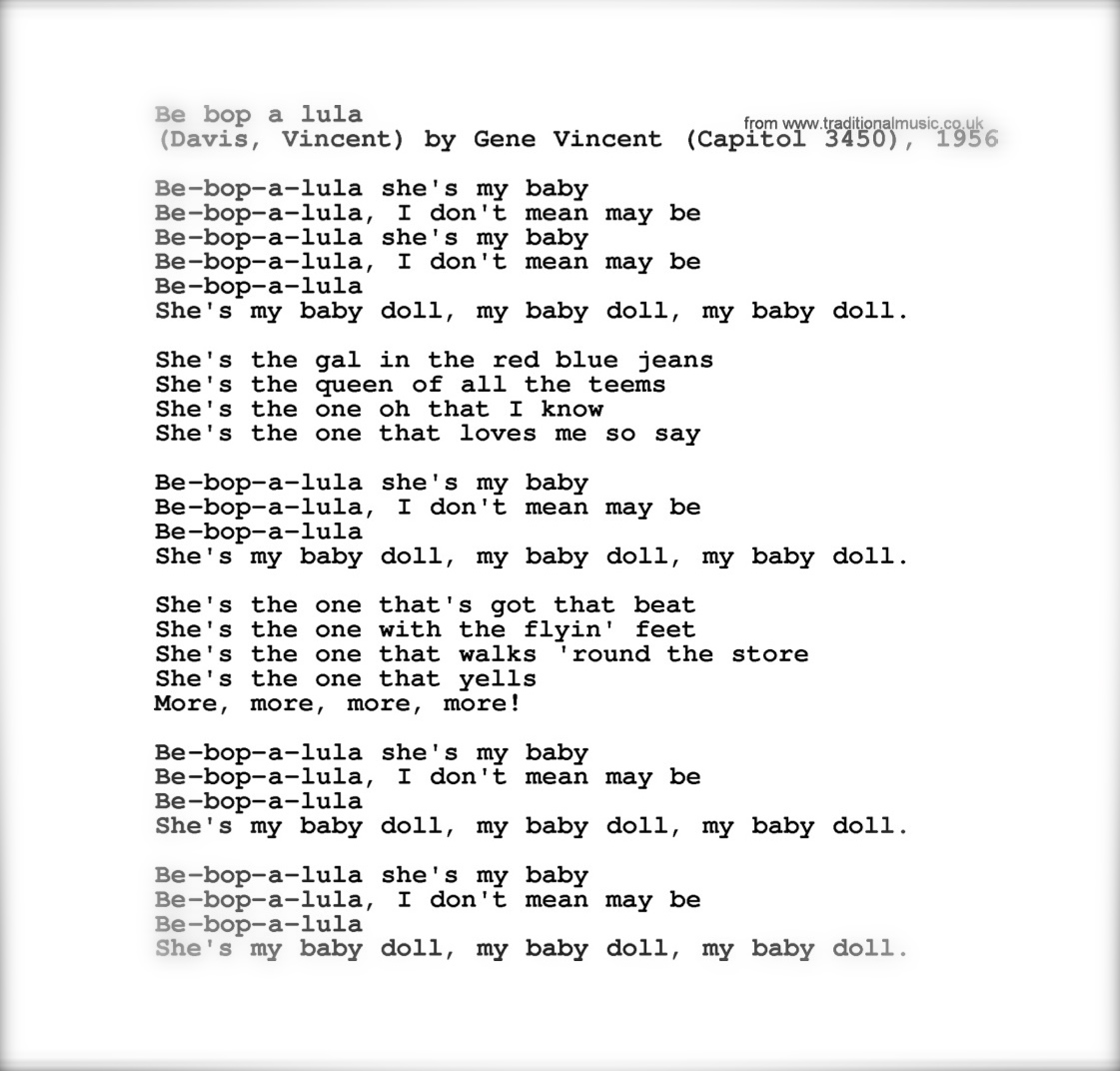
R – Back at the advent of Rock and Roll, the original host of the Tonight Show, Steve Allen, had a routine where he would take a popular song and read the lyrics as prose. The sheer ridiculousness of the lyrics would quickly become apparent Untitledsimply by reading it all out loud. Here is a clip of him reading Gene Vincent’s Be-Bop-A-Lula (great old chart btw). Funny stuff in the 1950’s, funny stuff still.
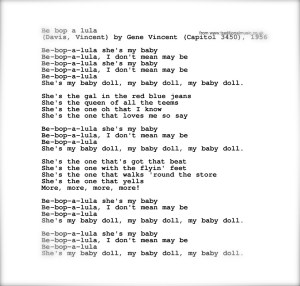
What made me think of that? Well, last November I did a blog post where I took an author to task for defending letter grades. At the end of it I provided a link to a debate site on this topic. Everyone is entitled to their opinions, this site allows for both sides of the argument to be heard. Every once in awhile I go back to see the latest arguments for and against. In doing so again a few times this Summer, I wondered if the people attempting to defend traditional letter grades actually READ their arguments out loud when they’re done writing them. Because they’re hysterical! Some new levels of absurdity are being encroached upon, so I thought it would be fun to point some of them out here for this morning’s post, especially as Maine moves further away from grades and toward actual proficiency (take heart, it’s the right path!). Mind you, this wasn’t terribly selective; this is virtually a straight run down of what’s posted on that site. If it appears that I’m getting a bit too sarcastic, and making a bit too much fun of some otherwise very nice people, ummm, that’s because I am. Items in red are copy/pasted from the, “No, grades should not be eliminated” column. Comments following in black may or may not be a randomly chosen (me) public school music teacher’s side comments.

Students should have a way of differentiating between each other. Absolutely. What’s public school education if we’re not labeling SOMEONE as the lowest 20% of their class?

The terms “Approaches”, “Meets”, or “Exceeds” Standards is difficult for me to explain to my daughter. But explaining what a “C+” actually means on the other hand is a piece of cake…

Students need grades in order to get motivated and to do well. Just what I’ve always said: what’s wrong with this country is people who think that learning should be for learning’s sake!!!

A letter grade is also used as a goal, like a kid is aiming to get an A in math, and that’s his goal, and he pushed to achieve his goal. That’s RIGHT! Why have goals as silly as achieving academic learning targets attached to rubrics which actually articulate what you learned and to what degree you learned it, when your goal can be merely to get an A? You tell ’em!!!

A high score on tests would mean a better letter grade while a low score would mean a worse grade. ?????????

Letter grades are more accurate than number grades for 1 reason only, Since there are more letters to use to grade someone than actual numbers the grading turns out to be more accurate. This is why the letter grades should NOT be eliminated. You can’t make this stuff up, folks.

Standards Based Grading is a way to raise low performing students scores while lowering high performing students scores so everyone can be the same. Everyone in this world is not the same. Some people have high IQ’s others average. You want quick people who understand difficult concepts immediately to have jobs like surgeons, lawyers, etc. We aren’t all the same, if you want a system for slow learners use SBG, however, I don’t believe this is a good system for children that have high IQ’s it holds them back and takes away grades they need to college admissions into elite universities. My bad. I forgot that success in school – learning – is supposed to be limited to just the smart kids. No WONDER education is so expensive and so difficult: we’re actually trying to teach EVERYBODY!

Grades are important in letting students know how they can improve. Tom gets a B on the quiz. Sherry gets a B on the quiz. They each got completely different examples wrong for completely different reasons. The grade however tells each of them how they can individually improve. Suuuuure.

In my school we have a number grading system with 4, 3, 2 and 1’s. Fours are 98% to 100% and A’s are 90% to 100%. My parents think that A’s are the same as 4’s but there is a big difference. Failure on the part of a school district to adequately explain SBG does not constitute a problem on SBG’s part. Just sayin’.

A 4 is much harder to get than an “A”. ……aaaand we wouldn’t want THAT now, would we?

Letter grades aren’t just an A or a C. Its an A+ or a C- etc. so it is very accurate for 2-3%. 2 to 3 percent of WHAT?

Also whats a check mark gonna teach you? (…and what’s the absence of a comma and an apostrophe among friends?) If you do something wrong and you get a check- it looks like an A- so you’ll (ah, there it is!) think you did good (or even well!), when you really didn’t. Which then you will keep doing the wrong thing, thinking its the right thing. Which then you will keep writing really confusing sentences. Okay, you got me, I’m sold: I’ll make sure that I don’t fight for a national system of check marks any more.

If children get bad letter grades, they will be motivated to work harder to get better letter grades. Wow. Clearly, good letter grades motivate high achieving students to do much worse, so the opposite MUST be true! Oy. #commentsmadebypeoplewhodontactuallyteach.

If you use numbers, they are more complicated. 1 could be the highest and 3 could be lower or the other way around. Did I already mention you can’t even make this stuff up?

If you don’t care, you shouldn’t be allowed to get credit for something you did not try/understand. If you’re on the job and you say you cannot do something and it was something you were supposed to learn then what can you do but realize you lied about your credit? I have no problem with grades. The way the grades are achieved is the problem, not the actual grade. It should not be based on our memory and but, on our capability to get the right info/answer at the end. Um, this is an argument someone is using for KEEPING letter grades?

This system has survived for a very long time and continues to be used because it is working. There you have it: No Child Left Behind and Common Core were introduced as necessary measures because our system is “working”.

The letter includes effort, problems that don’t exactly answer the assigned question but show that they understand, and it’s more up to the teacher. Grades should never, EVER reflect what you actually know and are able to do, it’s how hard you try! And don’t forget: grades must always be SUBJECTIVE!!!

Kids get to look forward to getting A’s, B’s, C’s, D’s, and F’s. When you complete a project, kids look forward to what they will get to see on their report card. It’s inconsequential of course what they actually learned, it’s the grade that counts!!!

Change MUST BEGIN at the post-secondary level and work its way down through the system in terms of its requirements for student admittance and then at the high school level and finally at the elementary level. If this only happens at the elementary level, we are not preparing students for grades that they will receive at higher educational institutions, which is also one of the jobs of the elementary school system. You know what? Spot on. For real. And this is why Standards Based Grading is doomed, and why a grading system developed prior to man’s learning how to fly will be entrenched from now until kingdom come: unless and until standards becomes culturally embraced by all educational institutions in this country. And that means higher ed getting off its throne and actually working with public schools to determine the future course of reporting out what our students know and are able to do. Common Core? Bring it. As long as grades are still in place, it all won’t amount to a hill of beans anyway. In the meantime, let’s not be guilty of sitting still: we need to work towards something more authentic than letter grades either way. Let’s make this the year to really do so.


Posted in Assessment, Standards | Leave a comment

have it both ways

R – One of the core issues I have with High School music programs in this country is that they often pass themselves off as academic and essential while not being so in practice, placing an emphasis on non academic goals or meeting the needs of only those kids who “sign up” for music classes. To a music teacher with a humanistic approach to education, music is considered only a means to the end. The opposite extreme is one where the music teacher values the student on their musical aptitude. I rail against both extremes. The reasons have been written about ad nauseum the last two and a half years in this blog: don’t call yourself “essential” if you don’t meet with all students, and don’t call yourself “academic” if you’re an extracurricular activity disguised in academic clothing. This has been interpreted by some as my railing agains the inherent benefits of music education that can’t be found elsewhere. I’ve never said that, and I’ve never believed it. My stance is that you can have it both ways. My insistence is that we as music programs PK-12 must have it both ways.

For my choirs, I assign an end of the semester (Choirs are a semester course at YHS) 5 paragraph essay based on several prompt options which counts as their Final exam. The students are told that whatever they say will not be assessed. The support of their viewpoints is what will be assessed. So don’t bother sucking up, and don’t bother skimming through it. I utilize the English department scoring rubric to grade it, so there’s no subjectivity. What follows below is a midterm that showed up in my turnitin.com inbox yesterday. It is complementary of me and the class, but that’s not the point, it’s not relevant, and it’s not typical of all the essays I receive – – TRUST me on that. I’m also not suggesting that there aren’t a myriad of music teachers out there through whom the following essay couldn’t have been written. But in a class taught by a standards crazed, academic emphasis, “music is for all students not just those who like music”, individual assessment based maniac like me, the following perspective occurred:

There is a certain definite level of respect that an individual teacher will earn from his or her students. Many of my past teachers have made mistakes in how they go about earning it. Respect is not something that children are expected, from day one, to give one hundred percent to adults (as much as parents try to argue the contrary). Teachers need to prove to their students that they deserve it. In chorus, the students respect their teacher on a level different from any other class I have participated in. It’s not because he has established intimidation or given us a fear of punishment. Instead, the atmosphere within the room is one of kindness. The respect is given by us, only because it is given to us. This lesson is one of the most important things to be learned by a teenage student- not the Pythagorean Theorem, or the definition of a helping verb, but instead how one’s attitude can help him or her succeed. Just in this short semester, I have not only grown as a musician, but as a person. I have learned about the ways in which respect is earned and the ways in which maturity and compassion will outweigh any academic achievement.

This is absolutely my only class in which the social expectations are ranked just as high, if not higher, than the academic ones. The emphasis on intellectual engagement in the chorus room has helped me grow tremendously as an individual by encouraging self-assessment on more than just educational aspects. In middle school, and with nearly every class I have taken at York High School, my personal definition of success has been seeing an “A” on my report card. I am proud to say that this class has helped me grow; I now strive to succeed in less measurable ways. In this class, we are evaluated on whether we “maintain a steady beat with the conductor,” but the rubric equally emphasizes “using appropriate language and holding others to the same standards, leading by example in daily classroom expectations, and encouraging others to be respectful.” In a standards-based class, either you meet the expectations, or you don’t, so this method of grading is a good choice for evaluating behavior skills. I like knowing that I am encouraged to make a conscious effort to better myself and my behavior in this class.

In chorus, maturity is valued on the same level as a grade in Powerschool. This one difference between junior high and high school is huge- it separates those who get by with good grades, and those who get by with a good mentality. A student can have the highest I.Q. in his class and still fail to succeed in the majority of subjects valued in chorus. This type of student, one who has scholar intelligence but very little social maturity, resembles myself in middle school. I had a pretty report card, but I was disrespectful to my peers as well as the adults in my life. I did not value kindness or common sense. Five years later, as I reflect on my growth, I like to credit a lot of my “growing up” to the classes in which I have learned more about being a person than being a student. Chorus is one of these classes.

We are often encouraged to self-evaluate in the chorus room. This is a simple concept, yet I have personally honed these skills vastly just by attending this course. With self-evaluation, I am able to set personal goals and strive to achieve them. Even with our simple reflection, where we assess the recording of our previous concert, students are taught to put a value on their own work. This assessment seems silly, but after doing it, I have developed skills that will help me evaluate my work in the future. The poem Success by Steve Kilbourne contains the passage “Success is an attitude, and you can always better your best.” The mindset behind this is the reason why I am glad to have gained skills like these- I am better shaped to “always better my best” in the future. I may not always remember how long to hold a dotted quarter note for, but this skill can always be used.

Essentially, my personal development within this course exceeds so much more than enhancing my knowledge of key signatures. I have learned what it takes to call myself a mature student. I have developed skills of self-assessment that I can use past this class, and most likely past high school. I have especially learned that respect is not given, it has to be earned, and I have learned what a person can do to earn it. The fundamentals in this classroom are important to me. I believe creative learning within art programs, including music programs, is always just as necessary in schools as core classes. I enjoy knowing that I have learned to sight-read. I honestly hope I never forget how to use these skills. But most importantly, what I have learned about being a person far surpasses the worth of anything else I have absorbed within the class.

On Thursday, in this same class, I had a crew of 9 students who still had not achieved at least a 3 on their key signature assessment (they fail the entire course if they don’t achieve at least one 3 on both their time signature and key signature assessments). We did a 20 minute tutorial together during class, an interactive one where the kiddos were sharing the discussion and dialogue. When they re-took the assessment, one of them for the third time now, they had to show me their work when they were done so I could score it in front of them. Every student did brilliantly. Just as significantly, the expressions on every one of those students’ faces when I looked at them and told them that they nailed it, was worth gold. They displayed genuine satisfaction (in one instance a spontaneous high-five) in accomplishing an academic goal – even something this mundane to you or I – that they previously believed they could not get. Moreover, the conversation with every student who took the course under duress due to the graduation requirement was told that now that they have the literacy foundation in place, “…just think what you can do with it if you choose to sign up for another term.” My roster next year is peppered with these kids.

Is this last paragraph in conflict with the essay?

My goal for music education over the next 25 years is for it to become an essential, academic foundation of our secondary schools while simultaneously reaching kids in ways that are, I believe, unique to music. I don’t buy the argument that it’s “either, or”, and I don’t buy the argument that you can’t accomplish both simultaneously. It’s not about the teacher, it’s about student expectations. What this looks like in each individual school may be very different. That’s okay. But please, let’s move forward with the agenda of being academically essential, with the knowledge that the value of our programs transcends the academic. Food for thought as we exhale for a bit during the Summer months. We can have it both ways. Moving forward in the months and years to come, let’s make sure it is.

IMG_0759


Posted in Advocacy, Assessment, Standards | 1 Comment

what would happen

R – What would happen if…

…students universally had more music instruction in their lives each week in 2014 than they did during the Roosevelt administration (pick either Roosevelt)?

…music teachers universally used their programs primarily to educate the musically illiterate rather than every other alternative on the table?

…music teachers were as universally concerned with the quality of their teaching and instructional methods as they were about the quality of their concerts?

…music teachers universally understood that group assessment is not the same thing as individual assessment?

…communities universally attended school concerts not to be entertained but rather to see the academic progress their tax money is paying for?

…music teachers who tell their underachieving students to consider leaving their programs were universally replaced by music teachers who instead made those students their highest priority?

…programs that are passed out at concerts universally had more in them than just the music titles, acknowledgements and student names?

…music teachers universally made it a point to skype/facetime/zoom at least one colleague outside their own building at least once a week all year long?

…every High School universally required every student to pass at least one music course to receive their diploma?

…every music teacher universally made it a point to have deep philosophical discussions with a colleague who has opposite views precisely because they have opposite views, instead of avoiding discussions with them precisely because they have opposite views?

…what if a music teacher’s response to slashes in instructional time resulted in the removal of the concert rather than reduction of foundational instruction in literacy?

…what if the community was outraged at the cancellation of that concert?

…what if the community found out that the concert was canceled because instructional time was slashed?

…what if the instructional time was reinstated because of the community outrage?

…what if music teachers universally spent more time talking about the controversial issues in our profession than they do about how cool the latest Eric Whitaker virtual youtube choir is?

Just asking.

question-63916_640

Posted in Etcetera | Leave a comment